How Much Is a Marquise Diamond Worth? Half Carat and 1 Carat Prices Explained
What half carat and 1 carat marquise diamonds are worth, why they cost less than rounds, and the bow tie flaw certificates never show.
Marquise diamonds are one of the best-value shapes in jewellery, and the two sizes people ask about most are the half carat and the one carat. The short answer is that both cost noticeably less than a round brilliant of the same weight and quality, and that a lab-grown marquise costs a small fraction of a natural one. The longer answer — which is the useful one — is about what actually drives the number.
What a marquise diamond is
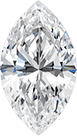
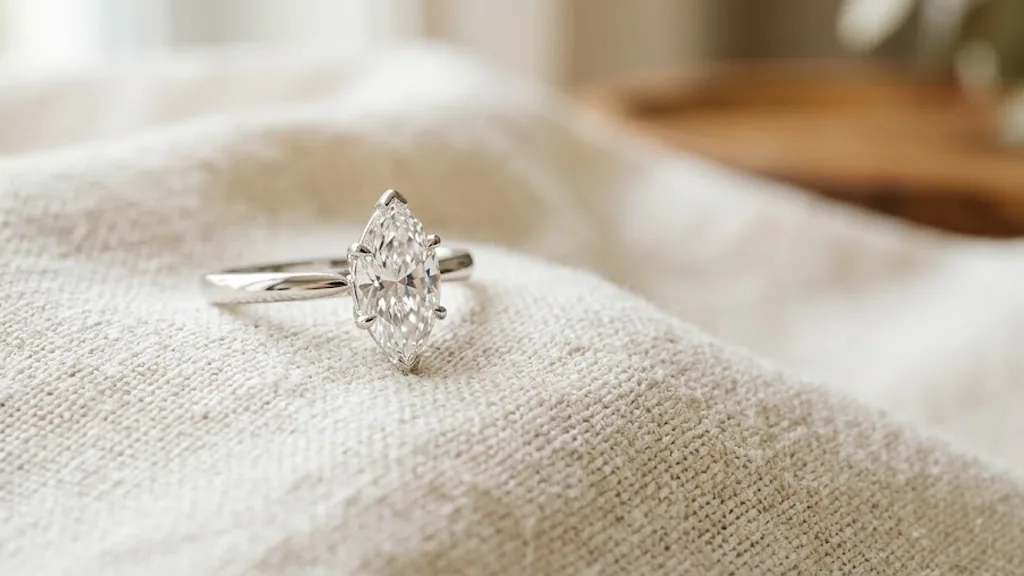
A marquise is a long, narrow shape with a point at each end, like a rugby ball or a boat hull. It is a brilliant cut, meaning it uses many small facets to bounce light back at your eye, so it sparkles hard.
Its defining quality is that it is the most efficient shape in the diamond world for turning weight into visible size. It is long, it is shallow relative to its footprint, and it sits along the finger rather than across it. Carat for carat, nothing looks bigger.
Carat and millimetres are not the same thing
Carat measures weight. One carat is 0.2 grams. A half carat stone weighs 0.1 grams.
Millimetres (mm) measure length. A marquise described as “10 x 5mm” is 10mm from point to point and 5mm across its widest part. This is the measurement that decides how big the ring looks.
Keeping these apart matters more with marquise cuts than with almost any other shape, because the gap between what a marquise weighs and what it looks like is so wide.
| Carat weight | Marquise, typical size | Round brilliant, for comparison |
|---|---|---|
| 0.25 ct | 6.5 x 3.2mm | 4.1mm |
| 0.50 ct | 8.0 x 4.0mm | 5.0mm |
| 0.75 ct | 9.0 x 4.5mm | 5.8mm |
| 1.00 ct | 10.0 x 5.0mm | 6.5mm |
| 1.50 ct | 12.0 x 6.0mm | 7.4mm |
| 2.00 ct | 13.0 x 6.5mm | 8.1mm |
A 1 carat marquise is 10mm long. A 1 carat round is 6.5mm across. That is the whole argument for the shape in one line — and it is why a half carat marquise, at 8mm long, already looks like a proper engagement ring stone rather than a modest one.
What drives the price
Five factors, in rough order of importance.
| Factor | Effect on price |
|---|---|
| Lab-grown or natural | The largest single difference by a very wide margin |
| Carat weight | Price per carat rises as stones get larger, so 1 ct costs more than double a 0.50 ct |
| Colour and clarity grades | Significant, but marquise cuts hide inclusions reasonably well |
| Cut quality and symmetry | Critical on this shape — see the bow tie section below |
| Length-to-width ratio | Unusual ratios can be cheaper, but also harder to set well |
Marquise cuts are generally cheaper per carat than round brilliants because the elongated outline wastes less of the original rough crystal during cutting, and because far fewer people are competing to buy them. You get the double benefit of a lower price per carat and more visible stone per carat.
The bow tie: what to look for before you pay
Almost every marquise has a shadow across its middle, shaped like a bow tie. It is caused by light failing to reflect properly through the centre of a long, narrow stone.
A faint bow tie is normal and adds character. A strong one leaves a dark band across the middle of the diamond that no setting can disguise, and it is the main reason someone ends up disappointed with a marquise they bought online.
Here is the problem: the certificate will not tell you about it. Bow ties are not graded. Neither are marquise cuts given an overall cut grade the way round brilliants are. You have to look at the stone itself, or at a video of it moving under light. Any seller who cannot show you that is asking you to buy blind.
Also check the symmetry grade and the length-to-width ratio. Around 1.85 to 2.10 is the classic marquise silhouette. Below that it looks stubby; above it, very slim and increasingly fragile at the points.
Lab-grown versus natural at these sizes
A lab-grown diamond is a real diamond — identical carbon crystal structure, identical hardness, identical sparkle, graded on the same scale by the same independent laboratories. It is grown in a controlled environment over a few weeks instead of forming underground over a very long time.
At half a carat the saving over a natural stone is already substantial. At one carat it is larger again, because natural diamond prices climb steeply with size while lab-grown prices climb far more gently. If you want the biggest, best-cut marquise your budget allows, lab-grown is the straightforward way to get there.
One honest note on prices: the lab-grown market has moved a great deal in recent years and continues to move. Treat any published range as guidance, never as a quote, and always ask for a live price on a specific certified stone before committing.
Marquise rings you can buy today
Prices are correct at the time of writing, and every centre stone comes with a free IGI certificate.
- Solitaire Marquise Cut Engagement Ring — £538. The purest expression of the shape, with nothing to distract from that long silhouette. It is also our most affordable way into a marquise.
- Halo Marquise Cut Engagement Ring in White Gold — £1,143. A ring of small diamonds follows the outline of the centre stone, adding a couple of millimetres of apparent size all the way round and protecting the vulnerable points.
- Three Stone Marquise Cut Engagement Ring — £1,143. Flanking stones extend the line even further along the finger.
- Stackable Marquise Cut Wedding Band in Rose Gold — £789. A row of small marquise stones across the band, ideal worn alongside a solitaire.
See everything in the marquise cut collection, or compare styles across our full engagement rings range. For a particular carat weight or millimetre size we work bespoke, with no extra design cost.
Protect the points
The two tips of a marquise are the thinnest, most exposed parts of any diamond shape, and they will chip if they are knocked hard enough. This is entirely manageable, but it is not something to leave to chance.
The standard solution is a V-shaped claw over each point, which wraps the tip in metal. A bezel setting — a rim of metal around the whole edge of the stone — is even more secure, and a halo naturally shields the points too. Whichever you choose, make sure someone has thought about the tips before the ring is made, rather than after.
Frequently asked questions
Is a half carat marquise big enough for an engagement ring?
Yes, and this surprises people. At around 8 x 4mm it is the same length as many 1.5 carat round diamonds. Set lengthways along the finger, it looks far more substantial than “half a carat” sounds. It is one of the best-value engagement stones you can buy.
Why is my marquise cheaper than a round of the same weight?
Because the shape wastes less rough crystal during cutting and because demand for round brilliants is far higher. It is a price difference driven by supply and fashion, not by quality.
Do marquise diamonds look old-fashioned?
They fell out of favour for a while and have come back strongly. Set east-west across the finger, or in a modern bezel, a marquise looks anything but dated. In a vintage-style halo it leans deliberately antique. The shape adapts to whichever direction you take it.
What length-to-width ratio should I choose?
Between about 1.85 and 2.10 for the classic look. Longer ratios are more dramatic and more elongating on the finger but leave thinner, more fragile points. Shorter ratios look fuller and are a little more robust.
How do I know a marquise is worth what I am being asked to pay?
Get the IGI certificate, check carat weight, exact millimetre measurements, colour, clarity, symmetry and polish — then look at the actual stone or a video of it for the bow tie. Two certificates can read identically while one stone is visibly better. With this shape, seeing it matters more than with any other.
If you would like to see a marquise in person before deciding, we hand-make everything in solid gold and platinum in North Harrow, London, deliver free and insured across the UK, and give you 30 days to change your mind.
More guides on this topic
Ready to find your perfect ring?
Explore our lab-grown diamond collection or book a virtual appointment with our team.