
How Many Facets Does a Cushion Cut Diamond Have?
A cushion cut diamond has 58 facets - and modified cushions have 61 to 64. What the count means for sparkle, and what matters more.
A facet is simply a flat polished surface on a diamond. Every one of them acts like a tiny mirror, catching light and throwing it back at your eye. When people ask how many facets a cushion cut diamond has, what they usually want to know is why one cushion sparkles in soft, fat flashes and another one glitters like crushed ice.
The short answer: most cushion cut diamonds have 58 facets. But that number hides a lot, and the detail is where the beauty actually lives.
The standard answer: 58 facets
A classic cushion cut is built on the same basic plan as a round brilliant. It has 58 facets, counted like this:
- Crown (the top, above the widest point): 33 facets, including the flat table on top
- Pavilion (the pointed bottom half): 25 facets, including the culet if there is one
Some cutters count 57 instead of 58. The difference is only whether the culet — the tiny flat facet right at the bottom tip — is counted as a facet or treated as a point. Modern cutting usually brings the pavilion to a sharp point, so you will see both numbers used for the same stone. Neither is wrong.
Why some cushions have more than 58
Here is the part most guides skip. “Cushion cut” is not one single design. It is a family of designs, and the newer members carry extra facets.
A modified cushion brilliant adds an extra row of small facets on the pavilion, underneath the main ones. That pushes the total to roughly 61 to 64, and on some designs higher still. Those extra facets chop the returned light into many small pieces instead of a few big ones.
| Type of cushion | Typical facet count | How the sparkle looks |
|---|---|---|
| Antique or “old mine” cushion | 58 | Large, slow, chunky flashes. Very romantic. Often a visible culet. |
| Standard cushion brilliant | 57–58 | Balanced. Broad flashes with good fire. |
| Modified cushion brilliant | 61–64 (sometimes more) | “Crushed ice” — lots of tiny, busy sparkles. |
| Cushion with a French or step-cut crown | Varies, often 58–64 | Slightly more geometric, a hint of emerald-cut character |
So if a jeweller tells you a cushion has 64 facets, they are not making it up. They are describing a modified cut, not a flawed one.
Does the facet count change how much a diamond sparkles?
Not in the way most people assume. More facets does not mean more sparkle. It means smaller sparkle.
Think of a disco ball versus a hall of mirrors. A stone with fewer, larger facets returns light in big, distinct flashes you can see across a room. A stone with more, smaller facets returns light in a fine glittery shimmer that reads as texture rather than as individual flashes.
Which one is better is genuinely a matter of taste. In our experience talking to customers in the shop, people who love antique jewellery tend to reach for the chunky 58-facet cushions, and people who want maximum liveliness under restaurant lighting tend to reach for the crushed-ice look. Neither is more valuable than the other on the basis of facet count alone.
What actually matters more than the number
If you take one thing from this page, take this: the facet count is a description, not a grade. Two cushions can both have 58 facets and look completely different. What separates them is:
- Proportions — how deep the pavilion is and how tall the crown is. A cushion cut too deep hides weight underneath and looks small for its carat.
- Symmetry and polish — whether the facets meet cleanly. Sloppy meeting points leak light.
- Length-to-width ratio — a square cushion sits around 1.00 to 1.05. An elongated cushion sits around 1.15 to 1.30 and reads longer on the finger.
- Corner roundness — the softer the corners, the more “pillow” it looks, which is where the name comes from.
Your IGI certificate will not usually print a facet count for a cushion, because there is no single standard to grade it against. It will print measurements, proportions, symmetry and polish — which are the things that decide how the stone performs. Every centre stone we set comes with a free IGI certificate, so you can read those numbers yourself rather than take anyone’s word for it.
How to check a cushion in person
You do not need a loupe or any training. Do these three things:
- Hold the ring at arm’s length under normal indoor light and rock it slowly. Count how long it takes to see a flash. Big slow flashes mean fewer, larger facets. A constant fine shimmer means a modified cut.
- Look straight down at the table. If you can see a dark ring or a dead patch in the middle, the pavilion is likely too deep.
- Compare it side by side with a round of the same carat weight. Cushions often look slightly smaller face-up than rounds at the same weight, because more of the weight sits below the girdle.
Cushion cut rings we currently make
We hand-make every ring in solid gold or platinum with lab-grown diamonds. Cushion is one of our smaller collections — we hold three cushion designs at the moment, against twenty round. If you have your heart set on a particular cushion setting we do not show, we will make it bespoke at no extra design cost.
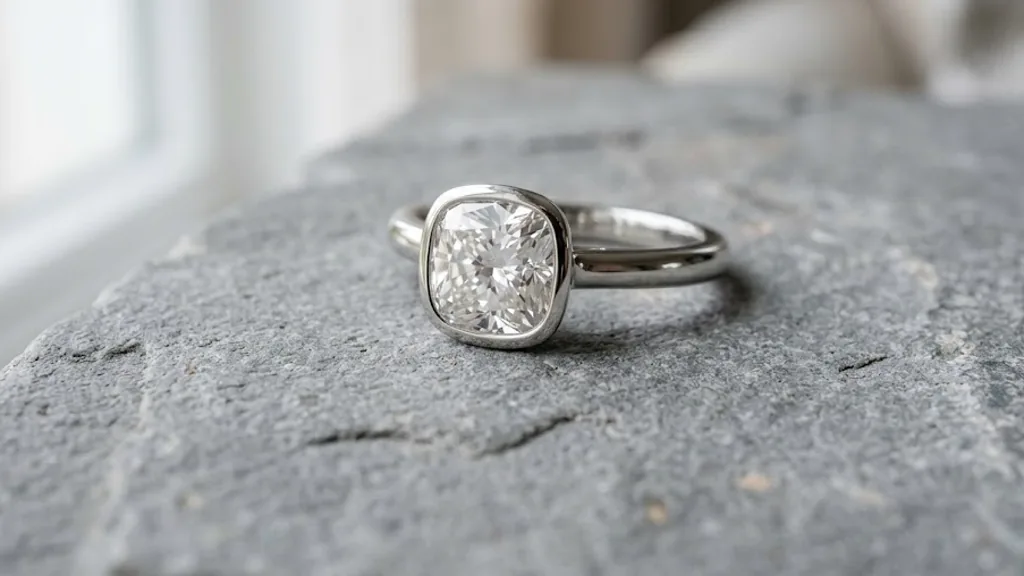
- Bezel Cushion Cut Engagement Ring in Platinum — £904 at the time of writing. The bezel rim protects the corners, which are the most vulnerable part of any cushion.
- Three Stone Cushion Cut Engagement Ring — £957 at the time of writing. Three cushions in a row make the soft corners much easier to see.
- Solitaire Cushion Cut Wedding Band in Sterling Silver — £904 at the time of writing, if you want to keep the shape running through the wedding band too.
You can see everything in the shape together on our cushion cut collection, or browse the wider engagement ring range if you are still comparing shapes.
Frequently asked questions
How many facets does a cushion cut diamond have?
Most have 58 — 33 on the crown and 25 on the pavilion. Counts of 57 appear when the culet is not counted separately. Modified cushion brilliants carry an extra row of pavilion facets and typically reach 61 to 64.
Is 58 facets the same as a round brilliant?
Yes, the total is the same. A standard round brilliant also has 57 or 58 facets. The difference is the outline and the shape of the individual facets, not how many there are.
Do more facets make a cushion cut worth more?
No. Price is driven by carat weight, colour, clarity and cut quality, not by facet count. A well-proportioned 58-facet cushion will usually outperform a badly proportioned 64-facet one.
Which cushion facet style hides inclusions better?
The crushed-ice look of a modified cushion brilliant breaks light into many small pieces, which does tend to make small inclusions harder to spot with the naked eye. That is a genuine practical advantage if you are buying at a lower clarity grade — though we would still rather you looked at the actual stone than relied on a general rule.
Will my certificate tell me the facet count?
Usually not for a cushion. Certificates report measurements, proportions, symmetry, polish and the four Cs. Facet counts are commonly printed for round brilliants, where there is a single agreed standard to compare against.
Are cushion cuts more fragile because of the corners?
The corners are the thinnest part and the most likely place to take a knock. A bezel or a setting with claws covering the corners deals with that neatly. It is a design consideration, not a reason to avoid the shape.
If you would like to see how a cushion looks against a round or an oval before you commit, come and try a few on, or message us and we will talk you through the differences honestly. Free insured UK delivery and 30-day returns apply to everything we make.
Ready to find your perfect ring?
Explore our lab-grown diamond collection or book a virtual appointment with our team.











