What Is an Emerald Cut Diamond? Shape, Sparkle and Rings Explained
An emerald cut is a rectangle with cut corners and step facets. What the shape is, why it sparkles differently, and the clarity trap.
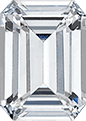
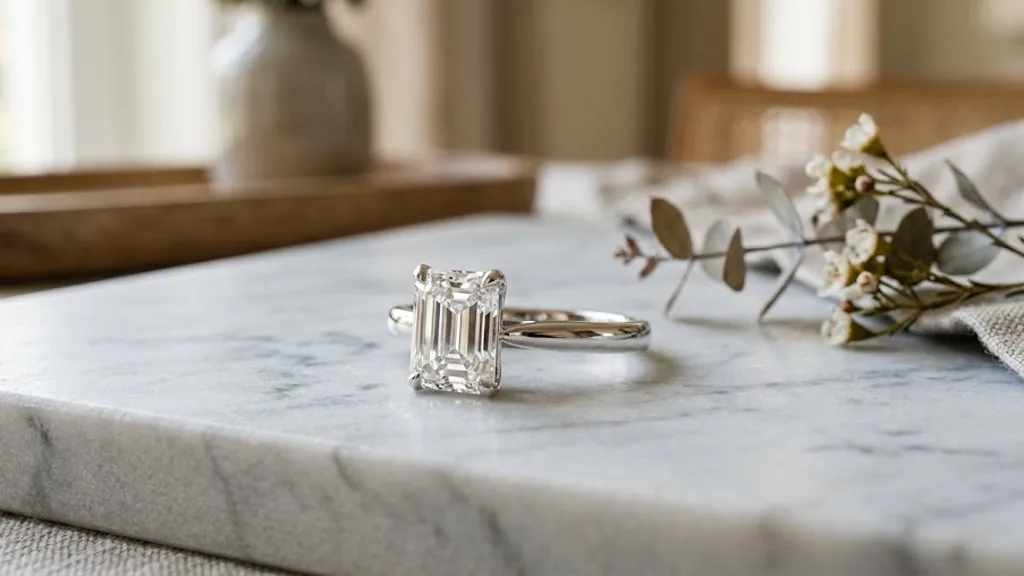
An emerald cut diamond is a rectangle with the four corners cut off, giving an eight-sided outline, and a flat top surrounded by long parallel facets that run in rows like steps down the sides. That is the whole shape in one sentence. Everything else about it follows from those two facts.
The name comes from the gemstone, not from any colour. Emeralds are brittle and chip easily at the corners, so cutters developed this shape to protect them. It worked so well that diamond cutters borrowed it. An emerald cut diamond is a colourless diamond cut in the shape traditionally used for emeralds.
What shape is an emerald cut, exactly
Picture a rectangle. Now slice a small triangle off each of the four corners. You are left with an eight-sided figure — an elongated octagon. Those cut corners are the defining feature and the reason the shape is so durable.
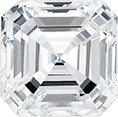
Most emerald cuts are rectangular, with a length-to-width ratio somewhere between 1.30 and 1.50. Some are cut nearly square, at around 1.00 to 1.05. A square emerald cut with a particular facet arrangement gets its own name — the asscher cut.
| Length-to-width ratio | Look |
|---|---|
| 1.00 – 1.05 | Square. Very Art Deco. Closely related to the asscher. |
| 1.30 – 1.40 | Classic rectangle. The most commonly requested proportion. |
| 1.45 – 1.55 | Long and slim. Very elegant, strongly finger-lengthening. |
| 1.60 and above | Dramatically long. Striking, but harder to source and to set. |
Why an emerald cut sparkles differently
This is the single most important thing to understand before you buy one, and it is where most people are caught out.
An emerald cut is a step cut. Its facets are long, flat rectangles arranged in parallel rows. A round brilliant is a brilliant cut — its facets are small triangles and kites radiating from the centre.
Brilliant cuts chop light into many small pieces, which is what gives you rapid, fiery sparkle. Step cuts do the opposite. They reflect light in long, broad flashes, like looking into a hall of mirrors. You see wide bands of light and dark shifting across the stone rather than glitter.
People who love emerald cuts love that calm, architectural quality. People who expect a round’s fireworks are sometimes disappointed. Neither reaction is wrong — but you should know which one you are before you spend the money.
The clarity trap
Because the top facet is large and flat, and the step facets are wide and open, an emerald cut behaves like a window into the stone. There is nothing to hide behind.
In a crushed-ice cushion or a busy round brilliant, a small inclusion — a natural internal mark — gets broken up by the sparkle pattern and disappears. In an emerald cut, you look straight through and see it.
The practical consequence: buy a higher clarity grade for an emerald cut than you would for any brilliant-cut shape. As a working guide, VS2 or better is a sensible floor for an emerald cut, where SI1 is often perfectly fine in a round. This is a rule of thumb used in the trade rather than a measured threshold, and the only real test is looking at the individual stone.
The same openness applies to colour. A faint warm tint that hides in a round can be visible along the length of an emerald cut, particularly at larger sizes.
What an emerald cut diamond ring is
An emerald cut diamond ring is simply any ring whose main stone is cut in this shape. What changes from ring to ring is the setting, and with an emerald cut the setting matters more than usual because the stone itself is so restrained.
- Solitaire. One stone, plain band. The purest expression of the shape and the setting most emerald-cut buyers choose. Nothing competes with the lines.
- Three stone. Traditionally a larger emerald cut flanked by two tapered baguettes or smaller emerald cuts. Deeply Art Deco.
- Hidden halo. A ring of tiny diamonds set underneath the centre stone, invisible from above. Adds sparkle from the side without disturbing the clean outline from the top.
- Bezel. A metal rim around the stone. Emphasises the geometry and is exceptionally secure.
- East-west. The stone turned sideways so it runs across the finger rather than along it. Unusual and increasingly requested.
Our emerald cut range runs to six designs. The Solitaire Emerald Cut Engagement Ring at £672 at the time of writing is the classic starting point — nothing but the stone and the band. The Three Stone Emerald Cut Engagement Ring at £1,017 at the time of writing is the Art Deco route. And the Hidden Halo Emerald Cut Engagement Ring at £1,016 at the time of writing adds discreet sparkle without touching the clean top line.
You can see all of them in the emerald cut collection, or compare against everything else in the engagement ring range.
How the emerald cut compares to its neighbours
| Shape | Outline | Cutting style | Character |
|---|---|---|---|
| Emerald | Rectangle, cut corners | Step cut | Long mirror flashes, calm, architectural |
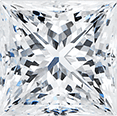
| Asscher | Square, cut corners | Step cut | Same flashes, deeper “windmill” pattern from above |
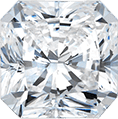
| Radiant | Rectangle, cut corners | Brilliant cut | Same outline, but full sparkle |
| Baguette | Rectangle, square corners | Step cut | Small, usually a side stone, no cut corners |
That radiant row is worth reading twice. If you love the shape of an emerald cut but want the sparkle of a round, the radiant cut is precisely that combination — the same silhouette with brilliant faceting underneath. Our radiant cut pieces are the place to look.
Frequently asked questions
What shape is an emerald cut diamond?
A rectangle with the four corners cut off, making an eight-sided outline. Most are noticeably longer than they are wide, with a length-to-width ratio around 1.30 to 1.50.
Is an emerald cut diamond green?
No. The name refers to the shape traditionally used for emerald gemstones, not to colour. An emerald cut diamond is a normal colourless diamond in that shape.
Do emerald cuts sparkle?
Yes, but in a different way. They give long, broad flashes of white light rather than the fine rapid glitter of a round brilliant. If you want maximum sparkle in that outline, choose a radiant cut instead.
What clarity should I choose for an emerald cut?
Higher than you would for a brilliant-cut shape, because the large open facets show everything. VS2 or better is a sensible working guide. Always look at the actual stone rather than relying on the grade alone.
Does an emerald cut look bigger than a round of the same carat?
Often yes, from above, because more of its weight sits in the length and less in the depth. It also runs along the finger, which reads as larger. It is a genuine effect rather than a marketing claim.
Are emerald cuts more fragile?
No — the opposite. The cut corners are what makes the shape durable. That was the original reason it was invented. It is one of the safer shapes for everyday wear.
Is an emerald cut good for a lab-grown diamond?
Very. Because emerald cuts reward higher clarity and colour grades, and lab-grown stones make those grades far more affordable, the shape is one of the best value propositions we sell. Every centre stone we set comes with a free IGI certificate.
If you would like to compare an emerald against an asscher or a radiant before you decide, come and see them side by side, or message us and we will send honest photographs. Free insured UK delivery and 30-day returns on everything we make.
More guides on this topic
Ready to find your perfect ring?
Explore our lab-grown diamond collection or book a virtual appointment with our team.