What Is a Marquise Cut Diamond?
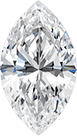
A marquise cut diamond is a long brilliant cut with a point at each end. A 1 ct stone measures about 10 x 5 mm, so it looks bigger than a 1 ct round.
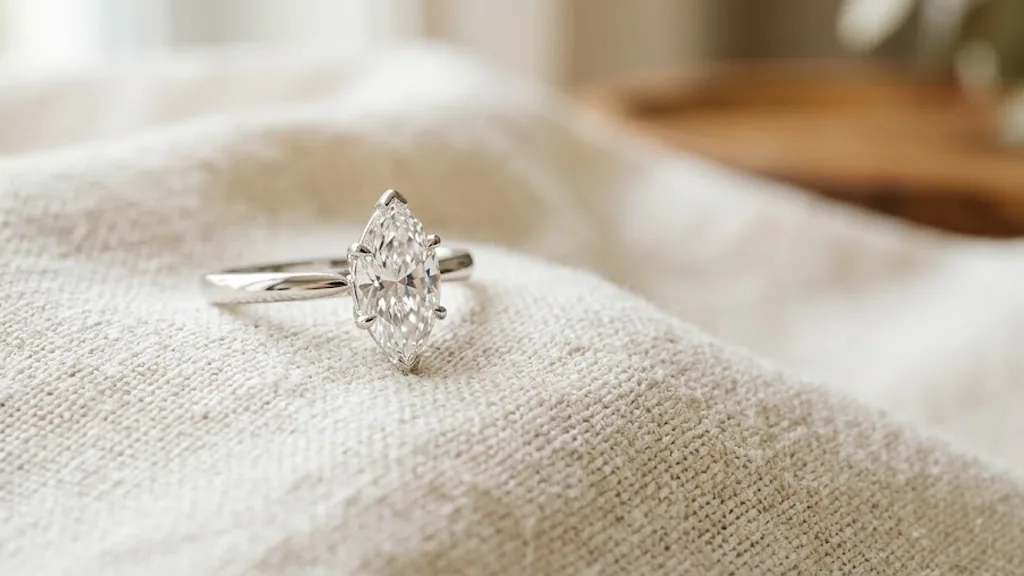
A marquise cut diamond is a long, narrow brilliant-cut stone with a point at each end, shaped like a rugby ball or the hull of a small boat. It is usually about twice as long as it is wide. A 1 ct marquise measures roughly 10 x 5 mm, so it covers more of the finger than a 1 ct round, which is about 6.5 mm across.
Where does the name marquise come from?
The name marquise comes from 18th-century France. The popular story says King Louis XV asked for a diamond cut to echo the smile of the Marquise de Pompadour in the 1700s. Treat that as a trade legend rather than proven history. The shape is also called a navette, French for a little boat, and some older UK ring listings still use that name.
A related shape, the Dutch marquise, has a fuller outline and a different facet layout. Our guide to whether marquise diamonds are outdated covers it, and how older marquise rings can be updated.
What are the parts of a marquise diamond called?
A marquise diamond has 2 points, one at each end, and a belly, the wide curved middle where the stone is broadest. Like a round brilliant, it is faceted (cut with many small flat surfaces) to throw back light, usually with 56 to 58 facets. Most marquise diamonds also show a bow-tie, a darker band across the belly where less light returns. A faint bow-tie is normal.
How big is a marquise diamond in millimetres?
A marquise diamond of 1 ct measures about 10.20 x 5.10 mm on our three stone ring, and the stone grows longer much faster than it grows wider as the weight rises. Carat is weight, not size: 1 ct is 0.20 grams. Because a marquise spreads that weight along a long outline, it looks larger than most shapes of the same weight.
The sizes below, taken from our product specifications, show each extra half carat adding well over 1 mm of length.
| Carat weight | Marquise length x width | Round brilliant width |
|---|---|---|
| 1.00 ct | 10.20 x 5.10 mm | 6.50 mm |
| 1.50 ct | 12.04 x 6.01 mm | 7.50 mm |
| 2.00 ct | 13.45 x 6.63 mm | 8.00 mm |
| 3.00 ct | 15.00 x 7.50 mm | 9.00 mm |
What each size costs is set out in our guide to 1 carat marquise prices.
How is a marquise different from a pear or an oval?
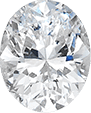
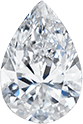
A marquise differs from a pear and an oval mainly in its points: an oval has none, a pear has 1 and a marquise has 2. A marquise is also the longest of the three, with a length-to-width ratio (how many times longer than wide) usually between about 1.85 and 2.10. Ovals typically sit nearer 1.3 to 1.5, and pears nearer 1.5 to 1.75.
Which settings protect the points of a marquise?
Settings that protect the points of a marquise use a V-shaped claw, a small metal cup, over each of the 2 tips. The points are the thinnest part of the stone and the most likely to chip if knocked. Most marquise solitaires use 6 claws: a V-claw at each point and two along each side. A rubover collar, also called a bezel, protects the whole edge instead.
Our Solitaire Marquise Cut Engagement Ring, at £538, is a six-claw solitaire. The Three Stone Marquise Cut Engagement Ring, at £1,143, adds kite cut side stones, and the V Shaped Marquise Cut Engagement Ring, at £1,143, comes with a matching V-shaped band. Prices are for lab-grown diamonds and correct at the time of writing. At CarbonstoneUK in North Harrow, London, every centre stone comes with a free IGI certificate. Browse every marquise ring in our collection.
Frequently asked questions
Is a marquise the same as a navette?
Yes. Navette is the French name for the marquise shape and means a little boat, describing its long outline with 2 pointed ends. Both names describe the same cut. Modern IGI reports always say marquise, while navette now appears mostly in antique and vintage descriptions.
Does a marquise diamond cover more finger than a round?
Yes. A 1 ct marquise is about 10.2 mm long, while a 1 ct round is about 6.5 mm across, so the marquise covers noticeably more of the finger. Set north-south, pointing along the finger, it also makes the finger look longer and noticeably slimmer.
Can a marquise diamond be set east-west on a ring?
Yes. An east-west setting turns the marquise sideways, so it lies across the finger instead of along it. The look is more modern, and the points sit lower against the hand, so they are less likely to catch. A 1 ct stone set this way spans about 10 mm across the finger.
What is the best length-to-width ratio for a marquise?
A length-to-width ratio of about 1.85 to 2.10 suits most people, and around 2.00 is a safe middle choice. Below about 1.75 the stone starts to look like a pinched oval. Above about 2.20 it becomes very slender and the points get more fragile. IGI reports print the measurements, so you can work it out.
Is a marquise cut diamond a brilliant cut?
Yes. A marquise is a brilliant cut, which means its facets are arranged to break up light and throw back sparkle, in the same family as a round brilliant. It is not a step cut like an emerald, which uses long parallel facets. That is why a marquise sparkles rather than flashing in broad planes.
Are lab-grown marquise diamonds real diamonds?
Yes. A lab-grown marquise is real diamond, made of carbon with the same hardness of 10 on the Mohs scale as a mined stone. Only its origin is different. It is cut and polished in exactly the same way, and an IGI certificate records its measurements, carat weight, colour and clarity.
More guides on this topic
Ready to find your perfect ring?
Explore our lab-grown diamond collection or book a virtual appointment with our team.