What Is an F Colour Diamond? When Colourless Is Worth Paying For
F is the last grade in the colourless band. Where it genuinely shows, where it is invisible, and how it compares with D, E and G.
An F colour diamond is a colourless diamond. It is the third grade on the scale, the last one inside the colourless band, and for most buyers it is the point where you get the word “colourless” on the certificate without paying the top of the market for it.
This guide explains what F actually means, who genuinely benefits from it, and when it is money better spent elsewhere.
What the F grade means
Diamond body colour is graded on a letter scale from D to Z. D is the whitest possible grade, and a faint warm tint builds gradually as you move down the alphabet.
The first three letters — D, E and F — make up the colourless band. A stone in this band shows no detectable body colour even when a trained grader examines it loose and upside down under controlled light.
| Grade | Band | How it is described |
|---|---|---|
| D | Colourless | The absolute top of the scale. No colour at all, even to a grader. |
| E | Colourless | Traces of colour visible only to an expert with master stones. |
| F | Colourless | A very slight trace an expert may detect from the side. Nothing visible face-up. |
| G to J | Near colourless | Reads as white in a ring; faint warmth may appear in comparison. |
| K onwards | Faint and below | A warm tone that becomes visible to ordinary eyes. |
The difference between D and F is real on paper and essentially invisible in a finished ring. That is not marketing — it is a consequence of how grading is carried out.
Why the grade is harsher than your eye
Graders do not look at diamonds the way you will. The stone is unset, placed table down — that is, upside down — in a white tray, and viewed through its side against master stones of known grade under standardised lighting.
Looking through the side of a diamond is the most revealing angle for body colour, because light travels the longest path through the stone. Turn it the right way up, set it in a ring, and the facets flood your eye with returned light that swamps any faint tint.
So a laboratory can confidently separate D from F, and you, in a restaurant, cannot. Both statements are true at once.
When F is genuinely worth choosing
There are situations where the extra grades earn their keep. Being specific is more useful than saying “always buy the best you can afford”.
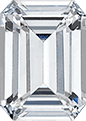
- Emerald, asscher and baguette cuts. Step cuts use long parallel facets that act like windows rather than mirrors. They show body colour more honestly than brilliant cuts do, so a colourless grade shows its value here. Our Solitaire Emerald Cut Engagement Ring, at £672 correct at the time of writing, is exactly the kind of open, honest cut where a higher colour grade repays you.
- Larger centre stones. Colour builds up with depth of material. Above roughly two carats, faint tints have more chance to show, and moving into the colourless band buys real peace of mind.
- Platinum and white gold settings. A bright white metal gives the eye a cool reference point right beside the stone. Our Bezel Cushion Cut Engagement Ring in Platinum, at £904 correct at the time of writing, wraps metal all the way round the stone, so the comparison is unavoidable.
- Bezel and rub-over settings generally. With metal touching the stone’s edge, any warmth reads against a bright white rim.
- If the certificate matters to you. Some people simply want the word “colourless” on the paperwork, and that is a legitimate reason. Just know that is what you are buying.
When F is money you could spend better
Equally honestly, there are cases where F is an upgrade nobody will ever see.
- Yellow or rose gold settings. Warm metal reflects gently into the stone from every direction. In yellow gold, an F and an H look near enough identical, and the money is better put into carat weight or cut.
- Round brilliants and other brilliant cuts under about one and a half carats. The facet pattern masks body colour so effectively that near colourless grades look white.
- When it forces you to compromise on cut. Cut is the one grade that changes how the stone actually behaves. A well-cut G will outshine a poorly cut F every time.
F against E and D
People often ask whether to stretch one more grade. The practical position:
| Comparison | Visible in a finished ring? | Worth the step? |
|---|---|---|
| F vs G | Essentially no | Only for step cuts, large stones, or if the certificate wording matters to you |
| F vs E | No, not to an untrained eye | Rarely — both sit inside the colourless band |
| F vs D | No, not face-up | D is a collector’s grade. You are buying the top of a scale, not a visible difference |
For a fuller comparison of the grade below, see our guide to what a G colour diamond is.
F colour in lab-grown diamonds
Lab-grown diamonds are graded on exactly the same D to Z scale, by the same laboratories, using the same master stones. An F lab-grown diamond and an F natural diamond are the same colour grade.
The practical difference is availability. Higher colour grades are more readily produced in a laboratory than they are found in the ground, so the price gap between near colourless and colourless tends to be narrower for lab-grown stones than for natural ones. That is general guidance about how the two markets behave, not a quoted figure — the actual difference varies by supplier, size and month.
What this means for you is straightforward: if you like the idea of a colourless certificate, a lab-grown route usually puts it within reach at a size you would not otherwise consider. Every centre stone we set comes with a free IGI certificate stating the grade.
The grade that matters more than colour
If you are working to a budget, protect cut before colour.
Colour is a static property — a faint tint that sits in the stone whether it moves or not. Cut is what decides whether light entering the top comes back out towards your eye or leaks away through the base. A stone cut too deep goes dark in the middle. Cut too shallow and it looks watery and flat.
No colour grade rescues a badly cut diamond, and a good cut makes a near colourless stone look brilliantly white. If something has to give, let it be the letter on the certificate.
Pairing F with a setting
A colourless centre stone deserves accent stones that match it. The tiny diamonds in halos and pavé bands — known as melee — are usually supplied within a colour range rather than graded one by one.
If accent stones sit noticeably warmer than an F centre, the mismatch is more obvious than any body colour would have been. It is a fair question to ask any jeweller before ordering.
Clean, simple settings show a colourless stone at its best. Our Solitaire Round Cut Engagement Ring in Platinum, at £657 correct at the time of writing, puts nothing between you and the stone. You can also browse all our engagement rings, or narrow to emerald and cushion shapes.
Frequently asked questions
Is an F colour diamond better than a G?
On the certificate, yes — F is one grade higher and sits inside the colourless band. To your eye in a finished ring, the difference is almost never visible. Choose F if you are buying a step cut, a large stone or a bezel setting; otherwise G does the same visual job.
Is F colour worth the extra money?
It depends entirely on the shape and setting. In an emerald cut set in platinum, yes, there is a case for it. In a round brilliant set in yellow gold, the same money spent on carat weight or cut will show far more.
Does an F colour diamond look yellow at all?
No. F carries no visible tint face-up. A grader may detect the faintest trace looking through the side of the unset stone, which is a laboratory observation rather than something you will ever see on a hand.
Is F colour good for a two carat diamond?
Yes, and this is one of the sizes where the colourless band genuinely earns its place. Larger stones give colour more depth of material to show through, so many buyers step up as carat weight increases.
Do lab-grown F colour diamonds exist?
Yes, and they are relatively common. Lab-grown production reaches the colourless band more readily than mining does, which is why colourless grades are easier to find in larger sizes at accessible prices.
Choosing with clear eyes
F colour is a genuinely good grade — properly colourless, not a near miss. Just make sure you are buying it for a reason that shows: an open step cut, a large centre stone, or a bright white metal that gives the eye something to compare against.
Every centre stone we set is lab-grown and IGI certified, hand-made into solid gold or platinum in North Harrow, London, with free insured UK delivery and 30-day returns. If you want a specific colour grade in a design we do not currently stock, we create bespoke pieces at no extra design cost.
More guides on this topic
Ready to find your perfect ring?
Explore our lab-grown diamond collection or book a virtual appointment with our team.