
Is an H Colour Diamond Too Yellow?
No. H reads as white face-up in a ring, in every common metal. Where it sits on the scale, when it shines, and the one time to go higher.
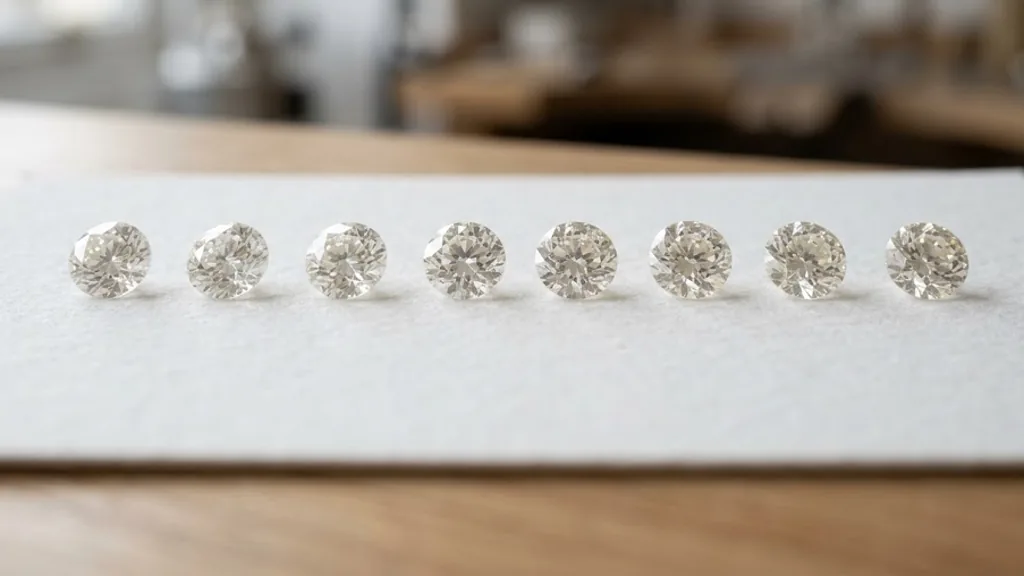
No — an H colour diamond is not too yellow. In normal light, set in a ring and viewed face-up, an H looks white. You would need to place it directly beside a D or E, both loose and face-down, before any warmth became apparent, and even then most people struggle to call it.
H sits in the near-colourless band and it is one of the most sensible grades you can buy. Here is exactly where it falls on the scale, when it works beautifully, and the one situation where you might want to go a step higher.
Where H sits
The colour scale runs from D, completely colourless, down to Z, an obvious light yellow. H is the fourth letter along and the second grade in the near-colourless band.
| Grade | Band | Face-up appearance in a ring |
|---|---|---|
| D, E, F | Colourless | White, with no tint under any conditions |
| G | Near colourless | White |
| H | Near colourless | White — warmth only in direct comparison with a higher grade |
| I, J | Near colourless | White in most settings; a hint of warmth in a large stone in white metal |
| K, L, M | Faint | A gentle warm tone, visible to an attentive eye |
The important thing to understand is how the grade was assigned. A laboratory grades a loose stone, face-down in a white tray, under a standardised lamp, against master stones of known grade. That is the most unforgiving way to look at a diamond that anyone has devised. It exists to be consistent, not to predict what you will see on a hand.
Once the same stone is set, viewed face-up, in ordinary light, with sparkle bouncing around, the picture changes completely. Grading conditions are a laboratory measurement. Your ring is not a laboratory.
When H is the right choice
In white gold or platinum. White metal is the toughest test, because the bright white setting gives your eye a reference. H passes it. G and H are the two grades most often recommended for white metal precisely because they hold up while costing meaningfully less than the colourless band.
In yellow or rose gold. Easily. Warm metal reflects its own colour into the stone, which hides any trace of tint. In warm metal you could comfortably go lower than H — an I, J or even K will look perfect — so paying for H in yellow gold is arguably spending more than you need to.
In brilliant cuts. Round, oval, pear, marquise, cushion and heart shapes have dozens of small facets that break light into flashes. That activity disguises body colour well, and H disappears completely.
The one situation to think twice about
Step cuts. Emerald and Asscher shapes have large flat facets and an open table — they behave more like a window than a mirror ball. Body colour shows honestly through them.
H is still perfectly usable in an emerald cut, especially under two carats. But if you are buying a large emerald or Asscher in platinum, and colour is something you know will nag at you, going up to F or G is a defensible use of money. It is the only combination where the extra grades genuinely earn their keep.
What H saves you, and what to do with it
Moving from D or E down to H makes a real difference to the price of a stone, and buys you something you can actually see. There are three good ways to spend it:
- A better cut. Cut controls how much light returns to your eye. It is the single biggest driver of how alive a diamond looks, and it is where money is never wasted.
- A larger stone. If size matters to the person wearing it, the difference between H and D can be a noticeable step up in carat weight.
- A better setting. A halo, hidden halo or three stone design changes the presence of a ring far more than two colour grades ever will.
Rings where H works well
For a white metal solitaire, the solitaire round cut engagement ring in white gold is the straightforward classic at £563 at the time of writing — a brilliant cut in white metal, exactly the pairing H is made for.
If you want more presence for the money, the hidden halo oval cut engagement ring uses a concealed ring of small stones under the centre so the diamond reads larger from above. And for a warm setting where colour stops mattering altogether, the pear cut engagement ring in yellow gold is a lovely option.
Every centre stone we set is lab-grown and comes with a free IGI certificate stating the colour grade — so H means H, in writing. See the full engagement ring collection, or our round cut rings, the largest group we make at twenty designs.
If you would like to compare grades, we have written separately about G colour diamonds and F colour diamonds.
How H compares with the grades either side of it
| Comparison | Visible difference face-up | Worth the price gap? |
|---|---|---|
| H against G | Effectively none | Only if the gap is small |
| H against F | Very hard to see in a ring; detectable side by side, loose | Rarely, except in large step cuts |
| H against D | Detectable in a direct loose comparison; not in normal wear | Only if owning the top grade matters to you |
| H against I | Effectively none | I is the cheaper of the two and loses nothing in most settings |
| H against K | Clear in white metal; invisible in yellow gold | Depends entirely on the metal |
The pattern is consistent: one grade apart is not a visible purchase, and three or more only becomes visible in white metal. If you are agonising over G against H, you are agonising over nothing.
H in multi-stone designs
Anything with several visible stones — eternity bands, three stone rings, five stone rings — raises a different question. It is not about the letter, it is about consistency. A row of stones all at H looks better than a row mixing F, H and J, because the eye picks up variation between neighbours far more readily than it detects absolute colour.
This is one of the quiet advantages of buying from a jeweller who sets stones by hand: matching is done at the bench, stone by stone, rather than assembled from whatever is in a drawer. In our eternity bands and side stone designs, the accent stones are selected to sit comfortably with the centre.
Where H genuinely earns its place
H is the grade to choose when you want a white-looking diamond in white metal and you would rather put the remaining budget into something you can see. Two sensible destinations for that money: a better cut grade, which drives every bit of sparkle the stone will ever have, and a setting that adds presence — a halo, a hidden halo, or a wider band that makes the whole ring read as more substantial on the hand.
Common questions
Is H colour good for an engagement ring?
Yes. It is one of the most widely chosen grades for engagement rings and for good reason — it looks white in a ring, in every common metal, at every common size, without paying colourless prices.
What is the difference between G and H?
One grade, and in practice almost nothing visible. Both are near-colourless and both look white face-up. G costs a little more. If the price gap is small, take the G; if it is not, H loses you nothing you will notice.
Will an H colour diamond look yellow in yellow gold?
It will pick up a little warmth from the metal, as every diamond does, and it will look entirely intentional. Warm metal masks tint rather than exposing it, so H is more than safe in yellow or rose gold.
Is H colour good for a large diamond?
Up to around two carats, yes, comfortably. Above that, colour becomes slightly easier to see in white metal, and G or F is worth considering if the budget allows.
Does an H colour diamond hold its value?
Diamonds of any grade should be bought to wear rather than as an investment — that goes for laboratory-grown and mined stones alike. What H does reliably is give you a beautiful, white-looking stone for less than the colourless grades cost, which is a much more useful kind of value.
Everything we make is hand-made in solid gold and platinum in North Harrow, London, with free insured UK delivery and 30-day returns.
Ready to find your perfect ring?
Explore our lab-grown diamond collection or book a virtual appointment with our team.











