
The Bow Tie Effect in Oval and Pear Diamonds: What It Is and How to Avoid a Bad One
Every oval diamond has a bow tie shadow. What causes it, why no certificate grades it, and the practical way to avoid a severe one.
The bow tie is the dark shadow that stretches across the middle of an elongated diamond, roughly at right angles to its length. It looks like a small bow tie lying across the stone, which is where the name comes from. You will see it in oval, pear and marquise diamonds most of all.
Two questions come up constantly about it, so let us answer both immediately. Do all oval diamonds have a bow tie? Effectively yes — every oval has some degree of it, and the honest question is how visible it is, not whether it exists. And can you avoid a bad one? Yes, and this guide explains exactly how.
What causes a bow tie
A round diamond is symmetrical in every direction, so its facets can be arranged to send light back to your eye evenly from all around the stone. An elongated diamond cannot do that. Stretch a round shape into an oval and the facets at the ends have to work at different angles from the ones at the sides.
In the middle of the stone, some of those facets end up pointing light out of the bottom of the diamond, or reflecting the shadow of your own head as you lean over it, instead of returning light to your eye. That area goes dark, and because the geometry is symmetrical, it goes dark in a band across the width — the bow tie.
It is a consequence of the shape, not a flaw in the diamond, and it has nothing to do with clarity, colour or the stone being lab-grown or mined.
Which shapes get it
| Shape | How prone it is | What to look for |
|---|---|---|
| Oval | Always present to some degree | A soft, even shadow rather than a hard black band |
| Marquise | Very prone; the pointed ends make it worse | Light reaching all the way to the points |
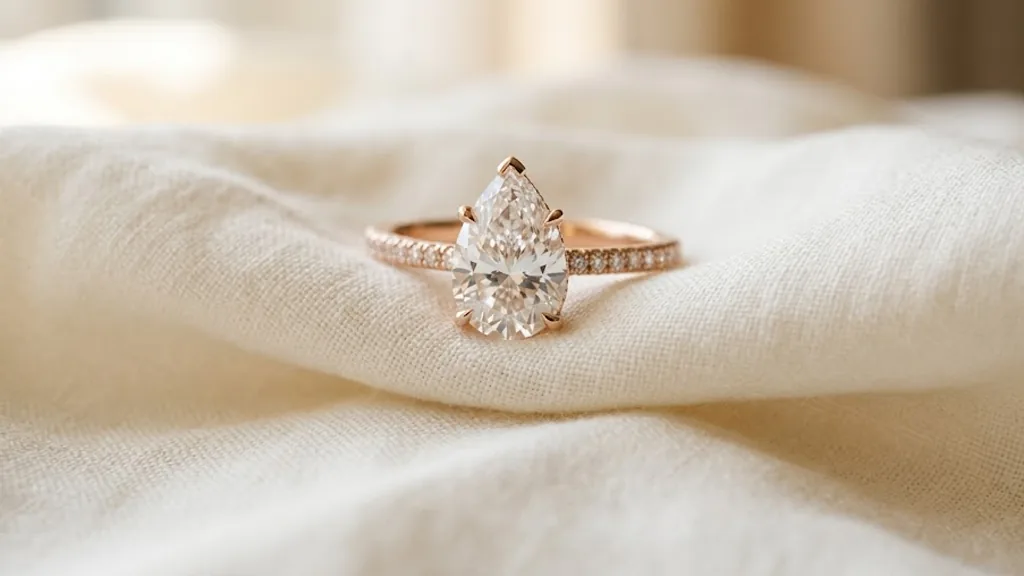
| Pear | Prone, usually milder than marquise | Shadow sitting near the widest part, not across the whole stone |
| Radiant, emerald, cushion | Rarely a real issue | Faceting is arranged differently |
| Round, asscher, princess | Not applicable | Symmetrical shapes do not produce it |
When a bow tie is fine, and when it is not
A faint bow tie is normal and, to a lot of eyes, attractive. It gives an oval a sense of depth and contrast, and a stone with no contrast at all can look flat and glassy. What you are avoiding is the severe version: a hard, dark, opaque band that stays black as the stone moves and takes a noticeable bite out of the sparkle.
A useful way to judge it is movement. Tilt the stone. In a good diamond, the shadow shifts, breaks up and fills with light as the angle changes. In a poor one, the black band sits there like a stripe of paint however you move it.
Why no grade tells you
This is the part most buyers do not know, and it matters. Diamond certificates give a cut grade — excellent, very good and so on — for round brilliants. For fancy shapes such as oval, pear and marquise, the major laboratories do not issue an overall cut grade in the same way. They report proportions, polish and symmetry, but not how well the stone actually performs.
So there is no line on a report that says “bow tie: mild”. You have to look. That is not a reason to avoid these shapes; it is a reason to insist on seeing the stone properly before you commit.
How to avoid a bad bow tie: the practical method
- Look at the stone, not the numbers. A high-resolution video or a 360-degree view is far more informative than any proportion figure. Watch the centre of the stone as it rotates.
- Watch it in ordinary light. Jewellery photography is lit to eliminate shadows. If you can see the ring in daylight or normal room light, do.
- Tilt it. Movement is the test. A shadow that breaks up is fine; one that does not is the one to reject.
- Treat depth figures as a hint, not a rule. Sellers often suggest that ovals with very deep proportions are more prone to a strong bow tie. There is something in it, but it is rough guidance from trade experience rather than a measured relationship, and plenty of stones defy it in both directions.
- Consider the length-to-width ratio. Longer, narrower ovals and pears tend to show the effect more than shorter, rounder ones. This is a tendency, not a guarantee.
- Buy where you can return it. The only complete test is the stone on the hand. Our returns window is 30 days and UK delivery is free and insured, which is exactly what that window is for.
Settings that help
The setting cannot remove a bow tie, but it can change how much you notice it.
A halo surrounds the centre stone with small diamonds, which adds bright light immediately around the shadow and draws the eye outward. A hidden halo oval cut ring at £1,021 (correct at the time of writing) does this discreetly, with the halo tucked underneath.
Side stones do something similar. A three stone oval cut ring at £1,021 places bright stones either side of the centre, so the eye reads the whole ring rather than the middle of one stone.
Higher settings that let more light in under the stone can lift the whole diamond, whereas anything that blocks light from below tends to make shadows worse.
If you want to see the effect at its mildest, a simple solitaire oval cut ring at £557 shows the stone with nothing else competing for attention — which is also the most honest way to judge one.
The bow tie in marquise diamonds
Marquise stones deserve their own paragraph, because the shape concentrates the problem. A marquise is elongated and pointed at both ends, so as well as the central shadow it can suffer dark or dull tips where the facets run out of room to work.
When you are judging one, look at three things: the centre, the two points, and whether the two halves match. Marquise cutting is unforgiving of asymmetry, and a stone whose points are not level with each other looks wrong even to people who cannot say why. A solitaire marquise cut ring at £538, correct at the time of writing, shows the shape with nothing hiding it, which is the right way to assess one.
Points are also the most vulnerable part of any diamond, so a marquise or pear worn daily is better in a setting that protects the tips with a claw over each end.
What else creates dark areas, and how to tell the difference
Not every shadow in a diamond is a bow tie, and confusing them leads people to reject perfectly good stones.
- Your own reflection. Lean over any diamond and you will see a dark patch, because your head is blocking the light. Move your head and it moves. That is not a bow tie.
- A dirty stone. Hand cream, soap and skin oils build up underneath a diamond and stop light entering from below. The whole stone goes dull. A soft brush, warm water and a drop of washing-up liquid fixes it.
- Poor light. Diamonds need direct light sources to sparkle. Under flat, diffuse lighting every stone looks lifeless.
- Windowing. A stone cut too shallow lets you see straight through the middle of it. That is a different fault, and a more serious one.
Clean the ring, take it to a window, move your head out of the way, and then judge the shadow. A surprising number of “bow tie” complaints disappear at that point.
Should the bow tie put you off elongated shapes?
No. Ovals, pears and marquises are popular for good reasons: they cover more of the finger than a round stone of the same weight, they make the hand look longer, and they have more character. A well-chosen oval with a mild bow tie is a beautiful thing.
The mistake is buying one unseen, from photographs that have been lit to hide it, and then discovering the shadow at home. Look properly and the problem largely goes away.
Frequently asked questions
Do all oval diamonds have a bow tie?
In practice, yes. All ovals show some shadow across the centre. The variation is in how strong and how dark it is.
Can a bow tie be polished out or fixed?
Not really. It comes from the stone’s proportions, so removing it would mean recutting the diamond, which loses weight and is rarely worth doing for this reason alone.
Do lab-grown diamonds have bow ties?
Yes, exactly as mined ones do. It is a function of the cut, not the origin of the crystal.
Is the bow tie mentioned on an IGI or GIA certificate?
No. Certificates report proportions, polish and symmetry, and the major laboratories do not give fancy shapes an overall cut grade in the way they do round brilliants.
Which elongated shape is safest if I am worried about it?
Of the three, pear tends to be the most forgiving and marquise the least, though individual stones vary enormously. Judging the specific stone matters far more than choosing the shape.
You can browse everything we make in these shapes through our oval cut collection and pear cut collection, or the full engagement ring range. Every centre stone comes with a free IGI certificate, and if you would like a particular set of proportions we can source and set a stone to order at no extra design cost.
More guides on this topic
Ready to find your perfect ring?
Explore our lab-grown diamond collection or book a virtual appointment with our team.











