Are Pink Diamonds an “Off Colour” Diamond?
No. Off colour describes a white diamond with unwanted tint. Pink is graded in a different system where colour is the whole point. Both explained.
No — a pink diamond is not an “off colour” diamond, and the phrase gets the grading system exactly backwards. Off colour is trade shorthand for a white diamond that has drifted away from colourless towards a faint yellow or brown tint. It describes a stone that fell short of what it was meant to be. A pink diamond is graded in an entirely different system, where colour is the point.
The confusion is understandable, because both situations involve a diamond that is not colourless. But one is a shortfall and the other is a prize. Here is how the two systems work and where pink sits.
What “off colour” actually means
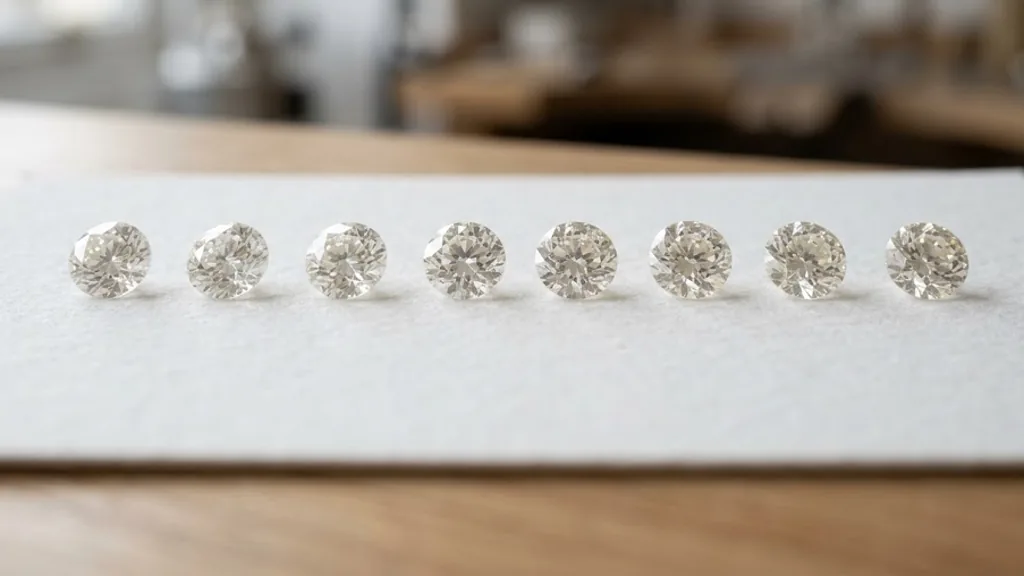
Ordinary white diamonds are graded from D, completely colourless, to Z, an obvious light yellow or brown. Every step down means slightly more tint, and slightly less money. When someone in the trade calls a stone off colour, they mean it sits noticeably down that scale — usually somewhere from around N onwards, with a tint you can see face-up without effort.
It is a mild criticism. The stone was cut and sold as a white diamond, and it is not as white as the market prefers. That is all the term means.
Why pink is graded differently
The D-to-Z scale only measures one thing: how far a diamond has drifted from colourless towards yellow or brown. It has nothing to say about pink, blue, green or any other colour, because those are not on that road at all.
So pink diamonds are graded under the fancy colour system instead. There, the assessment is hue (which colour it is), tone (how light or dark) and saturation (how strong), producing a grade such as “Fancy Intense purplish pink”. Under this system, more colour means more value — the exact opposite of the white diamond scale.
| White diamond scale | Fancy colour scale | |
|---|---|---|
| Range | D to Z | Faint through to Fancy Vivid, Deep and Dark |
| What is desirable | Less colour | More colour |
| How the stone is viewed | Face-down against white | Face-up, as it will be worn |
| “Off colour” applies? | Yes — a stone with unwanted tint | No such concept |
| Pink diamonds | Not graded here | Graded here |
Where pink diamonds come from
Pink is one of the more interesting colours because nothing was added to the stone. There is no pink element in a pink diamond.
The colour comes from physical distortion. As the crystal grew under enormous pressure, planes of atoms in its lattice were pushed permanently out of alignment. Those distorted planes absorb light in a way the eye reads as pink. Under magnification you can sometimes see this as fine coloured lines running through the stone, known as graining.
Push that distortion further and you get red, the rarest diamond colour of all. Get the conditions slightly wrong and you get brown, which is the most common. Pink sits in a narrow band between the two, which is a large part of why it is scarce.
Why natural pink became harder to find
Supply matters as much as geology. The Argyle mine in Western Australia was the principal source of natural pink diamonds for decades, and it ceased production in 2020. Since then the market has traded on existing stones rather than new supply.
That does not mean natural pinks are unobtainable — they appear at auction regularly — but it does mean they are firmly in the collector category, priced per stone rather than per carat, and not a normal engagement ring purchase for most people.
The three grades of pink you might encounter
- Natural pink. The colour formed in the earth. The report will state colour origin as natural. This is the expensive one.
- Treated pink. A finished diamond irradiated and then heated to shift its colour. The colour is permanent and genuine, but the report must disclose the treatment and the value is far lower.
- Laboratory-grown pink. A diamond grown in a chamber, with the colour produced during or after growth. Real diamond, real colour, a fraction of the natural price, and identified as laboratory-grown on the report and by a laser inscription on the girdle.
All three are diamond. What separates them commercially is where the colour came from, and only a gemmological laboratory can determine that.
What we make, and the honest alternative
We do not stock pink diamonds, natural or laboratory-grown. Our collection is built on colourless and near-colourless lab-grown stones, each with a free IGI certificate. We would rather tell you that than dress something up.
If it is the soft, romantic look of pink you are drawn to rather than the stone itself, rose gold gets you most of the way there for a fraction of the cost. Warm pink metal casts a genuine blush across a white diamond and across the skin, and it does it every day in every light.
The halo heart cut engagement ring in rose gold is the most romantic version we make, at £949 at the time of writing. For something less overt, the bezel hexagon cut engagement ring in rose gold wraps warm metal directly around a geometric stone. And if you want the rose gold to run through the whole set, the teardrop pear cut bridal set in rose gold includes the matching band.
Browse the full engagement ring collection or the bridal sets. If you genuinely want a pink centre stone, ask us about bespoke — we design at no extra design cost and will give you a straight answer on sourcing and price.
Reading a pink diamond grade
If you ever look at a report for a pink stone, the colour line will have three parts and each tells you something about the price.
- The strength. Fancy Light, Fancy, Fancy Intense or Fancy Vivid. Value rises steeply as you go up, and the jump between the top grades can be dramatic.
- The modifier. Purplish pink is generally desirable. Brownish pink and greyish pink are not — brown and grey mute the colour and reduce value considerably.
- The distribution. Colour spread evenly across the stone is worth more than colour concentrated in patches, which can look uneven face-up.
You will also notice that clarity carries far less weight than it does with a white diamond. Strong body colour and busy faceting hide small inclusions, so pink stones commonly trade at clarity grades that would be considered low for a colourless diamond, without anything being visible to the eye.
What actually makes a ring look expensive
It is worth stepping back from rarity for a moment. Almost nobody looking at a hand can identify a colour grade, a clarity grade or a stone’s origin. What people do register, instantly, is whether a ring looks well made and whether the stone looks bright.
That comes from cut quality, from clean settings with even, well finished metal, and from proportions that suit the wearer’s hand. A superbly cut white diamond in a well made setting reads as expensive. A weakly coloured pink in a clumsy mount does not, whatever the paperwork says.
So if the budget has to choose, put it into cut and craftsmanship first. Those are the things you see every day.
Common questions
Are pink diamonds real diamonds?
Completely. Same carbon, same crystal structure, same hardness. The pink comes from distortion in the structure rather than from any added material.
Why are pink diamonds so expensive?
Scarcity, plus tight supply since the main producing mine closed in 2020. Price is driven by how strong and pure the pink is, how evenly it spreads through the stone, and the size — and it is set stone by stone rather than from a price list.
Can a diamond be both off colour and pink?
No, because the terms belong to different systems. A stone is either graded on the D-to-Z white scale or in the fancy colour system. Once it is a fancy pink, the white scale no longer applies to it.
Is a faint pink tint in a white diamond a good thing?
It depends entirely on strength. A very faint pinkish cast in a stone sold as white is generally treated as a fault, because it is not colourless. Enough pink to be graded Fancy Light or above and it becomes a coloured diamond in its own right.
Are laboratory-grown pink diamonds worth buying?
If you want the colour and the look, yes — the material is genuine diamond and the colour is genuine colour. Just be clear that you are buying it to wear and enjoy, not as an equivalent of a natural pink, and make sure the report states the origin plainly.
Everything we make is hand-made in solid gold and platinum in North Harrow, London, with free insured UK delivery and 30 days to return it.
Ready to find your perfect ring?
Explore our lab-grown diamond collection or book a virtual appointment with our team.