
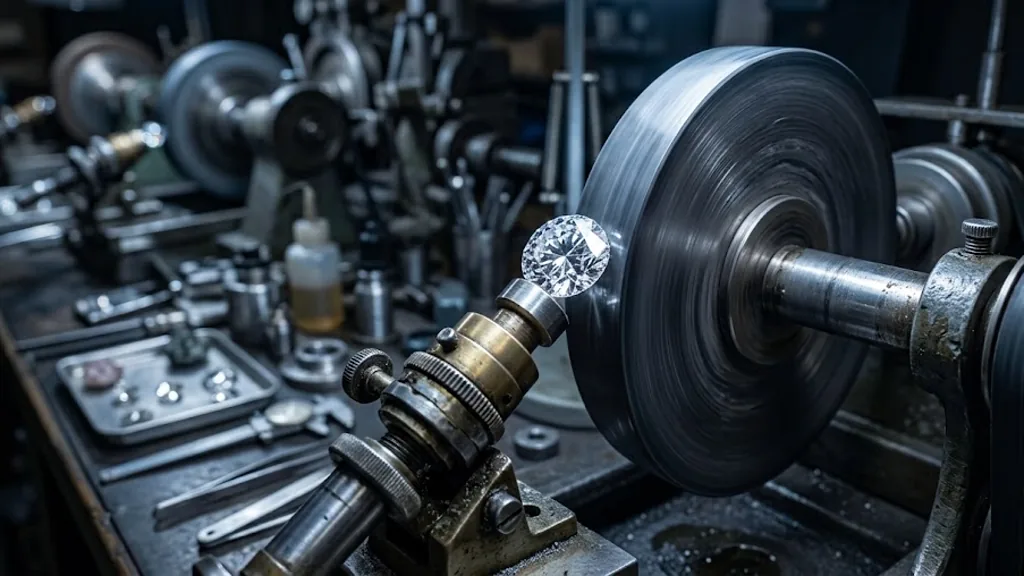
Which Country Is Famous for Diamond Cutting?
India, and Surat in particular, cuts more diamonds than anywhere else. Where Antwerp, Israel and Amsterdam fit, and why cut quality matters more.
India. If you want one answer, that is it — and specifically the city of Surat in the state of Gujarat, where an enormous share of the world’s diamonds are cut and polished. Belgium is the name most people reach for first, and Antwerp genuinely was the centre of the trade for centuries, but the cutting itself moved east decades ago.
The fuller answer is more interesting, because different countries became famous for different things: one for volume, one for trading, one for a particular cut, one for the machinery. Here is who does what, and why it matters to a ring you might buy.
India, and Surat in particular
Surat is the centre of gravity for diamond cutting. Thousands of cutting and polishing workshops operate there, from vast modern factories to small family units, and the industry employs a very large workforce across the region.
Two things built that position. India has an extremely long history with diamonds — for much of recorded history it was the world’s only known source — and in the modern era it developed the capacity to cut small stones economically, at a scale nobody else could match. Once that infrastructure existed, larger stones followed.
You will see confident percentages quoted for how much of the world’s diamond supply passes through Surat. Treat every one of them as an estimate. Different sources count by stone, by weight and by value, and they produce very different figures. What is not in dispute is that India cuts more diamonds than anywhere else by a wide margin.
Belgium: the trading floor rather than the wheel
Antwerp is the name that carries the historical weight, and rightly. From the fifteenth century onwards it was the place diamonds were bought, sold, valued and cut, and its diamond district remains one of the most important trading hubs in the world.
What has changed is the cutting. Labour costs made high-volume polishing in Belgium uncompetitive, and that work migrated to India. Antwerp today is about dealing, grading, banking and certification rather than production — still central to the trade, just at a different point in the chain.
The other names worth knowing
| Country or city | Known for |
|---|---|
| India (Surat) | Cutting and polishing at the greatest scale in the world |
| Belgium (Antwerp) | The historic trading centre; dealing, grading and certification |
| Israel (Ramat Gan) | Large stones, technology and trading; a major exchange |
| United States (New York) | High-end cutting and the American trade |
| Netherlands (Amsterdam) | The original European cutting centre; largely historic today |
| South Africa and Botswana | Mining, with growing local cutting industries |
| China | Significant modern cutting capacity |
The cuts that carry a country’s name
A few cutting styles are named after where they were developed, which is where a lot of the country associations come from.
The Asscher cut was created by the Asscher brothers in Amsterdam in the early twentieth century — a square step cut with cropped corners and a deep, hall-of-mirrors look. The Old European cut was the European standard before modern brilliant proportions were worked out, with a small flat top facet and a chunky, candlelit character.
Neither is a country’s exclusive property today; both are cut wherever the demand is. It is worth saying plainly that we do not stock Old European cuts or princess cuts — if either is what you want, we can make it as a bespoke piece at no extra design cost, and we would rather tell you that than pretend otherwise. We do make an Asscher cut band, though it is a single design rather than a range.
Why cutting matters more than country
Here is the part that actually affects your ring. Where a diamond was cut tells you very little about how well it was cut, and how well it was cut is the single biggest influence on how it looks.
Cut quality is about angles, proportions, symmetry and polish. Get them right and light entering the stone is returned to your eye as brightness and fire. Get them wrong and light leaks out of the bottom, leaving a stone that looks flat and lifeless however good its colour and clarity grades are.
Excellent cutting comes out of India, Israel, Belgium and the United States. So does poor cutting. The certificate tells you which you are getting; the country of origin does not.
Where our rings are made
Our diamonds are lab-grown and cut to modern proportions, and every centre stone comes with a free IGI certificate so the cut, colour and clarity are documented rather than described. The rings themselves are hand-made in solid gold and platinum in North Harrow, London.
If you want to see cutting quality doing its job, a round brilliant is the clearest demonstration — it is the shape whose proportions have been most thoroughly worked out. The solitaire round cut engagement ring in platinum is £657 at the time of writing.
Step cuts show the cutter’s precision differently, through the crispness of the facet lines rather than through sparkle — the solitaire emerald cut engagement ring at £672 is a good example. And for a shape where symmetry is unforgiving and skill really shows, look at the solitaire marquise cut engagement ring, where both points have to match perfectly.
Browse the whole engagement ring collection, or narrow to our emerald cut rings. Free insured UK delivery and 30-day returns as standard.
What happens between rough and finished stone
Cutting is not one job. It is a sequence, and every step is a decision that affects what you eventually buy.
Planning. The rough crystal is scanned and mapped so the cutter can decide how to get the best result from it — one large stone or two smaller ones, and where the inclusions can be cut away. This is where most of the value is won or lost.
Cleaving or sawing. The rough is divided, historically by hand and now usually by laser.
Bruting. The outline is shaped — the roundness of a round, the outline of a pear.
Faceting. Each facet is ground and positioned to a precise angle. This is where brilliance is created or lost, and where skill shows most.
Polishing. The final surface finish. Poor polish scatters light and dulls a stone that is otherwise well proportioned.
A cutter constantly trades weight against beauty. Leaving a stone slightly deeper keeps more carats and sells for more per stone, but light leaks out of the bottom and the diamond looks lifeless. Cutting to ideal proportions loses weight and makes a better diamond. That single tension explains most of the difference between a dull stone and a brilliant one.
How to judge cutting quality on paper
For round brilliants, the certificate gives you a cut grade — the simplest guide there is, and worth prioritising above colour and clarity.
Fancy shapes such as oval, pear, marquise and emerald are not given an overall cut grade, because there is no single agreed set of ideal proportions for them. For those, look at the polish and symmetry grades, check the measurements for a ratio you like the look of, and above all look at the stone. A well cut fancy shape looks bright right across its face; a poorly cut one shows a dark band or a dull centre.
Common questions
Which city cuts the most diamonds?
Surat, in India, by a considerable distance. It is the largest cutting and polishing centre in the world and has been for decades.
Is Antwerp still important?
Very. It remains one of the world’s principal trading centres, with dealers, banks, grading laboratories and exchanges concentrated in a small district. The change is that stones are traded there rather than cut there.
Does the country of cutting affect quality?
No, not in itself. Quality depends on the individual cutter and the standard the stone was cut to, both of which vary enormously within every country. Judge the cut grade on the certificate, not the postcode.
Are lab-grown diamonds cut in the same places?
Yes, largely. Laboratory-grown rough goes to the same cutting centres and is cut on the same equipment to the same proportions by the same cutters. There is no separate industry for it.
Where does the UK fit in?
Britain has never been a major cutting centre, but it has a long tradition of jewellery making — Hatton Garden in London and the Jewellery Quarter in Birmingham being the best known. Stones are imported and the pieces are made here, which is exactly how we work.
Ready to find your perfect ring?
Explore our lab-grown diamond collection or book a virtual appointment with our team.











