Can You Wear Your Wedding Ring at the Gym?
Better not to. Bars and dumbbells press gold out of round, and a 2mm band bends fastest. Degloving is rare but real, which is why we say leave it off.
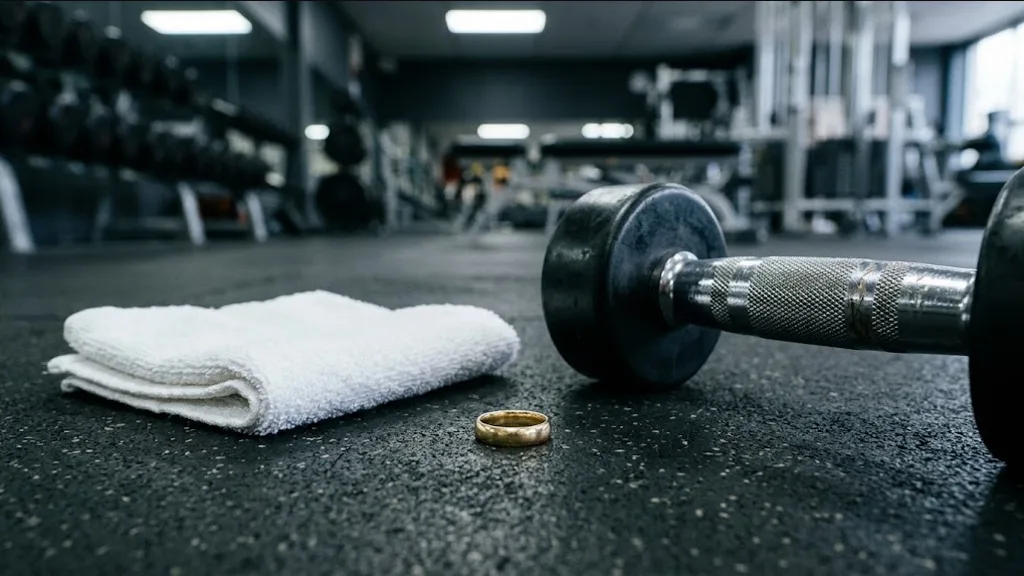
No, leave your wedding ring in the locker. Barbells, dumbbells and machine handles press a band from two sides at once, and the metal goes out of round long before you notice. A 2mm band bends fastest of all. Ring avulsion, an injury where a ring snags on equipment, is a real risk, and it is why we say take it off.
What does a barbell actually do to a gold band?
A barbell squashes a gold band into an oval, slowly, one set at a time. The bar sits across the base of the fingers and carries your whole load through a strip a few centimetres wide, so the ring is pressed between steel on one side and bone on the other. 9ct gold resists that best, because the alloy is the hardest of the common ones; 18ct moves more easily.
A ring that has gone oval usually shows on the inside first, as flat patches where the round profile used to be. It still turns on the finger, so most people miss it for a year or more. Our guide to wearing a wedding ring every day covers the five things that genuinely damage a band, and weights are one of them.
Which ring profiles survive the gym best?
Ring profiles that survive the gym best are wide, thick and plain. A 4mm to 6mm court band, meaning one rounded on both the inside and the outside, holds its shape far better than a 2mm one, because there is simply more metal resisting the squeeze. Platinum moves rather than cracks under load. A flat band with sharp edges dents at the corners first.
Nothing here makes a ring gym-proof, and we would not sell you a ring on that basis. The table below matches four common band types to how each behaves under a bar, so you can see which one is worth leaving on and which one is not.
| Band type | What happens under load |
|---|---|
| 2mm plain court band | Goes out of round soonest |
| 5mm plain court band | Holds its shape longest of the plain bands |
| Pavé or channel set band | Stones loosen before the metal bends |
| Full eternity band | Cannot be reshaped without unsetting stones |
Among the bands we make, our minimalist round cut wedding band at £687 is the plainer sort that takes the least harm, while our stackable round cut full eternity band at £707 is exactly the ring to take off first. Both prices are correct at the time of writing.
Where should you put the ring while you train?
Put the ring somewhere fixed rather than somewhere convenient, because rings are lost in the gap between the two. A zipped pocket in your bag, a small pouch that lives in that bag permanently, or a chain around your neck all work. Loose in a locker, threaded on a shoelace, or balanced on a bench are the three we hear about most when somebody comes in for a replacement.
A ring you take off often needs a plan for the day it does not come home, and claiming for a lost wedding ring sets out what an insurer will ask you for. The same habit of removing a ring in one fixed place applies elsewhere, and wearing a wedding ring through airport security answers the version of this people ask at the airport.
What happens to a diamond set band at the gym?
A diamond set band loses stones at the gym long before the metal shows anything at all. Grit, chalk and repeated pressure work the tiny claws over each pavé stone open a fraction at a time, and a stone loose for a week falls out on an ordinary Tuesday. Channel set bands hide the problem better and are worse to repair, because the stones sit in a groove.
Eternity bands are the hardest case of the lot, since stones run the whole way round and there is no plain section left to take the wear. whether eternity rings feel comfortable daily covers how they sit on a hand day to day, and how to take care of your diamond engagement ring covers the checks that catch a loose stone in time.
Do gloves or lifting straps protect a ring?
Gloves and lifting straps reduce direct contact, but they do not take the load off a ring. A padded glove spreads pressure across the palm; the bar still presses the band against the finger underneath it. Straps move some load to your wrist and help a little more. Neither stops a ring snagging on a machine, which is the risk that has nothing to do with metal.
We are jewellers, not a safety authority, and we will not tell you what is safe to wear or offer any advice about injuries. What we can tell you is what happens to the metal, and what we see when a ring comes back to the bench. On that evidence alone the ring is better off in the bag. You can compare plain and set bands across the whole wedding ring collection.
How do you get a bent ring back into shape?
Getting a bent ring back into shape is a bench job called reshaping, and on a plain band it is quick. The ring goes onto a steel mandrel, which is a tapered rod, and is tapped true with a hide mallet, then re-polished. A plain band takes this several times without complaint. A band with stones cannot, because every tap moves metal around the settings.
Each reshape also takes a little metal off in the polishing, so a band done four or five times ends up thinner than it started. That is the real long-term cost of wearing a ring through heavy work. The same reasoning sits behind taking your wedding ring off in the shower, which is the low-stakes version of the same habit. Every ring we make is hand finished in North Harrow, London.
Frequently asked questions
Can you wear a silicone ring instead?
Yes. A silicone band is the usual substitute for training, and plenty of our customers keep one in their gym bag. It costs a few pounds, it will not go out of round under a bar, and losing one costs nothing. We do not sell them, so buy one anywhere you like; the point is that the gold ring stays at home.
Does a platinum band bend as easily as gold?
No. Platinum is denser and tougher than gold, so a platinum band of the same width resists going out of round for longer, and it moves rather than cracking when it does give. The trade-off is that platinum scratches into a soft grey finish quickly. It bends less; it marks more.
Will the gym scratch a diamond?
No, not the diamond itself. Diamond is the hardest natural material there is, at 10 on the Mohs scale, so a steel bar will not scratch the stone. What the gym damages is everything around it: the metal claws holding the stone, the polish on the band, and the small pavé stones set along the shoulders.
Why does a narrow band bend before a wide one?
A narrow band has less metal to resist the same force, so the same load produces more movement. Think of it as a strip of metal squeezed from two sides: a 2mm strip gives before a 5mm one of the same thickness. Wall thickness counts just as much as width, and a heavy 3mm band beats a thin 5mm one.
How often should a gym-worn ring be checked?
Every six months rather than every year, if the ring goes to the gym at all. A bench check takes minutes and finds the two things you cannot: a claw that has lifted, and a band that has gone slightly oval. Waiting the usual twelve to eighteen months is fine for a ring that stays out of the gym.
Can a bent wedding ring be resized as well?
Yes, usually in the same visit, because reshaping and resizing are both done on the mandrel with the same tools. A plain band can be reshaped and sized up or down together. A band with stones all the way round is a different job and may not be possible at all, since every setting has to move too.
More guides on this topic
Ready to find your perfect ring?
Explore our lab-grown diamond collection or book a virtual appointment with our team.