Are Rose Cut Diamonds More Expensive? Understanding Their Value
Rose cuts usually cost less per carat and look bigger for their weight, but there are three situations where they cost more.
Rose cut diamonds have quietly become one of the most requested things in our workshop. They look nothing like the fiery modern brilliants most people picture when they hear the word diamond — softer, calmer, almost liquid — and buyers who fall for them tend to fall hard.
The question that follows almost immediately is whether that distinctive look carries a premium. The answer is more interesting than a simple yes or no.
What a rose cut actually is
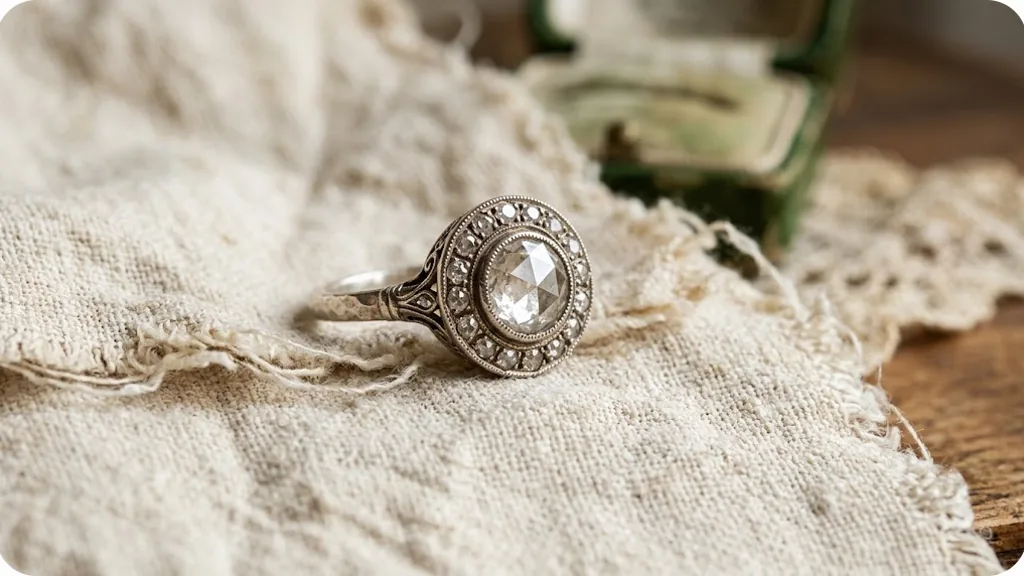
A rose cut is a flat-bottomed diamond with a domed top covered in triangular facets, arranged so they rise to a point like the petals of an opening rosebud. That is where the name comes from.
The crucial difference from a modern diamond is what is missing underneath. A modern brilliant has a pavilion — a cone-shaped bottom half that acts as a mirror, bouncing light back up through the top. A rose cut has no pavilion at all. Its base is flat.
Without that mirror, light does not ricochet around inside the stone the way it does in a brilliant. Instead you get a gentle, glassy shimmer that has been compared to candlelight or moving water. Rose cuts also have far fewer facets — typically somewhere between three and twenty-four, against 57 or 58 in a round brilliant.
The cut dates back to the 1500s, when diamonds were worked by hand and mostly seen by candlelight. It was designed for exactly those conditions, and it has been quietly beautiful in them ever since.
Are rose cut diamonds more expensive?
Per carat, rose cuts are generally less expensive than round brilliants of equivalent quality. But there are three specific situations where a rose cut ends up costing more, and they catch people out.
Why they usually cost less
The flat base is the whole story. A rose cut is shallow, so it spreads its weight sideways rather than downwards. That means:
- It looks much bigger than its carat weight. A rose cut can present a face-up size closer to a stone of considerably greater weight in a deep modern cut. You are paying for less material to cover more finger.
- It cuts efficiently from flat rough. Rough crystals that are too shallow to yield a decent brilliant can make an excellent rose cut. That is material that would otherwise be near worthless.
- Demand is niche. Rose cuts are a minority taste. Round brilliants are the most requested shape on earth, and popularity keeps prices firm.
Put together, rose cuts are one of the better value-per-visible-millimetre choices in diamond jewellery. Our Stackable Rose Cut Wedding Band in Sterling Silver is one of the most affordable pieces we make, and it does not look it.
The three times they cost more
1. Clarity has to be higher. This is the big one. A rose cut has few facets and no pavilion to scatter light, so you are effectively looking straight into the stone. There is nowhere for an inclusion — one of the small natural marks found inside every diamond — to hide.
On the clarity scale, which runs FL (flawless) at the top down through IF, VVS, VS, SI to I3 at the bottom, most buyers can happily use an SI1 in a sparkly brilliant cut and never see anything. In a rose cut, that same inclusion may be perfectly visible. You generally need to be at VS or better for a rose cut to look clean, and that grade costs more.
The same logic applies to colour on the D-to-Z scale. Fewer facets means less light bouncing about to disguise a warm tint, so a rose cut shows its body colour more honestly than a brilliant does.
2. Antique rose cuts are a different market entirely. Genuine period rose cuts from the 1700s or 1800s are collectable objects. Their price has nothing to do with grading scales and everything to do with rarity, age and how much someone wants that particular stone. Some are very expensive indeed.
3. Supply is thin. Far fewer rose cuts are produced than brilliants, so finding a specific size, shape and grade combination can take time. Scarcity of a particular stone can push its price up regardless of what the shape “should” cost.
| Rose cut | Round brilliant | |
|---|---|---|
| Facets | Roughly 3 to 24 | 57 or 58 |
| Bottom | Flat, no pavilion | Deep cone |
| Light effect | Soft glow, gentle shimmer | Bright fire and flashes |
| Size for the weight | Looks noticeably larger | Carries weight below |
| Clarity grade needed | Higher — VS or better | Lower — SI often fine |
| Price per carat | Usually lower | Usually highest of all shapes |
| Ring height | Low, sits close to the hand | Taller profile |
The practical advantages nobody mentions
Because a rose cut has no pointed pavilion, it sits low. A rose cut ring is one of the most comfortable things you can wear. It does not catch on jumpers, it slides under gloves, and it is far less likely to snag or knock than a tall solitaire.
That makes rose cuts an excellent choice for anyone who works with their hands, wears their ring every day without taking it off, or simply dislikes the feeling of a high setting.
Rose cuts also take beautifully to bezel settings — where a rim of metal wraps entirely around the stone rather than holding it with claws. A bezel protects the edges of a shallow stone and gives a clean modern outline. Our Bezel Rose Cut Eternity Band in Sterling Silver shows exactly why the two go together so well.
If you want the rose cut character in something with a more traditional engagement ring silhouette, the pear-shaped version in our Vintage Pear Rose Cut Engagement Ring combines the soft glow with a shape that reads instantly as bridal.
Rose cuts in lab-grown diamond
Lab-grown makes rose cuts far more accessible, for a specific reason.
The main obstacle to a good rose cut has always been that you need a clean stone, and clean rough is expensive. Because lab-grown rough costs a fraction of mined rough, the higher clarity grade a rose cut needs stops being a financial problem. You can have a VS-clarity rose cut without it being a luxury decision.
Lab-grown diamonds are chemically identical to mined ones and are graded on the same scales by the same laboratories. Every centre stone we set comes with a free IGI certificate confirming exactly that.
It is also worth saying plainly that lab-grown prices have fallen a long way and are still moving. Treat any specific price you see quoted anywhere as a snapshot of one moment.
Is a rose cut right for you?
Say yes if you like antique and vintage looks, want maximum visible size for your budget, prefer a low comfortable ring, or find modern brilliants a little too flashy.
Say no if sparkle is the whole point for you. A rose cut will never throw the fire a modern brilliant does — that is by design, not a defect, but it is not what everyone wants from a diamond. If you want maximum brightness, look at round brilliant pieces instead.
Frequently asked questions
Are rose cut diamonds cheaper than brilliant cuts?
Usually yes, per carat, and they look larger for their weight. The saving narrows because you generally need a higher clarity grade for a rose cut to look clean.
Do rose cut diamonds sparkle?
They shimmer rather than sparkle. Expect a soft, watery glow with occasional broad flashes, not the rapid fire of a modern brilliant.
Are rose cuts less durable?
They are the same material and the same hardness. The thin edge of a shallow stone is the vulnerable part, which is exactly why a bezel setting suits them so well.
Can I get a rose cut in any shape?
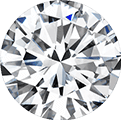
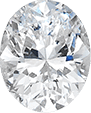
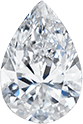
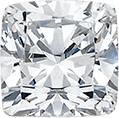
Yes — round, oval, pear, cushion and hexagon rose cuts all exist. We stock rose cut pieces and make bespoke ones at no extra design cost if you want a particular outline.
Will a rose cut hold its value?
All diamond jewellery, mined or lab-grown, should be bought to be worn rather than as an investment. Buy a rose cut because you love how it looks in daylight, which is the only test that matters.
Have a look through our wedding ring collection to see how rose cuts sit against modern brilliants in the metal. Everything is hand-made in London, delivered free and fully insured across the UK, with 30 days to send it back if it is not right.
More guides on this topic
Ready to find your perfect ring?
Explore our lab-grown diamond collection or book a virtual appointment with our team.