Are Square Cut Diamonds More Expensive? A Straight Answer
Princess, Asscher, radiant and square cushion compared on price, sparkle, durability and the clarity grade each one really needs.
Square diamonds have a particular kind of appeal. They look architectural, deliberate and modern, and they fill a finger in a way a round stone of the same weight does not. The obvious next question is whether all that costs extra.
The short answer is that square diamonds are usually less expensive per carat than round ones — but not all squares behave the same way, and one of them can end up costing you more in the long run for reasons that have nothing to do with the price ticket.
What counts as a square cut diamond
“Square cut” is not a single shape. It covers several, and they differ enormously in how they look and how they are priced.
| Shape | Outline | Faceting style | Look |
|---|---|---|---|
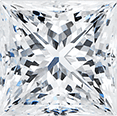
| Princess | Square with sharp corners | Brilliant — many small triangular facets | Fiery, sparkly, modern |
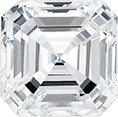
| Asscher | Square with cut-off corners | Step — long parallel facets | Art Deco, mirror-like, “hall of mirrors” |
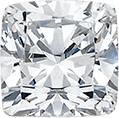
| Cushion (square) | Square with rounded corners | Brilliant | Soft, antique, warm sparkle |
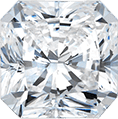
| Radiant (square) | Square with cut-off corners | Brilliant | Bright and lively, squarer than a cushion |
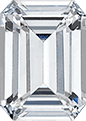
| Emerald (square) | Nearly square rectangle | Step | Clean, elegant, understated |
Two terms are doing the work there. A brilliant cut has lots of small facets arranged to bounce light back at you in flashes. A step cut has long, flat, parallel facets arranged like steps, which gives broad calm flashes of white light rather than fire. Step cuts look like looking into a hall of mirrors; brilliant cuts look like glitter.
Why square shapes usually cost less per carat
It comes down to what happens to the rough diamond crystal.
Diamond rough often forms in a shape called an octahedron — think of two pyramids joined base to base. Cutting a round brilliant from that means grinding away the corners and edges until you have a circle. A large amount of the original material ends up as dust. Estimates in the trade have long put the loss for a round brilliant at roughly half the rough weight.
A square outline fits that rough far more efficiently. The princess cut in particular was designed to get as much finished weight as possible out of a single crystal — you can effectively take two princess cuts from one octahedron. Less waste means a lower price per finished carat.
On top of that, demand plays its part. Round brilliants are far and away the most popular shape worldwide, and popularity keeps prices firm. Square shapes have their admirers but nothing like the same volume.
Put those together and a square stone of the same carat weight, clarity and colour generally sits below the equivalent round. The gap is real but moderate — shape shifts the price by a noticeable margin, not by half.
The catch with step-cut squares
There is one important exception, and it costs money.
Step cuts such as Asscher and emerald have long open facets and no glitter to distract the eye. That is exactly what makes them elegant — and it also means there is nowhere for an inclusion to hide. An inclusion is a small natural mark inside the diamond, and every diamond has some.
In a princess or radiant cut, all those small facets scatter light and disguise a minor inclusion. In an Asscher, you are looking straight down through clear open windows. A mark that would vanish in a brilliant cut sits there in plain sight.
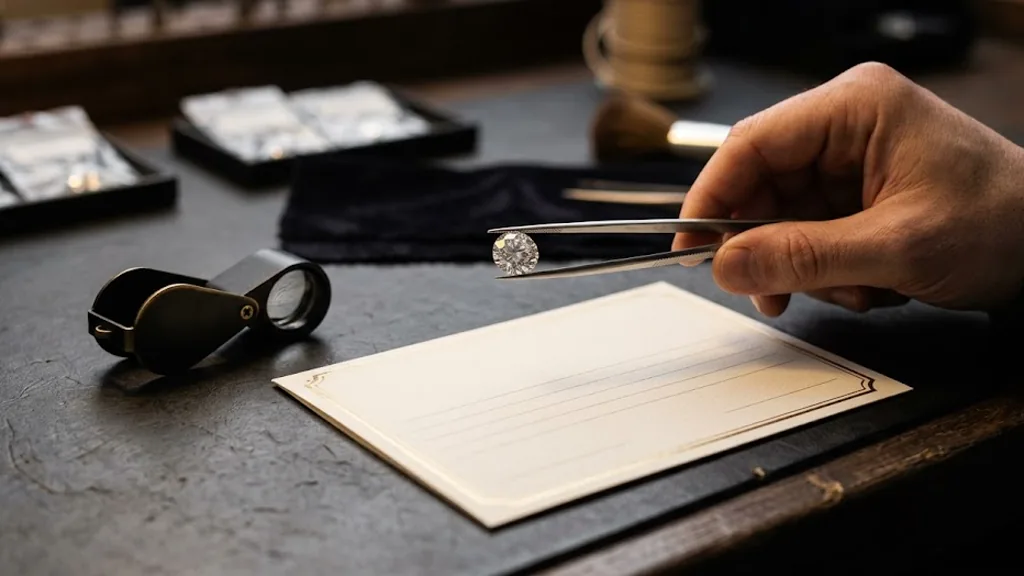
So with step-cut squares you generally need to buy a grade or two higher on clarity to reach the same eye-clean result. On the FL to I3 clarity scale, where FL is flawless and I3 is heavily included, you would typically want VS1 or better in an Asscher, where SI1 might be perfectly fine in a princess.
Step cuts are also less forgiving on colour. Open facets show a warm tint more readily than a brilliant cut does, so the same logic applies to the D to Z colour scale: aim a grade higher than you would for a sparkly shape, or set it in yellow gold where warmth reads as intentional.
Our Stackable Asscher Cut Wedding Band in Yellow Gold is a good illustration of that principle in practice — the yellow metal and the step facets work together rather than fighting each other.
Are square diamonds more expensive to set?
Slightly, and it depends which square.
Princess cuts have four sharp, unprotected corners. Diamond is the hardest material there is, but hardness is not the same as toughness — a sharp corner can chip if it catches a door frame. Good princess settings use V-shaped claws that wrap over each corner, which takes more work than the simple round claws used on a round stone.
Asscher, radiant and emerald cuts have their corners already cut off, which removes that weak point entirely. They are among the more robust shapes for everyday wear.
Square stones also need a square seat cutting into the setting, which is a little more bench time than a round seat. In the context of a hand-made ring the difference is small, but it exists.
Do square diamonds look bigger?
Not usually. This is where the value story gets more complicated.
Princess cuts are cut deep — that is part of how they save weight from the rough. Weight carried below the setting is weight you cannot see. So a 1.00ct princess often presents a smaller face than a 1.00ct round, even though it costs less.
Emerald and Asscher cuts are the opposite. They are relatively shallow, so they spread their weight across the top and can look noticeably larger than their carat weight suggests. If maximum visible size for the money is the aim, a step cut is one of the best value choices available — which is part of the appeal of pieces like our Solitaire Emerald Cut Engagement Ring and the three-stone version, our Three Stone Emerald Cut Engagement Ring.
Does any of this change with lab-grown diamonds?
The relationships stay the same, but the numbers shrink. A lab-grown diamond is the same material as a mined one, graded on the same scales by the same laboratories, and it is cut from rough in the same way with the same yield losses. So a square lab-grown stone still costs less per carat than a round lab-grown stone.
What changes is the size of the decision. When the whole stone budget is a few hundred pounds rather than a few thousand, the choice between shapes stops being a financial agony and becomes a straightforward matter of taste. That is genuinely one of the better things about lab-grown: you get to buy the shape you actually want.
Lab-grown prices have fallen a great deal and continue to move, so treat any specific figure you read — anywhere — as a snapshot rather than a rule.
Frequently asked questions
Are princess cut diamonds cheaper than round?
Yes, generally, for the same carat weight and grades. The princess cut wastes far less of the rough crystal and is less in demand. Just remember it may look slightly smaller face-up because it carries more depth.
Is an Asscher cut more expensive than a princess?
Often, once you account for the higher clarity and colour grades an Asscher needs to look its best. The cutting itself is also more exacting, because crooked step facets are impossible to hide.
Do square diamonds sparkle less?
Brilliant-faceted squares — princess, radiant, square cushion — sparkle every bit as much as a round. Step cuts sparkle differently: broad flashes of white light rather than rapid fire. Neither is better, they are just different effects.
Are square diamonds harder to wear day to day?
Only princess cuts, because of the sharp corners, and a well-made setting solves that. Asscher, radiant and emerald cuts have clipped corners and wear extremely well.
Do you stock princess cut?
Not at the moment. We stock Asscher, emerald, radiant and cushion, and we make bespoke pieces at no extra design cost — so if a princess is what you want, we can source the stone, supply its free IGI certificate and hand-make the ring in our North Harrow workshop.
Square diamonds reward buyers who look past the round-brilliant default. Have a look at our emerald cut collection or the wider engagement ring range to see how the shapes compare in the metal. Free insured UK delivery, 30-day returns, and a free IGI certificate on every centre stone.
More guides on this topic
Ready to find your perfect ring?
Explore our lab-grown diamond collection or book a virtual appointment with our team.