
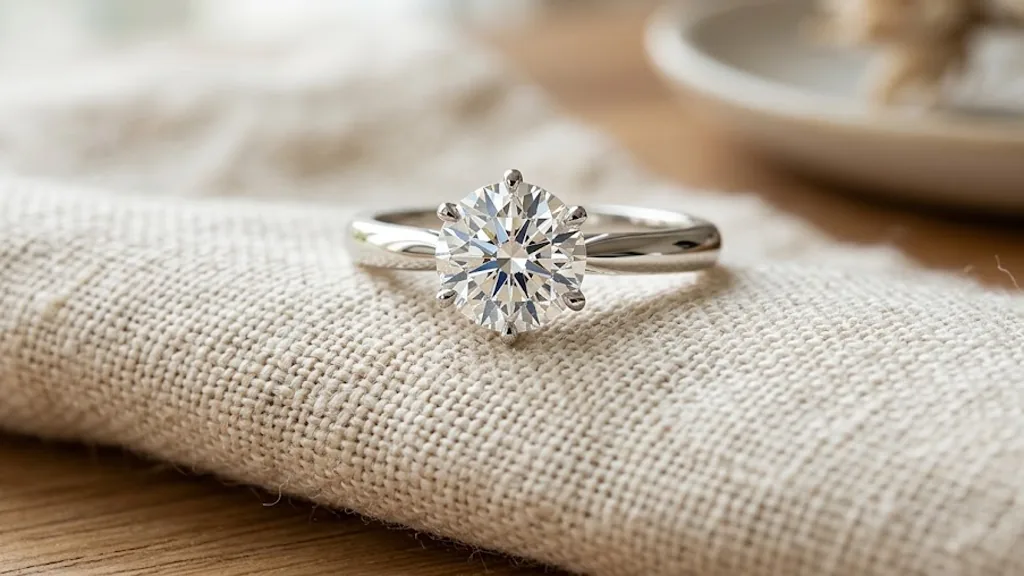
Are Square Diamonds Cheaper Than Round? Diamond Shape and Price Explained
Square diamonds usually cost less per carat than round. Here is why, which shapes are cheapest, and the size trap to avoid.
Yes — square diamonds are generally cheaper than round ones of the same carat weight, colour and clarity. That is one of the most reliable patterns in diamond pricing, and it holds for lab-grown diamonds as well as natural ones. But the reason why is more interesting than the fact itself, and understanding it will save you money on any shape you choose.
Why round diamonds cost the most
Rough waste
Diamond crystals grow in an octahedral form — think of two four-sided pyramids joined base to base. Cutting a round brilliant from that shape means grinding away a great deal of material to get from an angular crystal to a perfect circle.
Square and rectangular shapes follow the crystal more closely. Less of the original material ends up as dust. Since the cutter has paid for the whole crystal, whatever gets wasted has to be recovered in the price of the finished stone. Round brilliants waste the most, so they cost the most per carat.
Demand
Round is by far the most requested shape for engagement rings. Consistent, heavy demand supports a consistent premium. Shapes that go in and out of fashion — marquise, pear, emerald — tend to be gentler on price.
Cutting precision
Round brilliants are the only shape with a formal, universally applied cut grade. Achieving an Excellent cut grade takes precision, and precision costs money. Fancy shapes — the trade term for everything that is not round — are graded on polish and symmetry but not on overall cut quality, which gives cutters more latitude.
How the shapes usually rank on price
The following is a rule of thumb used across the trade, not a measured figure, and it describes price per carat at comparable colour and clarity. Individual stones vary enormously.
| Shape | Typical price per carat | Why |
|---|---|---|
| Round brilliant | Highest | Most rough wasted, highest demand |
| Princess / square brilliant | Lower than round | Follows the crystal closely, little waste |
| Cushion | Lower than round | Good yield, softened corners |
| Oval | Slightly below round | Popular, but better yield |
| Radiant | Lower than round | Good yield from the rough |
| Emerald / Asscher | Among the lowest | Step cuts use the crystal efficiently |
| Marquise / pear | Among the lowest | Efficient yield, less mainstream demand |
| Baguette / rose cut | Low | Shallow, efficient, usually used as accents |
The bigger saving nobody mentions: face-up size
Price per carat is only half the picture. What you actually care about is how much diamond you can see when the ring is on your finger.
Carat measures weight, not width. Some shapes carry their weight where you can see it; others hide it underneath the setting. Elongated shapes — marquise, pear, oval, emerald — spread their weight across the top of the stone, so they look larger per carat. Deep shapes such as cushion and princess hide more weight below.
Put the two effects together and the result is striking. A 1ct marquise costs less per carat than a 1ct round and covers noticeably more of your finger. If visible size is your priority and budget is finite, an elongated fancy shape is the most efficient purchase you can make.
| Shape | Visible size for the carat weight |
|---|---|
| Marquise | Largest |
| Pear | Very large |
| Oval | Large |
| Emerald | Large |
| Round | Average |
| Radiant | Slightly below average |
| Princess | Below average face-up, larger across the diagonal |
| Cushion | Smallest |
| Asscher | Small |
Does the same apply to lab-grown diamonds?
Yes, the pattern is the same, because it comes from how a rough crystal is cut — and lab-grown diamonds are cut and polished by the same people, using the same equipment, from crystals with the same structure.
The difference is that the price gaps between shapes tend to be less dramatic with lab-grown stones, because the underlying cost of the rough is a smaller part of the finished price. On a lab-grown diamond, the labour of cutting, the setting, the metal and the certification make up more of what you pay.
All our centre stones are lab-grown and come with a free IGI certificate. That means you can compare shapes on a like-for-like basis without the price of the rough distorting everything.
What this means in practice
If you want the absolute maximum sparkle and nothing else will do, buy a round. Nothing else returns light as well, and you should accept that you are paying for it.
If you want the largest-looking stone for your budget, look at marquise, pear or oval. Our Solitaire Marquise Cut Engagement Ring is £538 at the time of writing and reads considerably larger on the hand than its weight suggests.
If you want a clean, geometric, architectural look, an emerald cut is usually the best value of the step cuts. The Solitaire Emerald Cut Engagement Ring is £672 at the time of writing.
And if you simply like the classic, the Solitaire Round Cut Engagement Ring in White Gold starts at £563 at the time of writing — proof that a round need not be the expensive option once you are buying lab-grown.
One honest note: we do not stock princess cut rings. If you want a true square brilliant, we will make one as a bespoke commission at no extra design cost. For a square look from stock, an Asscher cut or a cushion cut is the closest we hold.
Frequently asked questions
Are square diamonds cheaper than round for the same size on the finger?
Less so than the headline suggests. A square stone is cheaper per carat, but it also looks smaller face-up than its weight implies, so you may need a heavier stone to match a round visually. Compare millimetre measurements, not carat weights.
Which diamond shape is the cheapest overall?
Among the shapes commonly used as centre stones, emerald, asscher, marquise and pear are usually the least expensive per carat. Rose cuts and baguettes are cheaper still but are shallow shapes normally used as accents rather than solitaires.
Is a cheaper shape a lower-quality diamond?
No. Price differences between shapes come from how much rough is wasted and how much demand there is — not from the quality of the stone. A well-cut emerald at a lower price per carat is not a compromise.
Does the metal change the price much?
Platinum is denser and more expensive than gold, so a platinum ring will normally cost more than the same design in 14k or 18k gold. The difference is in the mount, not the stone.
How can I compare two stones fairly?
Look at three things on the certificate: the millimetre measurements, the colour grade and the clarity grade. Then look at the stone itself in daylight. Carat weight alone tells you very little about how a ring will look.
Where to go from here
Browse the full engagement ring collection and use the shape filters to compare, or read our guide to princess cut versus round diamonds if you are weighing up those two specifically. Free insured UK delivery, 30-day returns, and every ring hand-made in North Harrow.
Ready to find your perfect ring?
Explore our lab-grown diamond collection or book a virtual appointment with our team.











