
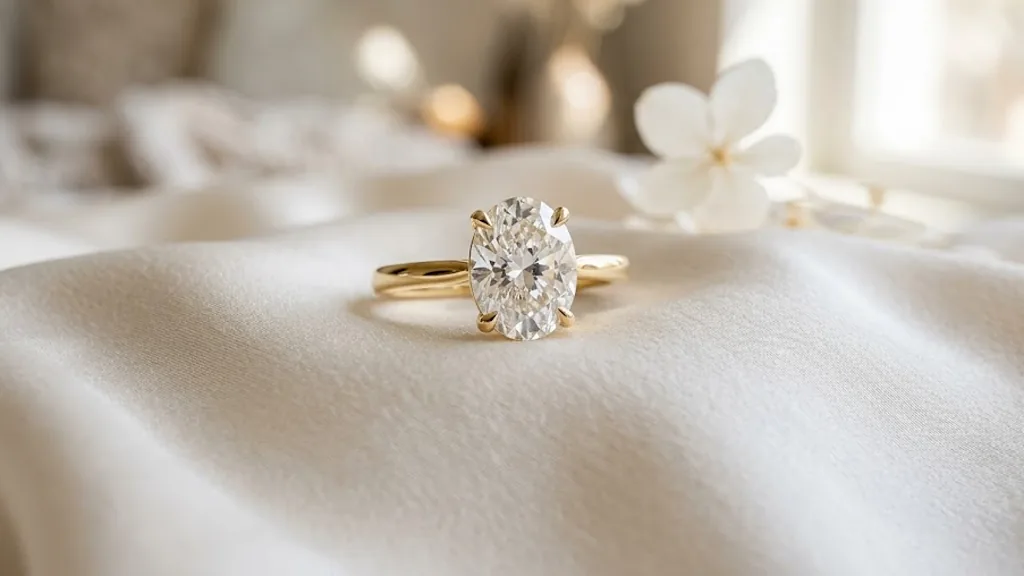
Do Oval or Round Diamonds Look Bigger?
Ovals look bigger than rounds of the same carat weight. Here is why, by how much, and what you give up in return.
Short answer: an oval looks bigger. Put a 1 carat oval next to a 1 carat round and the oval will look like the larger stone, even though the scales say they weigh exactly the same.
That surprises a lot of people, so it is worth explaining properly. Once you understand why it happens, you can use it to get a ring that looks generous without pushing your budget up.
Why weight and size are not the same thing
Carat is a measure of weight, not width. One carat is 0.2 grams. So when a jeweller says “one carat”, they are telling you how heavy the diamond is, not how big it looks on your hand.
What you actually see when you look down at a ring is the top surface of the stone. Jewellers call that the “face-up” size or the “spread”. Two stones of identical weight can have very different spreads, depending on how the cutter shaped them.
A round diamond is cut to a fairly strict formula, because that formula is what produces its famous sparkle. Part of that formula is depth — a good round brilliant carries a fair amount of its weight below the surface, where you cannot see it.
An oval is an elongated shape. Stretching a diamond out means more of its weight sits in length rather than depth. The result is a wider, longer top surface for the same weight.
The actual measurements
Here is roughly how the two compare at common sizes. These are typical well-cut proportions, and individual stones vary.
| Carat weight | Round — approx. size | Oval — approx. size | What you notice |
|---|---|---|---|
| 0.50ct | 5.1mm across | 6.5 × 4.3mm | Oval reads slightly longer |
| 1.00ct | 6.5mm across | 7.7 × 5.7mm | Oval clearly looks bigger |
| 1.50ct | 7.4mm across | 9.0 × 6.5mm | Oval covers noticeably more finger |
| 2.00ct | 8.1mm across | 10.0 × 7.0mm | Oval looks close to a larger round |
Look at the 1 carat row. The oval is about 1.2mm longer than the round is wide. That does not sound like much written down, but your eye is very good at judging length across a finger, and 1.2mm is easily visible.
There is a second effect on top of the measurements. The long axis of an oval points down the length of your finger, which draws the eye and makes the whole hand look longer and slimmer. Rounds sit as a neat dot. Ovals stretch.
So is an oval always the better buy?
No — and this is where honest advice matters more than a simple rule.
You get the extra spread for a reason: the cutter kept more of the rough diamond in width and less in depth. That is efficient, but it comes with two things you should know about.
The bow tie
Nearly every oval has a faint darker area across its middle, shaped a little like a bow tie. It is caused by the stone’s own facets blocking light in that area. A slight bow tie is normal and most people never notice it. A strong one looks like a dark stripe and never goes away.
You cannot see this on a certificate. You have to look at the actual stone, face-up, in ordinary daylight. Ask for a photo or video of the exact diamond. Any decent jeweller will send one.
Sparkle character
A round brilliant is the most efficient sparkler ever designed. Every proportion has been optimised for return of light. An oval is a brilliant cut too, so it sparkles plenty — but a top round will still out-sparkle a top oval, particularly in dim restaurant lighting.
If someone wants maximum fire above all else, a round is still the answer. If they want presence and elegance, an oval wins.
Price: the part that decides it for most people
Round diamonds are the most expensive shape per carat. There are two reasons. First, more of the original rough crystal is cut away to make a round, so there is more waste. Second, rounds are the most requested shape by a wide margin, and demand sets price.
Ovals are generally cheaper per carat than rounds of the same colour and clarity. Combine that with the extra face-up spread and the effect compounds: your money buys a stone that is both slightly cheaper and looks slightly bigger.
This is true for lab-grown and natural diamonds alike, though the pounds involved are very different. A lab-grown diamond is a real diamond — identical carbon, identical hardness, grown in a laboratory rather than underground — and it costs a fraction of the natural equivalent. All CarbonstoneUK centre stones are lab-grown and come with a free IGI certificate, so the grades are independently verified rather than simply claimed.
Length-to-width ratio: how to control the look
Ovals are not all the same shape. The ratio of length to width changes the whole character of the ring, and it is the single most useful thing to specify when you order.
| Ratio | How it looks | Best for |
|---|---|---|
| 1.30 – 1.35 | Rounded, almost egg-shaped | People who like ovals but want a softer look |
| 1.35 – 1.45 | The classic balanced oval | Most buyers — the safest choice |
| 1.45 – 1.55 | Long and elegant | Making the finger look longer; maximum spread |
| Over 1.60 | Very stretched and distinctive | A deliberate, unusual look |
If your aim is purely “looks as big as possible”, go for 1.45 to 1.55. If you want the oval to still feel classic, stay near 1.40.
Settings that make either shape look larger
The setting can add as much apparent size as a quarter of a carat, and it costs far less.
- A halo. A ring of tiny diamonds around the centre stone. It genuinely makes the stone read a size or two larger from a normal viewing distance. The Hidden Halo Oval Cut Engagement Ring uses a halo tucked underneath instead, so it lifts the stone and adds sparkle from the side without changing the outline.
- A slim band. The narrower the band, the bigger the stone looks by contrast. A clean Solitaire Oval Cut Engagement Ring shows how much presence a simple shank gives the centre stone.
- Side stones. Two stones either side extend the whole design along the finger. Our Three Stone Oval Cut Engagement Ring is a good example of that trick.
- Thin claws. Fine claws cover less of the diamond than heavy ones, so more stone shows.
Which should you choose?
Use this as a quick guide:
- Choose an oval if you want the largest look for the budget, you like elongated and elegant, or you have shorter fingers and want a lengthening effect.
- Choose a round if sparkle is the priority, you want the most classic and timeless outline, or you would rather not spend time hunting for a stone without a noticeable bow tie.
Neither is a mistake. They are simply different personalities. If you are torn, remember that this ring gets worn every day for decades — pick the one that makes you smile when you glance down, not the one that wins on paper.
Frequently asked questions
How much bigger does an oval look than a round of the same weight?
Meaningfully, but not dramatically. At one carat, an oval is typically about 7.7mm long against a round’s 6.5mm width. Most people read that as roughly a quarter-carat step up in apparent size.
Are oval diamonds less sparkly?
Slightly. Ovals are brilliant cuts and sparkle well, but the round brilliant is the most optically efficient shape there is. In bright daylight you would struggle to tell. In low light a round holds its sparkle a little better.
What is a bow tie, and should I worry about it?
It is a darker band across the middle of an oval, caused by how light travels through the stone. A faint one is completely normal. A strong one is a flaw you will notice forever. Always view the specific stone, ideally on video, before buying.
Do ovals cost less than rounds?
Usually yes, per carat, because they waste less of the rough crystal and demand for rounds is higher. The saving varies by size and quality, but it is real.
Are oval diamonds more fragile?
The two pointed ends are the thinnest part, so they need claws that cover them properly. Well set, an oval is perfectly hard-wearing. Diamond is the hardest material used in jewellery, whether it grew underground or in a laboratory.
Have a look for yourself
Photographs flatten everything, so the best way to decide is to see the two shapes in the same style of setting. Browse our engagement ring collection to compare, or narrow it down to the oval cut rings if you have already fallen for the shape.
Everything is hand-made to order in solid gold or platinum from our North Harrow workshop in London, with a free IGI certificate on the centre stone, free insured UK delivery and 30-day returns. If you cannot see the exact combination you want, our bespoke service carries no extra design cost — tell us the shape, the ratio and the budget, and we will work to it.
More guides on this topic
Ready to find your perfect ring?
Explore our lab-grown diamond collection or book a virtual appointment with our team.











