How Much Are Lab Diamonds Worth? Buying Price, Resale Value and Insurance
Three different numbers: what a lab diamond costs, what it resells for, and what to insure it for. Honest answers with real prices.
“How much are lab diamonds worth?” is really three different questions wearing one coat. What does one cost to buy? What would I get if I sold it? And what figure goes on my insurance policy?
Those three numbers are very different, and mixing them up is how people end up disappointed. Here is a straight answer to each.
1. What a lab-grown diamond costs to buy
A lab-grown diamond costs substantially less than a natural diamond of comparable size, cut, colour and clarity. We are not going to quote a percentage, and you should be sceptical of anyone who does — the gap has moved a great deal in recent years and any fixed figure is out of date almost immediately.
The reason for the gap is supply. Natural diamond supply is limited by geology and by what is economic to mine. Lab-grown supply responds to demand and improves as growth technology improves. Prices have fallen accordingly, particularly in the larger sizes where CVD growth has improved most.
To give you something concrete rather than a range, here is what real, complete, hand-made rings cost from us. These are finished pieces in solid metal with a certificated lab-grown centre stone, not loose stones. All prices correct at the time of writing.
| Ring | Style | Price |
|---|---|---|
| Stackable Pear Cut Engagement Ring | Pavé, pear | £503 |
| Solitaire Round Cut Engagement Ring in White Gold | Solitaire, round | £563 |
| Solitaire Round Cut Engagement Ring | Solitaire, round | £657 |
| Three Stone Oval Cut Engagement Ring | Three stone, oval | £1,021 |
| Halo Marquise Cut Engagement Ring in White Gold | Halo, marquise | £1,143 |
Note how much of the spread comes from the setting rather than the stone. A three-stone or halo design uses more diamonds and considerably more hand labour than a solitaire.
What actually drives the price
The same four Cs that price a natural diamond price a lab-grown one, in roughly this order of impact.
Carat weight
The biggest single factor, and it does not scale evenly. A two-carat stone costs far more than twice a one-carat, because larger crystals are harder to grow cleanly and more rough is lost in cutting. There are also price jumps at round numbers — a stone just under 1.00 carat can cost noticeably less than one just over, for a difference in diameter you cannot see. Buying a 0.90 rather than a 1.00 is one of the easiest savings available.
Cut
Cut grade affects price because a well-proportioned stone wastes more rough. It is also the only grade that genuinely changes how much the diamond sparkles, so it is the last place to economise.
Colour and clarity
Both affect price, and both are heavily over-bought. Beyond roughly VS2 clarity and G to H colour, you are paying for grades nobody can see on a hand. Our guide to the best clarity for a lab-grown diamond covers where to stop.
Shape
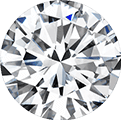
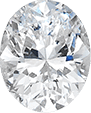
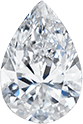
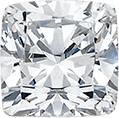
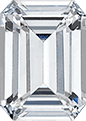
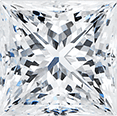
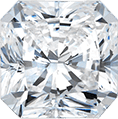
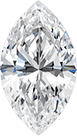
Round brilliants are the most expensive per carat, because they waste the most rough and demand the most precision. Fancy shapes — oval, pear, marquise, emerald — generally cost less per carat and often look larger for the same weight because they spread wider across the finger.
The setting
Easy to forget when you are focused on the stone. Metal choice, the number of accent diamonds, and the hours of hand work all add up. Platinum costs more than gold and is heavier. A pavé band with dozens of set stones is far more labour than a plain one.
2. What a lab-grown diamond is worth if you sell it
Considerably less than you paid. We would rather tell you this before you buy than after.
Expect a small fraction of the retail price if you sell a lab-grown diamond second-hand, and be aware that some traders will not buy them at all.
Two things are worth understanding about that.
First, this is not unique to lab-grown. The gap between retail and resale is wide for almost all jewellery, natural diamonds very much included. Retail price covers cutting, certification, hand fabrication, insurance, premises, staff and profit. None of that comes back when you sell. Buyers who try to sell a natural diamond ring are frequently shocked by the offers too.
Second, lab-grown prices have been falling. A stone bought two years ago competes against cheaper new stock today. That adds a downward pressure natural diamonds do not have to the same degree.
The conclusion is simple. Do not buy a diamond of any origin as an investment. Buy it because you want to wear it for the next forty years, in which case the resale number never comes up.
3. What it is worth for insurance
Different again — and this one is usually higher than what you paid, not lower.
Insurance valuations are normally written on a replacement basis: what it would cost to have an equivalent piece made today, at retail, from a similar jeweller. That figure can exceed your purchase price, especially if metal prices have risen.
To insure a lab-grown diamond ring you will typically need:
- The grading certificate — every centre stone we sell comes with a free IGI certificate
- Your purchase receipt
- For higher values, an independent valuation, usually reviewed every few years
Make sure the valuation states clearly that the stone is laboratory-grown. A valuation that implies a natural stone is inaccurate, and an inaccurate valuation is a problem at claim time, not at purchase time.
Getting the most stone for your money
If value is the goal, these are the moves that actually work, in order:
- Buy just under a round carat weight. 0.90 instead of 1.00, 1.90 instead of 2.00. Invisible difference, real saving.
- Choose a fancy shape. Oval, pear and marquise cost less per carat and look larger on the finger than a round of the same weight.
- Stop at eye-clean. VS2, or SI1 in a brilliant cut. Never pay for VVS.
- Match colour to metal. I or J colour looks perfectly white in yellow or rose gold and costs less than G.
- Never compromise on cut. This is the one that decides whether the ring looks alive.
- Consider a three-stone or halo design. Several smaller stones can give more visual size than one larger one for the same money.
Frequently asked questions
Do lab-grown diamonds hold their value?
No, and neither does most jewellery. Treat any diamond ring as a purchase, not an asset.
Why do lab-grown diamond prices keep dropping?
Production capacity has grown and the technology has improved, particularly for larger CVD stones. More supply at lower cost means lower prices. Good news if you are buying now.
Is a cheap lab-grown diamond a red flag?
Not by itself — the whole point is that they cost less. What matters is whether there is an independent certificate from a laboratory you can verify online. No certificate, no confidence.
Will a valuer recognise a lab-grown diamond?
Yes. The certificate states the origin and the girdle is laser-inscribed with the report number and wording identifying it as lab-grown. See do lab-grown diamonds test as real diamonds.
Are your prices for the ring or just the stone?
The complete, finished ring — hand-made in solid gold or platinum, with the certificated lab-grown centre stone set, plus free insured UK delivery.
See what your budget buys
Browse the engagement ring collection or the wedding rings and eternity bands. Everything is hand-made in North Harrow, London, with a free IGI certificate on the centre stone, free insured UK delivery and 30-day returns.
If nothing matches what you have in mind, our bespoke service carries no extra design cost — tell us the budget and we will tell you honestly what it will buy.
Ready to find your perfect ring?
Explore our lab-grown diamond collection or book a virtual appointment with our team.