What Is the Best Clarity for a Lab-Grown Diamond?
VS1 to VS2 is the sweet spot for a lab-grown centre stone. Here is why, how shape changes it, and whether clarity matters in small stones.
Clarity is where most diamond budgets get quietly wasted. It is the one grade nobody can see without a loupe, and it is the one buyers most often over-buy because a higher letter feels safer.
This guide gives you a direct recommendation for lab-grown diamonds, explains why the answer changes with shape and size, and answers the related question we get asked constantly: does clarity even matter in the small stones set around a band or a halo?
The short answer
For a lab-grown centre stone, VS1 or VS2 is the sweet spot. That gives you a diamond that is comfortably eye-clean, has no visible issues under casual inspection, and does not charge you for perfection that only a laboratory can detect.
SI1 is often perfectly good too, especially in a round brilliant, but it needs checking rather than assuming. Anything above VS1 — VVS or Flawless — is money spent on paperwork rather than appearance.
The clarity scale, quickly
| Grade | Meaning | Our verdict for lab-grown |
|---|---|---|
| FL / IF | Flawless / Internally Flawless | No visible benefit. Skip. |
| VVS1 / VVS2 | Very, very slightly included | Lovely, but invisible improvement over VS. |
| VS1 / VS2 | Very slightly included | The recommendation. Reliably eye-clean. |
| SI1 | Slightly included | Often eye-clean. Check the plot or the stone. |
| SI2 | Slightly included | A gamble. Sometimes clean, often not. |
| I1 – I3 | Included | Visible inclusions. Avoid for a centre stone. |
Everything hinges on the phrase eye-clean: no inclusion visible to normal vision at about 25 to 30 centimetres, looking at the stone face-up. That is the only clarity test that affects how your ring looks in real life.
Why the answer differs for lab-grown diamonds
With natural diamonds, high clarity is scarce and priced accordingly, so buyers are pushed down the scale to afford the size they want. Lab-grown diamonds flip that pressure. Because supply is not limited by what geology happened to produce, VS material is widely available and the price gap between SI and VS is far less punishing.
The practical consequence: there is rarely a good reason to buy a borderline lab-grown stone. If you were prepared to accept SI2 in a natural diamond to afford the carat weight, you can usually have VS2 in a lab-grown stone at the same size and budget.
Lab-grown diamonds also tend to have slightly different inclusion types. HPHT-grown stones can contain tiny metallic flux inclusions, which are dark and therefore easier to spot than a colourless crystal of the same size. CVD-grown stones more often show faint internal graining, which is usually invisible. Neither changes the grading scale — both are graded exactly as natural stones are — but it does mean the plot diagram is worth a proper look.
Shape changes the recommendation
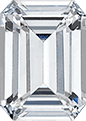
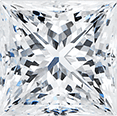
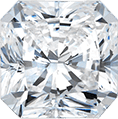
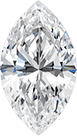
How a diamond is faceted decides how well it hides its inclusions. This matters more than any other factor.
| Shape | Faceting style | Suggested minimum clarity |
|---|---|---|
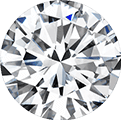
| Round brilliant | Brilliant — hides best | SI1 |
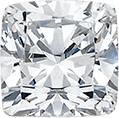
| Cushion, radiant | Brilliant, crushed-ice style | SI1 |
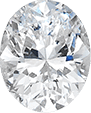
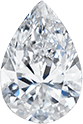
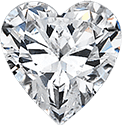
| Oval, pear, marquise, heart | Brilliant, elongated | VS2 |
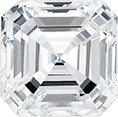
| Emerald, asscher, baguette | Step cut — hides worst | VS1 |
| Rose cut, hexagon | Open, fewer facets | VS1 |
Step cuts are the ones to be careful with. Long, open, parallel facets act like a series of mirrors and windows into the stone, so a feather that would vanish in a round brilliant is plainly visible. If you are drawn to a design like our Hidden Halo Emerald Cut Engagement Ring at £1,016 (correct at the time of writing), spend the extra on clarity rather than on carat weight.
Does clarity matter in small diamonds?
This is the question behind every pavé band, halo and eternity ring. The honest answer is: much less than you would think, and in most cases not at all.
Here is why. Clarity is judged at 10x magnification, and the grade is relative to the size of the stone. An inclusion that would be an SI2 problem in a two-carat diamond is a fraction of a millimetre across. Put that same inclusion in a 1.5 mm accent stone and it is beyond the resolving power of the human eye entirely.
Small stones also work differently in a design. They are set in groups, close together, moving constantly, and surrounded by reflective metal. Your eye reads the row as a line of light, not as individual diamonds. Nobody inspects the third stone from the left on a pavé shoulder.
What to look for in small stones instead
If you are assessing a pavé band or halo, these four things genuinely affect how it looks, and none of them is clarity:
- Consistency of colour. A row of melee that varies in tint looks patchy. This shows far more readily than any inclusion.
- Even cutting and matched sizes. Small stones that vary in diameter make a line look wobbly.
- Setting quality. Straight, evenly spaced beads or claws are what make a pavé band look expensive. Poor setting is the number one giveaway of a cheap ring.
- Security. A well-set small stone stays put. Ask how the stones are held — bead-set, channel-set or bezel-set — because that determines how likely you are to lose one.
You will notice that accent stones are usually described by a range such as “VS–SI, G–H colour” rather than an individual grade. That is normal and not a red flag. Melee is bought and sold in parcels, and grading each 1.3 mm stone individually would cost more than the stones. What matters is that the seller states the range and that the parcel is consistent.
Our Stackable Round Cut Full Eternity Band at £707 and Pavé Baguette Cut Wedding Band at £690 (both correct at the time of writing) are good examples — the effect comes from the setting and the matching of the stones, not from any individual grade.
The one exception
Baguette and emerald-cut accent stones are step cuts, so they are more revealing than round melee even at small sizes. If a design uses larger baguettes as visible side stones rather than tiny pavé, clarity is worth a little more attention.
How to spend the money instead
If you free up budget by not buying VVS, this is where it does visible work, in order:
- Cut grade. Excellent or Ideal. This is what creates sparkle and no other grade compensates for it.
- Setting and craftsmanship. Solid gold or platinum, well-finished claws, a comfortable band. This is what you feel every day.
- Colour, matched to your metal. G to H for platinum and white gold; I to J looks perfectly white in yellow or rose gold.
- Carat weight. The most noticeable difference of all, and the last place to compromise.
Frequently asked questions
Is VS2 good enough for an engagement ring?
Yes. VS2 is eye-clean in the overwhelming majority of stones and in every shape. It is the grade we would recommend to a friend.
Is SI1 a mistake?
Not at all, in a brilliant cut. Just verify it rather than assuming — look at the plot diagram for anything large or centrally placed, and specifically for the word “cloud”, which can make a stone look hazy even at a respectable grade.
Should I pay more for VVS or Flawless in a lab-grown diamond?
Only if the certificate itself matters to you. There is no visible difference between VVS2 and VS1 on a hand, at any size we sell.
Do the small diamonds in a halo or pavé come with certificates?
Individually, no — that is true across the industry. Only the centre stone is separately certificated. Every centre stone we set comes with a free IGI certificate.
Does clarity affect durability?
Only in the included grades. A large feather reaching the surface is a genuine weak point. At VS and SI there is no practical durability concern.
Have a browse
Every centre stone we set is an untreated lab-grown diamond with a free IGI certificate, hand-made into solid gold or platinum in North Harrow, London. Free insured UK delivery, 30 days to return, and bespoke design at no extra design cost if you want something we do not stock.
Start with the engagement rings or the wedding rings and eternity bands. To go deeper, read how diamond clarity is judged and how to see it yourself.
More guides on this topic
- How Is Diamond Clarity Measured? Inside the Grading Process
- What Do Diamond Colour and Clarity Mean? The 4Cs in Plain English
- What Clarity of Diamond Is Eye Clean?
- VS2 and SI1 Diamond Clarity: What They Mean and How They Look
- What Is the Difference Between VVS and VS Diamond Clarity?
- Clarity Enhanced Diamonds: What They Are, How to Spot One, and Whether They Last
Ready to find your perfect ring?
Explore our lab-grown diamond collection or book a virtual appointment with our team.