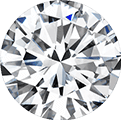
How Much Is a Half Carat Round Diamond Worth? The Complete Guide
What a 0.50ct round diamond is worth, how big it looks, lab-grown vs natural pricing, and how to make a half carat look larger.
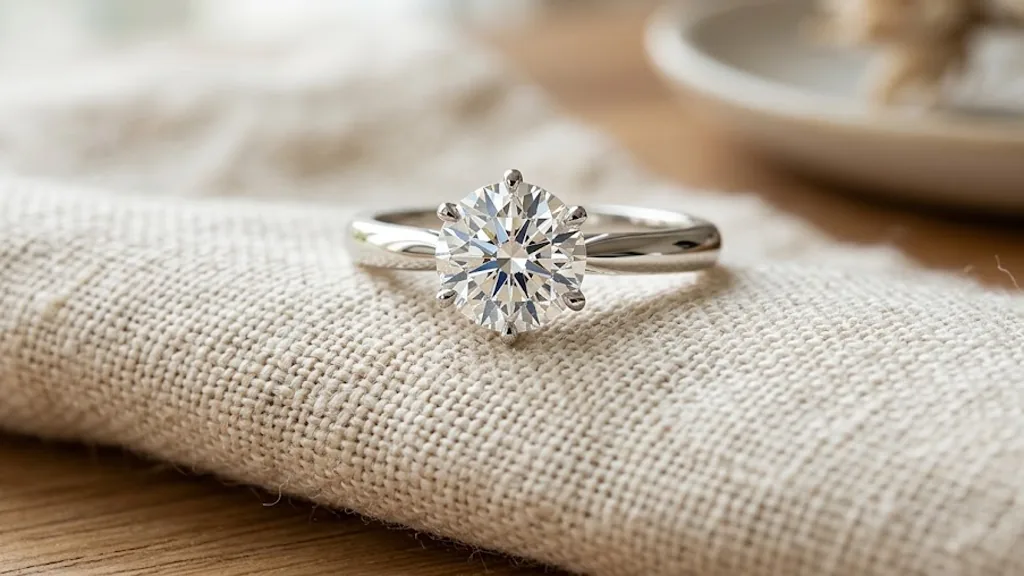
A half carat round is the quiet workhorse of British engagement rings. It is big enough to be unmistakably a diamond ring, small enough to wear every day without thinking about it, and it sits at a price point most couples can actually reach without borrowing.
This guide explains what a half carat round is worth, why the answer changes so much depending on the stone, and how to make sure you are not overpaying for grades nobody can see.
What “half carat” means in real terms
A carat is a unit of weight. One carat is 0.20 grams, so half a carat is 0.10 grams. It is written as 0.50ct.
On the finger, a well-cut half carat round measures roughly 5.0mm to 5.2mm across the top. For comparison, a one carat round is about 6.4mm. So halving the weight does not halve the width — a 0.50ct is around 80% the diameter of a 1.00ct.
That is the single most useful fact in this article. You give up a fifth of the width and a much larger share of the price. For many buyers that is the best trade in diamond buying.
What is a half carat round diamond worth?
There are two questions hiding inside that word “worth”, and they need separate answers.
What it costs to buy. This depends far more on quality than on weight. Two 0.50ct rounds can differ in price several times over based on cut, colour, clarity and whether the stone is lab-grown or natural.
What it fetches if you sell. Considerably less than you paid, for every diamond ever sold, lab-grown or natural. The retail price includes the metal, the setting labour, the certificate and the shop’s overheads, and a second-hand buyer will not pay for those again. Buy a ring to wear, not to trade.
Guidance on price
The bands below are broad market guidance for the UK to help you orientate, not a quote. Prices change, and a specific stone can sit outside them.
| What you are buying | Typical UK guidance |
|---|---|
| 0.50ct round lab-grown, loose stone | Well under a hundred pounds to a couple of hundred |
| 0.50ct round lab-grown, finished gold or platinum ring | Several hundred pounds |
| 0.50ct round natural, loose stone | Several hundred to over a thousand |
| 0.50ct round natural, finished gold or platinum ring | Low thousands |
The gap between the lab-grown and natural rows is the biggest single lever you have over the price. A lab-grown diamond is a real diamond — identical carbon crystal, identical hardness, identical sparkle — grown in weeks rather than formed underground. You cannot tell them apart by eye, and nor can a jeweller with a loupe.
The half carat sweet spot
Diamond prices do not rise smoothly with weight. They jump at the round numbers, because those are the numbers people ask for. 0.50ct is one of those numbers, along with 0.75ct, 1.00ct and 1.50ct.
That creates a genuine opportunity. A 0.45ct or 0.48ct round is barely a tenth of a millimetre narrower than a 0.50ct — completely invisible on a hand — but it sits in a cheaper band. If your budget is tight, ask your jeweller for stones just under the half carat mark. This is a long-standing trade rule of thumb, not a measured figure, but it holds up well in practice.
Where the money should go
At half a carat, quality decisions matter more than weight decisions. Here is where to spend and where to save.
- Cut — spend here. Cut is how skilfully the stone was shaped and polished, and it controls how much light comes back out. On a round diamond this is everything. Insist on Excellent or Ideal. A poorly cut half carat looks dull and small; a beautifully cut one looks alive.
- Colour — save here. Graded D (colourless) downwards. G and H look colourless once set, especially in white gold or platinum. At half a carat, warmth is even harder to spot than at one carat because there is less stone to see through.
- Clarity — save here. VS1, VS2 and many SI1 stones are “eye-clean”, meaning nothing is visible without magnification. Paying for VVS or Flawless buys a better piece of paper, not a better ring.
- Certification — do not skip. An independent lab report is the only proof of what you bought. We include a free IGI certificate on every centre stone.
How to make a half carat look larger
Setting design changes the apparent size of a stone far more cheaply than adding carats does.
- A halo. A ring of tiny diamonds around the centre stone adds real visible width. A halo can make a half carat read close to a much larger solitaire from normal viewing distance.
- A cluster. Several small stones arranged as one shape give a broad face for a modest total weight.
- A thin band. The narrower the band, the larger the stone looks by contrast. This costs nothing.
- A white metal. White gold and platinum blend into the stone’s outline and make it read wider. Yellow gold frames it and defines its edge more sharply.
- Fewer, finer prongs. Slim claws hide less of the stone.
Our round rings at this level
Every ring below is hand-made in solid metal with lab-grown diamonds, and every price is correct at the time of writing.
| Ring | Why it suits a modest centre stone | Price |
|---|---|---|
| Minimalist Round Cut Engagement Ring | Slim band, minimal metal, so the stone dominates | £587 |
| Solitaire Round Cut Engagement Ring | The classic single stone — nothing to distract | £657 |
| Cluster Round Cut Engagement Ring | Grouped stones give a wide face for a small total weight | £707 |
Round is our largest collection — around twenty designs. You can filter the whole lot in our round diamond collection, or browse everything in engagement rings.
Is half a carat “enough”?
You will find plenty of articles quoting an average engagement ring carat weight. Treat all of them with suspicion — they are usually based on one retailer’s own sales, which tells you about that retailer, not about the country.
What is true is simpler. A half carat round is a proper diamond that reads clearly as an engagement ring, sits comfortably under gloves and jumper sleeves, and does not catch on things. Plenty of people who could afford larger choose it deliberately because they want to wear it every day. Size is a preference, not a standard.
Frequently asked questions
How much is a half carat round diamond worth?
As guidance only: a loose 0.50ct lab-grown round typically costs from well under a hundred pounds up to a couple of hundred, while a comparable natural stone typically runs into the several hundreds or more. Set into a finished ring, our own round designs start at £587 at the time of writing. Resale value is far lower than retail for every diamond.
How big does a 0.50ct round look?
About 5.0mm to 5.2mm across when well cut, which is roughly 80% of the width of a one carat. It is clearly visible from across a table.
Is a half carat lab-grown diamond a real diamond?
Yes. Same carbon crystal, same hardness, same optical behaviour as a mined diamond. It is not cubic zirconia or moissanite, which are different materials. The free IGI certificate on your centre stone states exactly what it is.
Should I buy 0.50ct with better quality, or 0.70ct with lower quality?
Neither extreme. The best-looking rings usually come from an Excellent cut with G or H colour and VS2 or eye-clean SI1 clarity, and then whatever weight your budget allows on top. Never buy weight by sacrificing cut — a dull large stone always looks worse than a bright smaller one.
Can you build a half carat ring to my own design?
Yes. Bespoke design carries no extra design cost with us — you pay for materials and making. Tell us the budget and we will show you honestly what it buys.
If you are choosing between weights, the most useful thing is to see them on a hand rather than on a screen. Free insured UK delivery and 30-day returns mean you can make that decision at home in your own light.
More guides on this topic
Ready to find your perfect ring?
Explore our lab-grown diamond collection or book a virtual appointment with our team.