
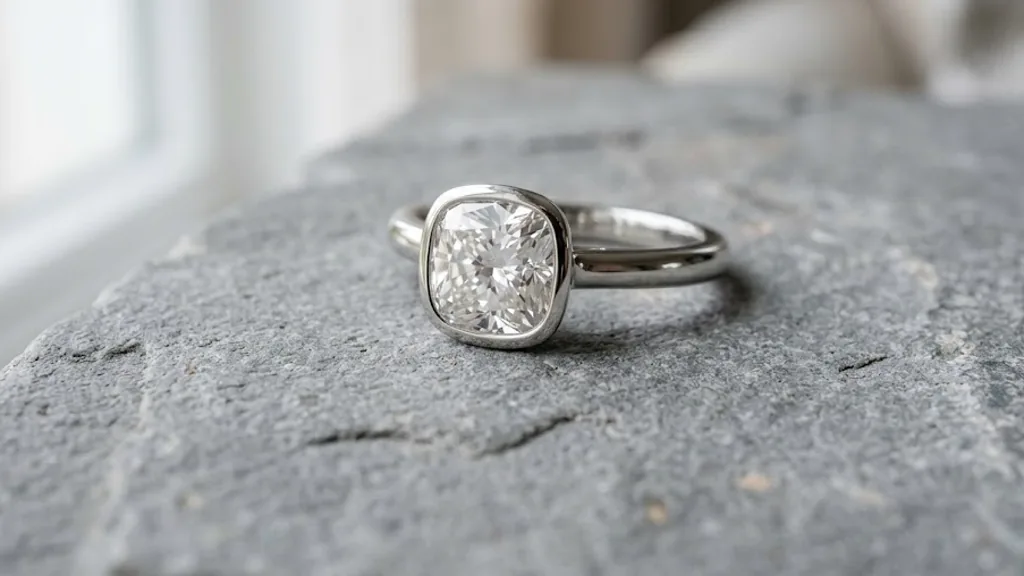
How Much Does a Cushion Cut Diamond Cost? Pricing, Value and Options
What a cushion cut diamond costs in the UK, why it is cheaper per carat than round, and the five factors that move the price.
The cushion cut is the shape people fall for when they want something warmer and softer than a round. It looks like a square or rectangle with gently rounded corners — a pillow, which is exactly where the name comes from.
It is also one of the better value shapes on the market, and this guide explains why, what actually drives the price up or down, and what a cushion cut ring costs in practice.
What a cushion cut is
A cushion is a brilliant cut, meaning it is faceted for sparkle rather than for clean reflections. Its outline is squared off with soft, curved corners and no sharp points anywhere.
Two things vary a lot between cushions, and both change how the stone looks and what it costs:
- Shape ratio. A cushion can be almost perfectly square, or drawn out into a rectangle. Neither is right or wrong, but they read very differently on a hand.
- Facet pattern. Some cushions are cut with large facets that produce big, broad flashes of light — often called “chunky” or “crushed ice” depending on the style. Others are cut closer to a modern round brilliant. Ask which you are looking at, because photographs rarely make it obvious.
How much does a cushion cut diamond cost?
Cushions are a fancy shape, which simply means any shape that is not round. As a rule of thumb in the trade, fancy shapes cost less per carat than rounds of the same colour, clarity and cut quality. That is not a statistic; it is a long-standing pattern with two straightforward causes.
First, cutting a round brilliant wastes a very large share of the original rough crystal. A cushion follows the natural shape of rough more closely, so less material is thrown away.
Second, round is the most requested shape in Britain, and demand supports price. Cushion is popular but it is not the default.
The ranges below are broad market guidance to help you orientate. They are not quotes, prices move, and any specific stone can sit outside them.
| Stone | Lab-grown, loose (guidance) | Natural, loose (guidance) |
|---|---|---|
| 0.50ct cushion | Under a hundred to a couple of hundred pounds | Several hundred pounds |
| 1.00ct cushion | Low hundreds of pounds | Low thousands of pounds |
| 2.00ct cushion | Several hundred pounds upwards | Several thousand pounds upwards |
A finished ring adds the metal and the making on top. A lab-grown diamond is a real diamond — the same carbon crystal, the same hardness, the same sparkle, grown in weeks instead of formed underground. Choosing lab-grown is the single largest saving available to you, and nobody can see the difference by eye.
The five things that change a cushion’s price
1. Carat weight
Price rises faster than weight, and it jumps at round numbers — 0.50ct, 1.00ct, 1.50ct, 2.00ct. A 1.90ct cushion looks the same as a 2.00ct on a hand but sits in a cheaper band. Asking for stones just below a milestone weight is one of the few free wins in diamond buying.
2. Cut quality
This is where most cushion buyers go wrong. There is no single agreed cut grade for cushions the way there is for rounds, so certificates give you less guidance. A poorly proportioned cushion looks flat and glassy, and no amount of colour or clarity will rescue it. Look at the actual stone, or a real video of it, before buying.
3. Colour
Cushions hold colour more visibly than rounds, because their broader facets show body colour rather than masking it. If you want a stone that reads truly white, aim a grade or two higher than you would for a round — G or better is a sensible target. If you like a warm, candlelit look, a lower grade in yellow or rose gold is beautiful and cheaper.
4. Clarity
Eye-clean is the standard worth aiming for: VS2 or a well-chosen SI1. That means nothing visible without magnification. Paying for VVS or Flawless buys a better certificate, not a better-looking ring.
5. The setting
The stone is often not the biggest number on the invoice. Metal choice matters — platinum is denser and more expensive to work than gold. Side stones, halos and pavé bands add small diamonds that need individual setting by hand. A plain solitaire is always the cheapest way to mount any stone.
What our cushion rings cost
We hold a small, deliberately chosen cushion collection — three designs at the time of writing. Every ring is hand-made in solid metal with lab-grown diamonds, and every centre stone comes with a free IGI certificate. Prices correct at the time of writing.
| Ring | Style | Price |
|---|---|---|
| Bezel Cushion Cut Engagement Ring in Platinum | Rim of metal fully surrounding the stone — the most protective setting there is | £904 |
| Three Stone Cushion Cut Engagement Ring | Centre stone with a companion each side | £957 |
| Solitaire Cushion Cut Wedding Band in Sterling Silver | A cushion band designed to pair with an engagement ring | £904 |
You can see the whole cushion range in our cushion cut collection, and compare it against everything else in engagement rings. If you want a cushion in a design we do not stock, we make bespoke rings in solid gold and platinum at no extra design cost.
Cushion versus the alternatives
| Cushion | Round | Emerald | |
|---|---|---|---|
| Price per carat | Lower than round | Highest | Lower than round |
| Sparkle style | Soft, broad flashes | Bright, fine sparkle | Long clean flashes, not sparkly |
| Hides inclusions | Reasonably well | Very well | Poorly — everything shows |
| Shows body colour | More than round | Least | Most |
| Durability | Excellent — no sharp corners | Excellent | Corners need protecting |
How to buy a cushion well
- Choose your ratio before your budget. Square and rectangular cushions suit different hands. Decide which you want, then shop.
- See it move. Cushion sparkle is very hard to judge from a still photograph. Always look at video or the real thing.
- Go a grade higher on colour than you would for a round if you want a bright white look, or lean into warmth and save money.
- Do not overpay for clarity. Eye-clean is the target; anything beyond it is invisible.
- Consider a bezel. A metal rim protects the stone and suits people who work with their hands.
Frequently asked questions
How much does a cushion cut diamond cost in the UK?
As guidance only, a one carat lab-grown cushion typically sits in the low hundreds of pounds as a loose stone, while a comparable natural stone typically runs into the low thousands. Set into a finished ring, our cushion designs start at £904 at the time of writing.
Are cushion cut diamonds cheaper than round?
Usually, yes, for the same weight and quality. Cushions waste less rough when cut and are in lower demand than rounds, and both of those push the price down.
Do cushion cuts sparkle less than rounds?
They sparkle differently, not less. A round produces fine, rapid sparkle. A cushion produces broader, slower flashes of light. Many people prefer the cushion’s softer effect; it is a matter of taste, not quality.
Are cushion cut diamonds hard-wearing?
Yes — among the toughest shapes. The rounded corners mean there is no thin sharp point to chip, unlike a pear, marquise or square-cornered cut.
Can I have a cushion in a setting you do not stock?
Yes. Bespoke design costs nothing extra with us; you pay for the materials and the making. Send us a picture or a description and we will price it honestly.
A cushion is the shape for someone who wants a diamond ring that feels a little older and a little softer than the modern round. Every order includes free insured UK delivery and 30 days to return it, so you can judge the sparkle at home rather than under shop lighting.
More guides on this topic
Ready to find your perfect ring?
Explore our lab-grown diamond collection or book a virtual appointment with our team.











