How to Choose an Emerald Cut Diamond: A Complete Buyer’s Guide
Clarity, ratio, colour and cut, in the right order. A plain English guide to buying an emerald cut diamond, with real UK prices.
The emerald cut is the quiet confidence of the diamond world. Instead of throwing off small flashes of light like a round brilliant, it produces long, broad flashes that roll across the stone as your hand moves. Jewellers call this the “hall of mirrors” effect.
It is also the shape that punishes a careless purchase most. Choosing an emerald cut well is a slightly different job from choosing any other diamond, and this guide walks through it in order.
What is an emerald cut diamond?
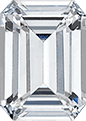
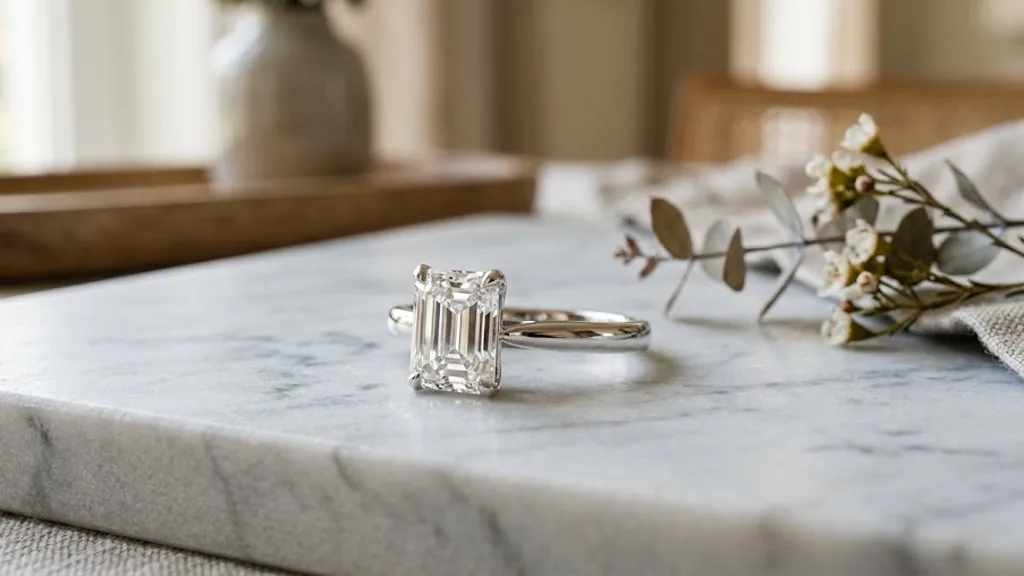
An emerald cut is a rectangular stone with cut-off corners and a flat top, cut with a series of long, straight steps rather than lots of small triangular facets. That is why it belongs to the “step cut” family, along with the Asscher and the baguette.
Two consequences follow from that flat, open top:
- You are looking straight into the stone, so anything inside it is easier to see.
- There is less small-scale sparkle to distract the eye, so the stone lives or dies on how clean and well proportioned it is.
Get those right and an emerald cut is one of the most elegant things you can wear.
Step 1: what clarity does an emerald cut need?
Clarity describes how few natural marks, called inclusions, a diamond contains. On a round brilliant you can often get away with a lower clarity grade because the sparkle hides small marks. On an emerald cut you cannot.
Practical guidance for emerald cuts:
- Aim for VS2 or better if you want a stone that looks clean to the naked eye with confidence.
- VS1 and VVS grades are safest, and on lab-grown stones the extra cost of moving up a grade is far smaller than it would be on a natural diamond.
- SI grades can work, but only if you or we have looked at the actual stone. Ask where the inclusion sits: one under a cut corner is far less noticeable than one in the middle of the open table.
Every centre stone we sell comes with a free IGI certificate, and the certificate includes a plotted diagram showing where the inclusions are. Ask us to read it with you.
Step 2: which length-to-width ratio should you choose?
Length-to-width is simply how long the stone is compared with how wide. It is the single biggest influence on the personality of an emerald cut.
| Ratio | Look | Suits |
|---|---|---|
| 1.30 to 1.40 | Squarer, chunkier, close to an Asscher | Those who want a bold, architectural stone |
| 1.40 to 1.50 | The classic emerald cut proportion | Most buyers; balanced and timeless |
| 1.50 to 1.60 | Long and slim, very elongating on the finger | Shorter fingers, or anyone who loves a slender line |
There is no correct answer here, only preference. If you cannot decide, 1.45 is a safe middle ground that almost everyone likes.
Step 3: what colour grade should an emerald cut be?
Colour grades run from D (completely colourless) downwards. Because an emerald cut has large, open facets, any warmth in the stone shows more readily than in a busy brilliant cut.
Guidance:
- In white gold or platinum, aim for a colourless or near-colourless grade, because a cool metal makes any warmth stand out.
- In yellow or rose gold, you can comfortably go a little warmer. The metal picks up the tone and it looks intentional.
- Larger stones show colour more than smaller ones, so the bigger you go, the more colour matters.
Step 4: how do you judge cut quality on an emerald cut?
Step cut diamonds are not given the same standardised cut grade as round brilliants on every certificate, so you need to use your eyes. Look for:
- Even steps. The parallel lines inside the stone should look straight and regular, not wobbly.
- A lively centre. Some emerald cuts go flat and glassy in the middle. A good one keeps flashing as you tilt it.
- Neat corners. The four cut corners should be even in size. Uneven corners look off-balance once the stone is set.
Always ask for a video of the actual stone if you cannot see it in person.
Step 5: which setting suits an emerald cut?
Emerald cuts have long, straight edges, which gives the setting a lot to work with.
- Solitaire (one stone alone) lets the shape speak. The purest choice.
- Hidden halo places a small ring of diamonds underneath the centre stone, so it sparkles from the side without cluttering the top view.
- Three stone flanks the centre with two smaller diamonds, which suits the emerald cut’s clean lines beautifully.
- East-west sets the stone sideways across the finger. Modern, and it makes the ring look wider.
How much do our emerald cut rings cost?
All lab-grown diamonds, hand-made in solid metal, free IGI certificate on the centre stone. Prices correct at the time of writing.
| Piece | Style | Price |
|---|---|---|
| Solitaire Emerald Cut Engagement Ring | Single stone, clean band | £672 |
| Hidden Halo Emerald Cut Engagement Ring | Small diamonds hidden beneath the centre stone | £1,016 |
| Three Stone Emerald Cut Engagement Ring | Centre stone with two side stones | £1,017 |
| Stackable Emerald Cut Half Eternity Band | Matching band to wear alongside | £770 |
We currently hold six emerald cut designs. See them all in the emerald cut collection, or compare with other shapes across engagement rings.
How much does an emerald cut diamond cost in general?
As broad guidance rather than a quote: emerald cut diamonds are usually less expensive per carat than round brilliants, because cutting them wastes less of the rough crystal. Lab-grown emerald cuts cost a fraction of natural ones of comparable colour and clarity, which is precisely why buyers of this shape often move up a clarity grade rather than a carat size. That is the right instinct for a step cut.
Frequently asked questions
What clarity should I choose for an emerald cut diamond?
VS2 or better is the practical floor if you want to be confident the stone looks clean without a magnifier. VS1 and above is safer still. Because lab-grown stones make higher clarity affordable, it is usually the best place to spend your money on this shape.
Does an emerald cut look bigger than a round of the same weight?
Generally yes. Emerald cuts are elongated and carry more of their weight across the top, so they read larger on the finger than a round brilliant of the same carat weight.
Is an emerald cut less sparkly?
It sparkles differently rather than less. Instead of many small flashes, you get broad flashes of white light and dark contrast. Some people prefer it precisely because it looks calmer and more sophisticated.
Are the corners fragile?
No, the cut corners are actually one of the emerald cut’s strengths. Sharp points are what break on diamonds, and the emerald cut does not have any. It is a sensible everyday shape.
Can you make an emerald cut ring to my own design?
Yes. Bespoke commissions carry no extra design cost with us. Tell us the ratio, clarity and metal you want and we will make it by hand in solid gold or platinum at our North Harrow workshop.
What matters most when choosing an emerald cut?
If you take one thing from this guide, make it this: on an emerald cut, spend on clarity and cut quality before carat weight. A slightly smaller, perfectly clean emerald cut will always outshine a bigger, busier one.
Free insured UK delivery and 30-day returns apply to every piece, so you can see the stone properly at home before you commit.
Ready to find your perfect ring?
Explore our lab-grown diamond collection or book a virtual appointment with our team.