What Colour Do Real Diamonds Shine and Reflect?
Real diamonds return mostly white light with coloured sparks. Here is what a diamond really reflects, and why the rainbow myth is wrong.
People ask this in two ways: “what colour do real diamonds shine?” and “what colour do real diamonds reflect?” They are the same question, and the honest answer surprises a lot of first-time buyers.
A real diamond returns mostly white light, broken up by small flashes of coloured light — blue, orange, yellow, green and pink. Both happen at once. If someone tells you a real diamond never shows colour, or that only fakes show rainbows, they have been given bad information.
The short answer
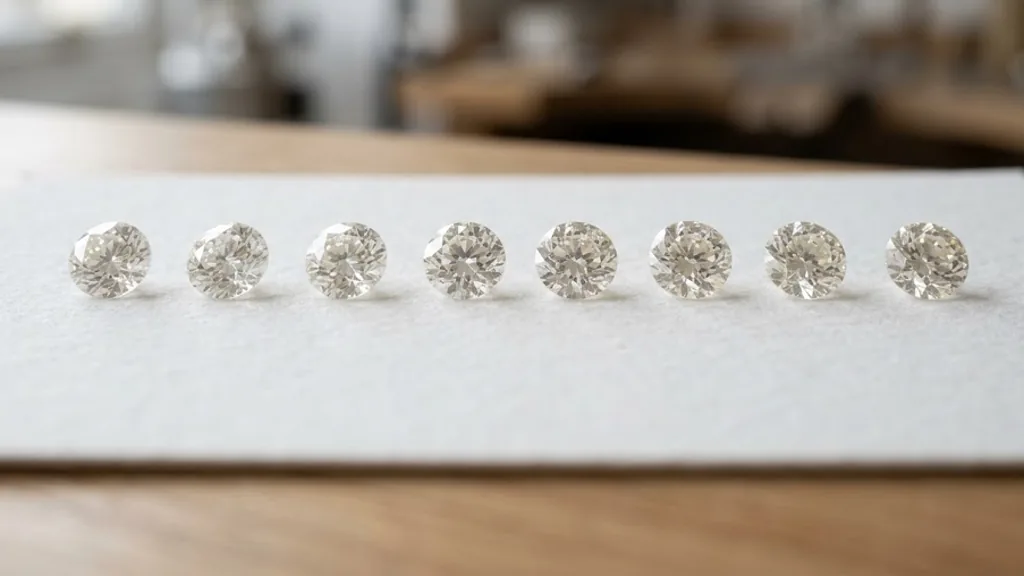
Hold a well-cut diamond under a normal ceiling light and move it. You will see:
- Bright white flashes — this is the dominant effect, and the trade calls it brilliance.
- Small coloured flashes — brief sparks of blue, orange and yellow. The trade calls this fire.
- Movement — the flashes switch on and off as your hand moves. The trade calls this scintillation.
So the answer to “what colour does it shine?” is: mainly white, with coloured sparks mixed in. The proportion of white to colour depends on the cut and on the lighting you are standing in.
Why a diamond gives off white light
Light enters through the flat top of the stone, bounces off the angled facets inside, and comes back out towards your eye. Facets are the polished flat surfaces cut into the stone.
When light bounces cleanly and leaves through the top, you see a bright white return. When the angles are wrong and light escapes out of the bottom of the stone instead, the diamond looks dull or shows a dark patch in the centre. That is a cutting problem, not a “real or fake” problem.
This is why cut quality matters more than almost anything else for how a diamond looks. A perfectly clean, perfectly colourless stone that has been cut too deep or too shallow will still look lifeless.
Why a diamond also gives off coloured light
White light is a mixture of every colour. Diamond bends each colour by a slightly different amount as light passes through it, so the mixture separates on the way out — the same way a glass prism separates sunlight.
Physicists call this dispersion. Jewellers call it fire. It is a real, measurable property of diamond, and every genuine diamond has it.
You see fire best in point lighting — a spotlight, a candle, direct sunshine, a single bulb. You see it least under a big soft light source like an overcast sky or an office ceiling panel, because the colours overlap and average back out to white.
The “real diamonds don’t show rainbows” myth
You will find this claim all over social media: if it flashes rainbow colours it must be cubic zirconia or moissanite. It is not true, and following it will make you reject perfectly good diamonds.
Here is the accurate version. Diamond does show colour. Some simulants show more colour than diamond does. Moissanite in particular disperses light more strongly than diamond, which is why a large moissanite can look almost disco-like next to a diamond of the same size. Cubic zirconia also disperses more than diamond.
So the difference is one of degree, not presence:
| Stone | What you notice |
|---|---|
| Diamond (natural or lab-grown) | Strong white flashes with restrained coloured sparks mixed in |
| Moissanite | Noticeably more coloured flashing, often described as rainbow-heavy in larger sizes |
| Cubic zirconia | More colour than diamond, but weaker overall brightness, and it dulls quickly as it scratches and picks up film |
Judging by eye alone takes practice, and even experienced buyers get it wrong across a shop counter. The reliable answer is a laboratory certificate, not a sparkle test.
Do lab-grown diamonds shine the same colours?
Yes. A lab-grown diamond is diamond — the same carbon structure, the same hardness, the same way of bending light. It reflects light in exactly the same manner as a mined stone, so the white brilliance and the coloured fire are identical.
The difference is where the carbon crystallised, not what it does with light. Every centre stone we set at CarbonstoneUK comes with a free IGI certificate that records its grades, so you are not asked to judge by eye.
What about the colour of the diamond itself?
There are two separate things people mean by “diamond colour”, and mixing them up causes a lot of confusion:
- The colour it reflects — the flashes, as described above. This is about cut and lighting.
- The colour it is — the faint body tint of the stone itself, graded on a letter scale.
Standard white diamonds are graded D to Z. D is completely colourless. As you move down the alphabet, a faint warm tint creeps in — usually described as yellow or brown, and usually far too subtle to spot without a comparison stone next to it.
| Grade range | Name | What most people see face-up |
|---|---|---|
| D, E, F | Colourless | No tint at all |
| G, H, I, J | Near colourless | Still looks white; a faint warmth may show against a D stone |
| K to M | Faint | A warm tone becomes visible to many people, especially in larger stones |
| N to Z | Very light to light | Clearly tinted |
Body colour has very little to do with how much a stone sparkles. A G stone and a D stone of the same cut will flash the same way. If you want the detail, read our guides to what a G colour diamond is and what an F colour diamond is.
Why the same ring looks different in different rooms
This catches people out after they get home. The stone has not changed — the light has.
- Direct sunlight or a spotlight: maximum coloured fire, very lively.
- Restaurant candlelight: warm, rich flashes, usually the most flattering light there is.
- Office strip lighting: flat and white, very little fire.
- Overcast daylight through a window: soft, gentle, mostly white return.
Jewellery shops are lit with lots of small bright spotlights for exactly this reason. It is not a trick, but it is worth asking to look at a ring away from the display case before you decide.
Which shapes throw the most colour?
Cutting style changes the balance between white flash and coloured flash.
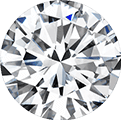
- Round brilliant — the all-rounder. Fifty-seven or fifty-eight facets arranged to return the most light. Our Solitaire Round Cut Engagement Ring in White Gold is the plainest way to see this, at £563 correct at the time of writing.
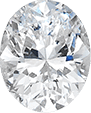
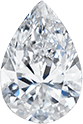
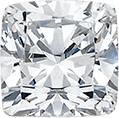
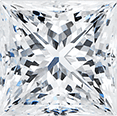
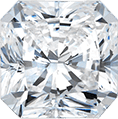
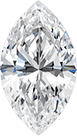
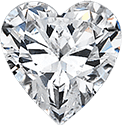
- Other brilliant-style cuts — pear, oval, marquise, cushion, heart and radiant all use similar facet patterns and behave in a similar lively way.
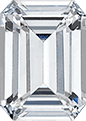
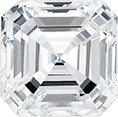
- Step cuts — emerald, asscher and baguette use long parallel facets. They give broad mirror-like flashes rather than rapid sparkle, with less coloured fire. Some people much prefer this calmer look. A Solitaire Emerald Cut Engagement Ring shows it clearly, at £672 correct at the time of writing.
- Halo settings — small diamonds surrounding the centre stone add a lot of extra small flashes. Our Halo Round Cut Engagement Ring is a good example, at £707 correct at the time of writing.
You can browse everything by shape — round, emerald or any other — or look through all our engagement rings together.
Home tests: what works and what does not
Some of the popular home tests are simply unreliable.
- The newspaper or dot test — placing a loose stone over printed text. Diamond bends light so sharply that you usually cannot read through it. This can hint at cubic zirconia, but it fails on a well-cut moissanite and it is useless once a stone is set in a ring.
- The fog test — breathing on the stone. Diamond conducts heat away fast, so the mist clears quickly. Moissanite also conducts heat well, so this test does not separate the two.
- The scratch test — never do this. You can damage the setting, the stone next to it, or whatever you scratch.
- A jeweller’s tester and a certificate — this is what actually settles it. Electronic testers that check both heat and electrical conductivity can separate diamond from moissanite, and a laboratory report identifies the stone properly.
Keeping the sparkle
The single biggest cause of a dull diamond is not the diamond. It is a thin film of hand cream, soap and skin oil on the underside, which stops light getting in and out.
Warm water, a drop of washing-up liquid and a soft baby toothbrush, once a fortnight, restores almost every “my diamond has gone flat” complaint we hear. Rinse well and dry with a lint-free cloth.
Frequently asked questions
What colour does a real diamond shine in the dark?
None. A diamond has no light of its own — it can only return light that reaches it. In a dark room it looks like a dark stone. Some diamonds do glow blue under ultraviolet light, which is a separate property called fluorescence, but that is not what happens in an ordinary dark room.
If my diamond flashes rainbow colours, is it fake?
No. All genuine diamonds show coloured flashes. What matters is the balance — a diamond shows plenty of white brilliance alongside the colour, while a simulant often shows colour without matching brightness. It is not something to judge from a photograph or a video.
Does a diamond reflect the colour of the metal it is set in?
Slightly, yes. A yellow or rose gold setting can put a warm cast into the lower part of the stone, and white metals keep it cooler. This is genuinely useful: a warmer-graded stone in yellow gold often looks better matched than the same stone in platinum.
Do lab-grown diamonds sparkle less over time?
No. Diamond is the hardest natural material there is, lab-grown or mined, and it does not go cloudy or wear smooth in normal wear. Any loss of sparkle is dirt, and it cleans off.
Why does my diamond look grey in photos?
Phone cameras average out fast-moving flashes and often lose the coloured sparks entirely. A short video taken while slowly rotating the ring under a single bright light shows far more of what your eye actually sees.
Choosing with your own eyes
If you take one thing from this: judge a diamond by how it behaves when it moves, not by a still photo and not by a myth about rainbows. Ask for the certificate, look at the stone in more than one light, and trust what you see.
Every centre stone we set is lab-grown, IGI certified, and hand-set in solid gold or platinum in North Harrow, London. If you would like to see how a particular shape behaves before committing, we are happy to talk it through — and if nothing in the collection is quite right, we design bespoke pieces at no extra design cost.
More guides on this topic
Ready to find your perfect ring?
Explore our lab-grown diamond collection or book a virtual appointment with our team.