How to Select a Wedding Ring: A Step-by-Step Guide
How to choose a wedding ring in the right order: matching the engagement ring, metal, width, profile, stones, sizing and timing.
Choosing a wedding ring is a strange purchase. It is not expensive by wedding standards, it takes half an hour to decide, and you will then wear it every day for the rest of your life. Most of the regret we hear about comes from decisions made in the wrong order.
This is the order that works, from someone who has watched a lot of couples do it well and a few do it badly.
Step 1: Look at the engagement ring first
If there is an engagement ring, it sets the rules. The wedding band has to sit next to it every day, and a band that does not fit against it will either rock, gap, or rub the stones.
Three things to check:
- The profile of the engagement ring’s shoulders. If the setting sits high with a straight shank, most flat bands will sit flush. If the stone dips low, or the shoulders are shaped, you may need a curved or shaped band.
- The metal. A softer metal worn tight against a harder one wears faster. Matching the metals is not compulsory, but it is the safe choice.
- The width. A very slim engagement ring next to a broad band looks unbalanced from above. Aim for widths that are within about a millimetre of each other unless you are deliberately contrasting.
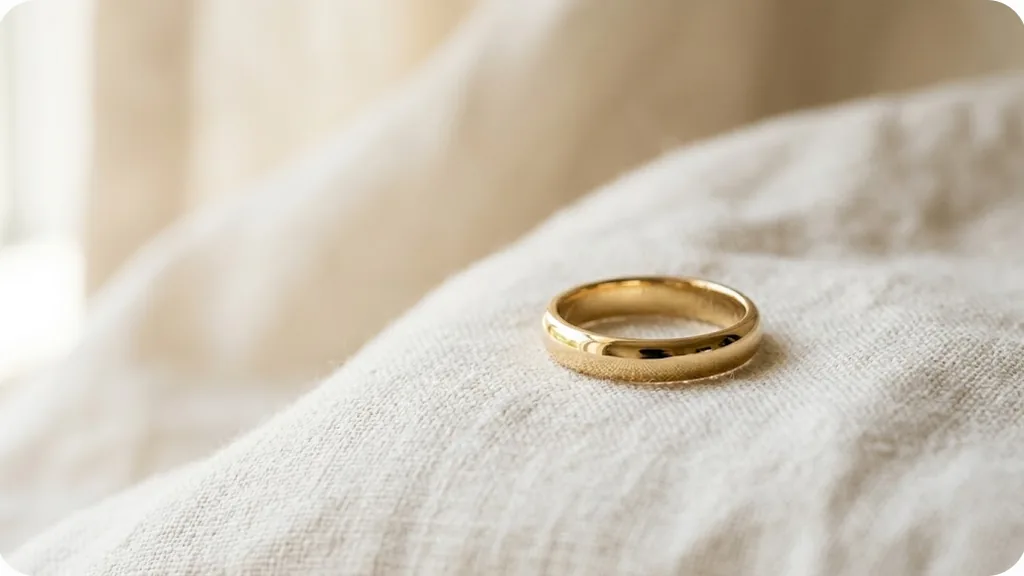
If the two will not sit flush, a shaped band is the answer. Something like the Curved Round Cut Wedding Band in Yellow Gold (£707, correct at the time of writing) is cut to nest against a raised centre stone. Our guide on connecting an engagement ring and wedding band goes further into this.
Step 2: Choose the metal
This is the decision you cannot change later without remaking the ring, so it deserves the most thought.
| Metal | How it behaves | Worth knowing |
|---|---|---|
| 9ct gold | Harder, less gold content, paler colour | Cheapest of the golds. Slightly more prone to tarnishing over decades. |
| 14ct gold | Good balance of colour and toughness | The middle option; popular for men’s bands. |
| 18ct gold | Richer colour, softer | The classic fine-jewellery choice. Scratches more readily but polishes beautifully. |
| White gold | Gold alloyed pale, then rhodium plated | The plating wears and needs renewing periodically. Budget for that. |
| Rose gold | Gold with copper | Warm colour, and the copper makes it slightly harder than yellow gold. |
| Platinum | Naturally white, dense, nickel-free | Never needs re-plating. Heaviest on the finger. Scratches displace metal rather than remove it, giving a soft patina. |
Two practical notes. If anyone in the couple reacts to costume jewellery, platinum is the safest bet, because it contains no nickel. And if you love the look of white metal but want to avoid re-plating appointments for the next forty years, platinum solves that problem permanently.
Step 3: Decide the width and the profile
Width is measured in millimetres across the top of the band. Profile is the shape of the cross-section — how it sits against your skin.
| Width | Typically suits | How it feels |
|---|---|---|
| 2mm | Slim fingers, stacking | Barely noticeable; delicate |
| 2.5–3mm | The most common women’s width | Present but light |
| 4mm | Common men’s width, or a bolder women’s band | Solid, easy to notice |
| 5–6mm | Broad men’s bands, larger hands | Substantial; can feel restrictive on shorter fingers |
On profile, the main choices are:
- Court (or comfort fit) — rounded outside and inside. The most comfortable for daily wear, especially in wider bands.
- D-shape — rounded outside, flat inside. Traditional and slightly less bulky.
- Flat — flat both sides. Modern and architectural, but the square inner edges can dig in on a wide band.
If you are choosing a band above 4mm and you have never worn one, choose a court profile. Wide flat bands are the single most common cause of “I love it but I keep taking it off”.
Step 4: Plain, or set with diamonds?
A plain band is the lowest-maintenance object you will ever own. It cannot lose a stone, it resizes easily, and it can be re-polished to look new indefinitely. The Minimalist Round Cut Wedding Band (£687) is that idea done well.
Set bands sparkle, and they raise three questions:
- How far round do the stones go? A half eternity has stones across the top half, a three-quarter goes further, a full eternity goes all the way round.
- Can it be resized? Half and three-quarter bands usually can, because there is plain metal at the base to work on. Full eternity bands usually cannot. Our guide to resizing eternity rings explains why.
- How are the stones held? Rubbed-over and channel settings sit low and survive knocks better than raised claws.
For most people, a half eternity is the sensible middle: sparkle where it shows, plain metal where it needs to be workable. The Stackable Emerald Cut Half Eternity Band (£770) is a good example of the type.
Step 5: Get the size right, at the right time of day
Fingers change size through the day and through the year. They are smaller when you are cold and larger when you are hot, tired or have eaten salty food. A measurement taken at 8am in February and a measurement taken at 6pm in August can differ by a full size.
Measure in the middle of the day, at normal room temperature, and take more than one reading on separate days. Full detail is in our guide on finding your wedding ring size, and there is a separate one on sizing a man’s wedding ring.
One extra point people miss: a wider band needs a slightly larger size than a narrow one, because it covers more of the finger. If you are moving from a 2mm engagement ring to a 5mm band, do not assume the same number.
Step 6: Decide whether to match
Matching rings — same metal, same profile, scaled to each hand — look considered and photograph well. Non-matching rings let each person have what actually suits their hand.
There is no rule. A useful compromise is to match one element and let everything else differ: the same metal, or the same profile, or the same finish. That gives a visual connection without forcing one person into a ring they will not enjoy wearing.
Step 7: Order early
Hand-made rings take time, and sizing problems take more time. Ordering two to three months before the wedding gives room for a resize, a change of mind, or a delay, without anybody having to panic in the final fortnight.
If you are buying an engagement ring and wedding band together, our bridal sets are designed as pairs from the start, which removes the matching problem entirely.
A note on budget
There is no correct amount. The old percentage-of-salary rules came from advertising, not from any real convention. Spend what is comfortable, and put the money where it shows: metal quality and comfort matter more day to day than carat weight on a band. We go into this properly in how much to spend on a wedding ring.
Frequently asked questions
Should the wedding ring match the engagement ring metal?
It is the safe choice, mainly because different metals of different hardness rub against each other over years. Mixing metals is a real design option and plenty of people do it deliberately — just accept that the softer of the two will show wear first.
How tight should a wedding ring be?
It should take a little effort to get over the knuckle and should not spin loosely once on. A ring that slides off easily in cold weather is too big. A ring you cannot remove at all is too small.
Can I choose the ring on my own as a surprise?
For a wedding band, most couples choose together, because it is worn permanently and comfort is personal. If it must be a surprise, buy the size cautiously and check the ring can be resized before you order.
Does the engagement ring have to come off during the ceremony?
Traditionally it moves to the right hand so the wedding band goes on first and sits closest to the heart, then the engagement ring goes back on top. It is a convention, not a requirement — our guide to wearing an engagement ring and wedding band covers the options.
What if we choose wrong?
Buy from somewhere with a proper returns policy. Ours is 30 days, delivery in the UK is free and insured, and if nothing in the collection is right, bespoke design carries no extra design cost.
Where to start looking
Work through the steps above in order and the choice usually makes itself by step four. When you are ready, our wedding ring collection is all hand-made in solid gold and platinum with lab-grown diamonds, and every centre stone comes with a free IGI certificate.
More guides on this topic
Ready to find your perfect ring?
Explore our lab-grown diamond collection or book a virtual appointment with our team.