Do Engagement Rings Need to Be Diamonds?
Engagement rings do not need diamonds. The realistic alternatives, a hardness table for daily wear, and what actually lasts.
No. There is no rule, no law and no real tradition requiring a diamond. Engagement rings were made with rubies, sapphires, pearls, coloured glass and plain gold for centuries before diamonds took over, and the takeover is much more recent than most people assume.
That said, there are practical reasons diamonds became the default for a ring worn every day. Here is the honest case for and against, and what actually happens to the alternatives after a few years on a hand.
How diamonds became the assumption
Diamond engagement rings existed among European nobility from the fifteenth century, but they were rare and expensive. They became a mass expectation only in the twentieth century, driven largely by advertising — the famous “a diamond is forever” campaign began in 1947 and worked extraordinarily well.
That is worth knowing, because it means the “tradition” you may feel obliged to follow is roughly as old as your grandparents. Ignoring it costs you nothing in terms of authenticity.
The one thing that genuinely matters: hardness
An engagement ring is worn on the hand, every day, for decades. It gets knocked on door frames, dragged through pockets, and covered in hand cream. The single biggest practical difference between stones is how well they survive that.
Gemstone hardness is measured on the Mohs scale, from 1 (talc) to 10 (diamond). The scale is not evenly spaced — the gap between 9 and 10 is enormous. Anything below about 7 will scratch over time simply from everyday dust, which contains quartz.
| Stone | Mohs hardness | Suitable for daily wear? |
|---|---|---|
| Diamond (mined or lab-grown) | 10 | Yes. Nothing in daily life scratches it. |
| Moissanite | 9.25 | Yes. Very durable. |
| Sapphire and ruby | 9 | Yes. The best coloured-stone choice for an everyday ring. |
| Topaz, spinel | 8 | Generally yes, though topaz can chip along cleavage planes. |
| Emerald, aquamarine, morganite | 7.5–8 | With care. Emeralds are usually heavily included and can be brittle despite the number. |
| Amethyst, citrine, garnet | 6.5–7.5 | Will dull and scratch within a few years of daily wear. |
| Opal, tanzanite, moonstone | 5.5–6.5 | Not really. Beautiful, but fragile for a ring worn constantly. |
| Pearl | 2.5–4.5 | No. Soft, porous, and damaged by perfume, hairspray and sweat. |
None of this means you cannot have an opal or a pearl. It means you should know that it will need replacing or resetting, and choose it with your eyes open.
The realistic alternatives
Sapphire
The strongest non-diamond choice. Hard enough for daily wear, available in blue, pink, yellow, green, teal and colourless, and with a long history in British engagement rings. Untreated stones in rare colours can cost as much as diamonds; ordinary blues are usually less.
Moissanite
A lab-made stone, nearly as hard as diamond and considerably cheaper. It has a higher dispersion than diamond, which means more of that rainbow flash. Some people love it; others find it too much. It is not a diamond and should never be sold as one.
A plain or textured band
Underrated. A well-made band in solid gold or platinum, engraved inside, is a real engagement ring and always has been. It is also the most practical option for anyone whose work makes a raised stone impossible.
An heirloom, reset
If there is a family ring, resetting the stone into a new setting is often cheaper than buying new, and it keeps the part that carries the meaning. Any competent jeweller can quote for this, including us.
A lab-grown diamond
Worth naming as an alternative in its own right, because a lot of people asking this question are really asking “must I spend that much?” A lab-grown diamond is chemically and optically the same material as a mined one — it is a diamond, not a simulant — and it costs substantially less for the same size and quality. For many couples, that removes the reason they were looking elsewhere in the first place.
What we stock, plainly
We should be direct: CarbonstoneUK is a lab-grown diamond specialist. We do not stock sapphire, ruby, emerald, moissanite or opal rings, and we are not going to point you at a product that does not exist. If a coloured stone is what you want, a coloured-gemstone specialist will serve you better than we will.
What we can do is design bespoke at no extra design cost, including resetting a stone you already own into a new hand-made setting.
And if a diamond ring is what you are after but the price is the obstacle, our lower-priced designs may surprise you. Prices correct at the time of writing:
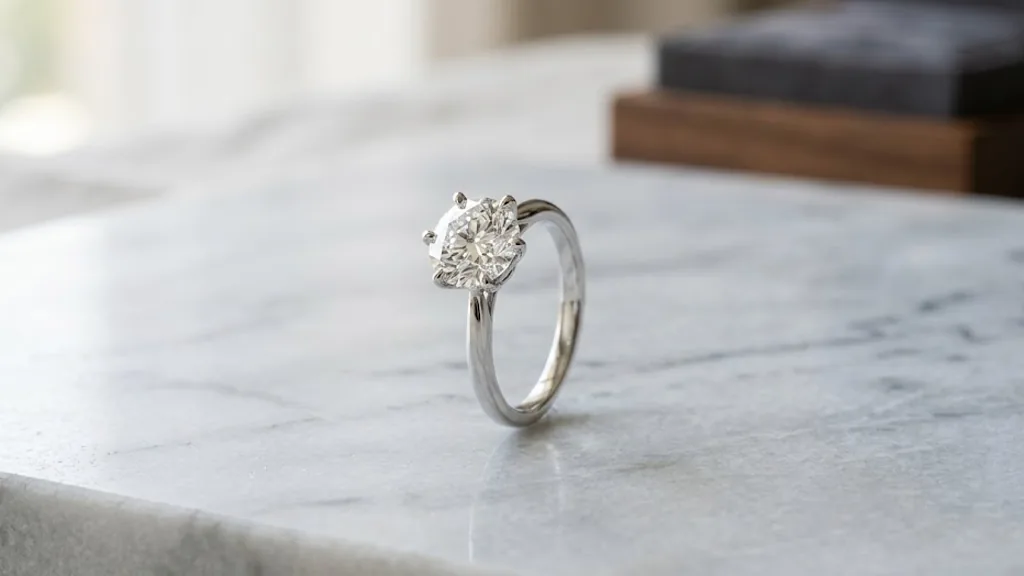
- Minimalist Round Cut Engagement Ring — £587. A single stone on a slim band, nothing extra.
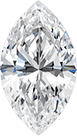
- Solitaire Marquise Cut Engagement Ring — £538. A marquise stone covers more of the finger than a round of the same carat weight, so it reads larger.
- Solitaire Oval Cut Engagement Ring — £557. Softer than a marquise, with the same lengthening effect.
Every centre stone comes with a free IGI certificate, and delivery is free and insured across the UK. Have a look at the engagement ring collection, or the plain and set bands if a band is the direction you are heading.
If you choose something unusual, do these three things
- Ask about the setting, not just the stone. A softer stone in a bezel — a rim of metal around the edge — survives far better than the same stone held in raised claws.
- Insure it and check the terms. Some policies exclude stones below a certain hardness for accidental damage.
- Accept a maintenance schedule. A pearl or opal ring worn daily is a consumable. Plan for replacement rather than being upset by it.
Frequently asked questions
Do engagement rings have to have diamonds?
No. There is no rule of any kind. Diamonds are the most common choice in the UK because they are hard enough to survive daily wear, not because anything requires them.
Is it acceptable not to have a diamond engagement ring?
Completely. Sapphire engagement rings have a long and respectable history in Britain, and plain bands are older still. The only opinion that matters is that of the person wearing it.
What is the most durable alternative to a diamond?
Moissanite at 9.25 on the Mohs scale, then sapphire and ruby at 9. Both will comfortably survive daily wear for decades.
Are lab-grown diamonds a “real” alternative or a real diamond?
They are real diamonds — the same crystal structure and the same hardness, grown rather than mined. They are not simulants like cubic zirconia. The difference from a mined diamond is origin and price.
Can I put a coloured stone in one of your settings?
Talk to us. We work in lab-grown diamonds, but our bespoke service can accommodate a stone you supply or inherit, and there is no extra charge for the design work.
Will a non-diamond ring hold its value?
Most jewellery of any kind resells for far less than it cost, diamonds included. Buy a ring because you want to wear it, not as an investment — that is true across the board and we would rather say it than pretend otherwise.
If you would like a hand thinking it through, we are in North Harrow and happy to talk, including when the honest answer is that another jeweller suits you better.
More guides on this topic
Ready to find your perfect ring?
Explore our lab-grown diamond collection or book a virtual appointment with our team.