What Colour Does a Diamond Look Under UV Light?
Most diamonds that react to UV glow blue. What fluorescence is, how it is graded, whether it matters, and why a blacklight is not a diamond test.
Put a diamond under a UV lamp or a blacklight and there is a good chance it will glow blue. Not all of them do, and a small number glow yellow, white, green or orange instead. The effect is called fluorescence, it is completely normal, and it says almost nothing about whether the diamond is real.
That last point is worth stating early, because the internet is full of advice suggesting a blacklight is a diamond test. It is not. Here is what fluorescence actually is, what colour to expect, what it means for the look and price of a stone, and where it genuinely is useful.
What fluorescence is
Ultraviolet light is light your eyes cannot see. When UV hits certain diamonds, the stone absorbs that invisible energy and re-emits it at a wavelength you can see. The diamond appears to glow from within for as long as the lamp is on it.
Whether it happens depends on trace elements in the crystal — mainly nitrogen, sometimes with boron or other impurities. Nitrogen arranged in particular groupings is the usual cause of the blue glow.
Sunlight contains UV, so a strongly fluorescent diamond can show a faint effect outdoors on a bright day. Under ordinary indoor lighting there is essentially no UV, so nothing happens at all.
What colour will it glow?
| Glow colour | How often it turns up | Usual cause |
|---|---|---|
| Blue | By far the most common | Nitrogen in specific groupings |
| None | Very common — many diamonds simply do not react | Too few of the relevant impurities |
| Yellow | Uncommon | Different nitrogen arrangements |
| White | Uncommon | Mixed emissions |
| Green | Rare | Often linked to hydrogen or nickel |
| Orange or red | Rare | Various trace impurities |
Blue and none between them account for the great majority of diamonds. If a stone glows a strong orange or red, that is unusual enough to be worth asking a laboratory about.
How fluorescence is graded
Certificates from IGI and GIA include a fluorescence line. It records strength, and colour if there is any:
- None — no reaction at all
- Faint — barely detectable
- Medium — clearly visible under the lamp
- Strong — obvious
- Very Strong — unmistakable
The grade is judged under long-wave UV, which is the type used in blacklights, against a set of reference stones. It describes the reaction, not the quality of the diamond.
Does fluorescence make a diamond look better or worse?
Usually neither. In normal indoor light, the vast majority of people cannot tell a fluorescent diamond from a non-fluorescent one. There are two situations where it does have an effect, and both are worth knowing.
It can help a slightly tinted stone. A faint yellow tint and a blue glow are opposite colours. In daylight, blue fluorescence can cancel some of that warmth and make a J, K or L look a touch whiter than its grade. Some buyers deliberately seek out fluorescence in lower colour grades for exactly this reason.
It can occasionally cause haziness. In a small minority of stones — normally those graded Strong or Very Strong — the reaction can give a milky or oily look in strong daylight. This is uncommon, but it is real, and it is the reason strongly fluorescent diamonds often sell at a discount. The trade generally treats Strong fluorescence in a high colour grade (D to F) as a price reducer, and that is a market convention rather than a measured optical fact.
The practical rule: None, Faint and Medium need no thought at all. Strong or Very Strong is worth looking at the stone in daylight before committing.
Why a blacklight is not a diamond test
This is the myth that sends people to the internet in the first place, so let us kill it properly.
A real diamond may glow blue — or it may not glow at all. Cubic zirconia often fluoresces too, frequently a mustard yellow or greenish colour. Moissanite can show a reaction. Glass and white sapphire can react as well. Because both real diamonds and imitations can glow, and both can stay dark, a UV lamp cannot separate them.
What actually identifies a diamond is a thermal or electrical conductivity tester in a jeweller’s hands, and beyond that, a laboratory report. If you want certainty, that is where it comes from — not from a torch.
Where fluorescence genuinely is useful
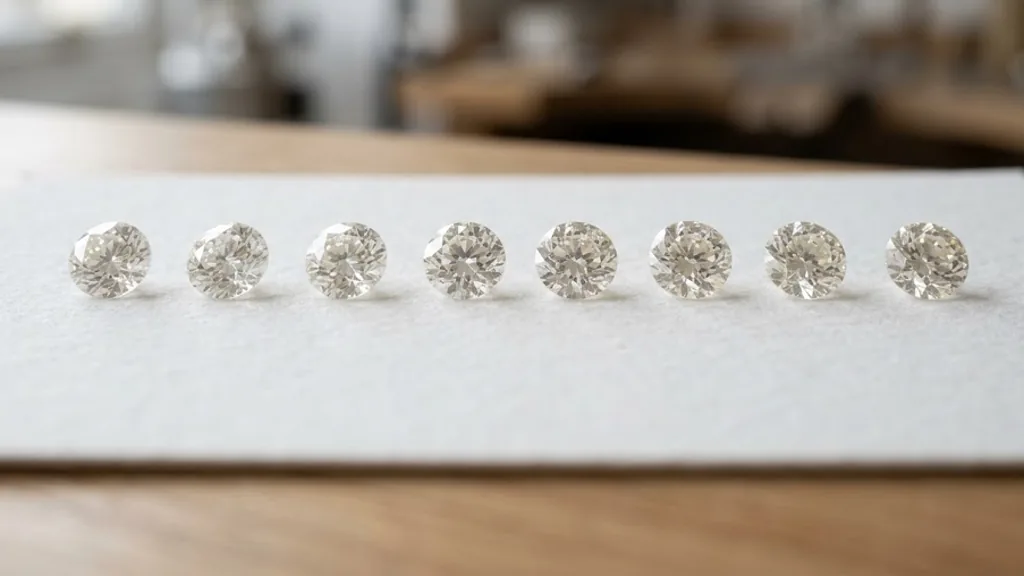
Two places. First, matching. If you are having a piece made with several stones side by side — an eternity band, a three stone ring — you want them to behave the same way. One strongly fluorescent stone among five inert ones can look slightly different outdoors. Any good jeweller will match this when selecting stones.
Second, identification. A UV lamp is how a jeweller reads the laser inscription region and how laboratories examine growth patterns, because fluorescence often reveals structures in the crystal that are invisible in ordinary light. That is a laboratory technique, not a kitchen one.
What we do
Every centre stone we set is lab-grown and comes with a free IGI certificate, and that certificate includes the fluorescence line — so you can read it for your own stone rather than wonder. Where a design uses several matched stones, we select them to behave consistently.
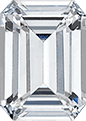
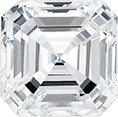
If you would like a stone where nothing is hiding, an open cut shows everything: the solitaire emerald cut engagement ring has a large flat table and step facets, so what you see is what you get, at £672 at the time of writing. For maximum brightness in white metal, the solitaire round cut engagement ring in platinum is the classic choice.
If you are choosing a multi-stone design where matching matters, have a look at the stackable round cut full eternity band, where every stone sits in a row and consistency is everything.
Browse the full engagement ring collection or our wedding rings. Everything is hand-made in solid gold and platinum in North Harrow, London, with free insured UK delivery and 30-day returns.
Long-wave and short-wave UV are not the same test
Ultraviolet light comes in different wavelengths, and diamonds respond to them differently. This matters if you ever try the experiment yourself.
Long-wave UV, around 365 nanometres, is what a standard blacklight and a jeweller’s UV lamp produce. It is the wavelength grading laboratories use to assign the fluorescence grade on your certificate. Short-wave UV, around 254 nanometres, is a separate laboratory tool and produces different reactions in the same stone — a diamond that looks inert under long-wave can react under short-wave, and the reverse happens too.
So if you shine a cheap torch at a ring and see nothing, that tells you very little. It may not be a true UV source, the wavelength may be wrong, and even a correct reading would not identify the stone. Certificates state which conditions were used, which is why the printed grade is worth more than any home test.
A word on safety
UV light is not something to point at eyes or skin for long. Proper gemmological lamps are shielded, used in a darkened viewing box and looked at briefly. Consumer blacklights vary enormously in output and quality. If you are curious about your own ring, take it to a jeweller and ask them to show you under a proper lamp — it takes seconds and costs nothing.
How this differs from the sparkle you see every day
Fluorescence is often confused with two other things a diamond does, and they are entirely separate effects.
- Brilliance is white light returned to your eye from the facets. It is the brightness of the stone.
- Fire is the rainbow flashes you see when the stone moves, caused by white light splitting into colours as it passes through the diamond.
- Fluorescence is a glow generated inside the stone by invisible ultraviolet light, and it only appears when a UV source is present.
Brilliance and fire come from cut quality, and they are what make a diamond look alive. Fluorescence is a property of the crystal’s chemistry and plays almost no part in everyday appearance.
Common questions
Should a diamond glow under UV light?
There is no “should”. A diamond with no fluorescence is not fake, and one that glows brightly is not automatically better or worse. Both are entirely normal and both appear on certificates every day.
Does fluorescence affect the value of a diamond?
It can. In the top colour grades, Strong and Very Strong fluorescence usually reduces the price, because of the small risk of haziness. In lower colour grades, blue fluorescence is often considered a benefit and has little or no effect on price. Treat these as trade conventions rather than fixed rules.
Can I see fluorescence in everyday life?
Rarely. It needs a UV source. Bright sunlight contains enough UV to show a strong reaction faintly, and some nightclub and stage lighting will make a fluorescent stone glow obviously. Under a normal light bulb, nothing happens.
Is fluorescence a flaw or damage?
Neither. It is a natural optical property caused by trace elements. It does not weaken the diamond, it will never change over time, and it cannot be worn away.
What does phosphorescence mean?
Phosphorescence is a glow that continues briefly after the UV lamp is switched off, rather than stopping instantly. It is much less common than fluorescence and is sometimes used by laboratories as an identification clue.
More guides on this topic
Ready to find your perfect ring?
Explore our lab-grown diamond collection or book a virtual appointment with our team.