
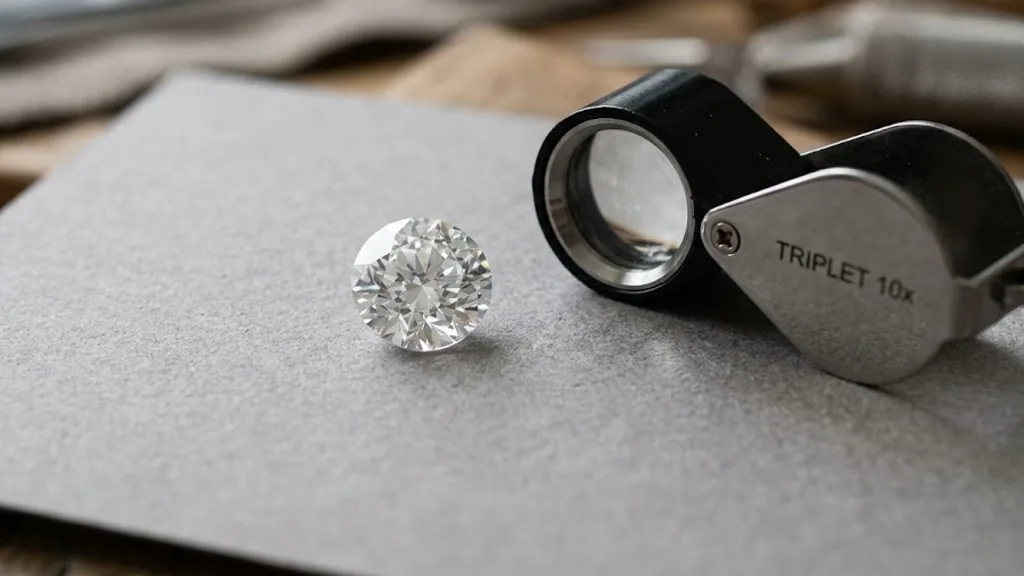
Diamond Clarity Characteristics: Inclusions and Blemishes Explained
Feathers, clouds, crystals and knots: what every clarity characteristic on a diamond certificate means and which ones actually matter.
Every diamond certificate has a section called “clarity characteristics”. It lists things with names like feather, cloud, twinning wisp and indented natural — and almost nobody explains what any of them are. This guide does.
Understanding these words changes how you shop. Two diamonds can both be graded SI1 and look completely different, because the grade tells you how much is inside the stone but not what it is. The type of inclusion often matters more than the letter code.
Two categories: inclusions and blemishes
Clarity characteristics split into two groups. Inclusions are inside the diamond and were formed while the crystal grew. Blemishes are on the outside surface and were usually created during cutting and polishing, or by later wear.
Inclusions carry far more weight in a clarity grade, because they cannot be removed without recutting the stone. Blemishes can often be polished away.
The inclusions you will actually see on a certificate
| Name | What it is | How much it matters |
|---|---|---|
| Crystal | Another mineral trapped inside the diamond. Can be colourless, white or black | Depends entirely on colour. A black crystal is far more visible than a white one of the same size |
| Pinpoint | A single, extremely small crystal | Minimal. Usually invisible even under magnification unless clustered |
| Cloud | A group of pinpoints close together, looking hazy | Small clouds are harmless. A large, dense cloud can make a stone look milky and dull |
| Feather | A small internal fracture or crack, so named because it looks feathery | Usually harmless. Only a concern if it is large and reaches the surface at a vulnerable point |
| Needle | A long, thin crystal | Low impact. Often transparent and easily missed |
| Twinning wisp | A ribbon-like distortion where the crystal’s growth twisted | Usually low impact and often near-transparent |
| Internal graining | Faint lines from uneven crystal growth | Normally invisible. Heavy graining can give a slightly hazy look |
| Knot | An included crystal that breaks the polished surface | More serious. Can create a raised or pitted spot and, rarely, a weak point |
| Cavity | An open hole in the surface, often where a crystal fell out during polishing | Significant. Can trap dirt and dull the stone over time |
| Indented natural | A dip in the surface left from the original rough crystal skin | Usually harmless if it sits on the girdle where a setting covers it |
The blemishes you will see
- Polish lines — fine parallel marks left by the polishing wheel. Almost always invisible without magnification.
- Scratch — a thin surface line from wear or handling. Can be polished out.
- Nick or chip — a small break at a facet edge or the girdle, usually from a knock.
- Abrasion — softened, slightly rough facet edges from general wear.
- Natural — a small patch of the original unpolished crystal surface left on the girdle. Not a flaw so much as a leftover.
- Extra facet — an additional small facet, often added to remove a blemish. Harmless if it is not visible face-up.
- Surface graining — faint growth lines showing on the polished surface.
The five things a grader weighs up
A clarity grade is not a count of inclusions. Graders assess five factors together:
- Size — how large each characteristic is relative to the stone.
- Number — how many there are.
- Position — where they sit. Under the table, dead centre, is the worst place. Near the girdle, hidden under a prong, is the best.
- Nature — what type they are, and whether they threaten durability.
- Relief — how strongly they contrast against the diamond. This is why black crystals hurt a grade more than colourless ones.
Relief is the factor buyers most often overlook. A single dark crystal under the table can pull a stone down to SI2, while three colourless feathers near the girdle might still grade VS2. If you are shopping in the SI range, always ask about relief and position — not just the letter grade.
Reading the plotting diagram
Full laboratory reports include a small map of the diamond showing where each characteristic sits. Two colours are used by convention:
- Red symbols mark inclusions — things inside the stone.
- Green symbols mark blemishes — things on the surface.
Reports on smaller stones sometimes replace the diagram with a written list of characteristics instead. Both are equally valid; the diagram is simply more detailed.
One caution: the plot is drawn to be legible, not to scale. A symbol that looks alarming on paper may correspond to something genuinely microscopic.
What is different in lab-grown diamonds
Lab-grown diamonds have clarity characteristics too. They are grown crystals, not glass, and the same five-factor grading applies on the same scale from the same laboratories.
The types can differ slightly. Diamonds grown by the high-pressure high-temperature method sometimes contain small metallic inclusions from the metal used to help the crystal form. Diamonds grown by chemical vapour deposition more often show growth graining. Neither affects wearability, and both are covered by exactly the same grades you would see on a mined stone.
How the setting changes what you see
This is where clarity stops being theory. A setting can hide an inclusion completely.
A bezel setting wraps a rim of metal all the way around the stone, covering the girdle and the outer edges. Anything sitting near the rim disappears. A bezel hexagon cut engagement ring in rose gold or a bezel lozenge cut engagement ring in yellow gold both use this to good effect.
A halo of small diamonds around a centre stone adds scattered light all around it, which draws the eye outward and makes central characteristics harder to spot.
By contrast, a plain solitaire with four thin prongs shows you everything. That is part of its appeal — a solitaire oval cut engagement ring is a stone with nowhere to hide, so it deserves a clarity grade you are confident in.
Frequently asked questions
Do inclusions make a diamond weaker?
Almost never at the grades most people buy. The exception is a large feather or knot that reaches the surface near a corner, a thin girdle, or a point — a marquise tip, for example. Anywhere from SI1 upwards, this is very rarely an issue. Ask specifically if you are buying lower.
Can inclusions be removed?
Surface blemishes can often be polished away, though this removes a little weight. Internal inclusions cannot be removed without recutting the stone. Some treated stones have had fractures filled or laser-drilled — these should always be disclosed, and we do not sell them.
Do inclusions get worse over time?
No. Inclusions are locked in the crystal structure and are permanent and stable. Blemishes, on the other hand, accumulate with wear — scratches and abraded facet edges build up slowly, which is why a professional clean and polish every few years keeps a ring looking new.
Which inclusion type should I avoid most?
Large dark crystals under the table, dense clouds that make the stone look milky, and cavities that will collect dirt. In that order.
Does every diamond have inclusions?
Nearly every one. Flawless stones exist but are genuinely uncommon. Inclusions are the normal, expected result of a crystal growing — in a laboratory or in the ground.
Putting it to use
When you next look at a certificate, read past the grade. Check the characteristic types, look at where they sit on the plot, and ask whether the setting will cover them. That is how experienced buyers choose.
Our guide to the full clarity scale covers what each grade means. When you are ready to look at rings, the engagement ring collection is the place to start — every centre stone comes with a free IGI certificate so you can read the characteristics for yourself.
Ready to find your perfect ring?
Explore our lab-grown diamond collection or book a virtual appointment with our team.











