Is VS Clarity Good? VS1 and VS2 Diamonds Explained
VS clarity is eye-clean without paying for perfection. What VS1 and VS2 mean, how they differ, and which shapes need which grade.
VS clarity is, for most buyers, the sweet spot of the whole clarity scale. It is clean enough that you will not see anything with your eyes, but not so clean that you are paying for perfection only a microscope can confirm.
This guide covers the three questions people usually ask separately: is VS clarity good, what does VS1 mean, and what does VS2 mean. They belong in one answer, because the differences between them are smaller than most buyers expect.
What “clarity” is actually measuring
Diamonds form under enormous heat and pressure, whether that happens deep in the earth or inside a growth chamber. Tiny features get trapped in the crystal as it grows.
- Inclusions are internal — small crystals, feathers (tiny fractures), clouds (hazy groups of pinpoints), needles and pinpoints.
- Blemishes are on the surface — small naturals, polish lines, tiny nicks.
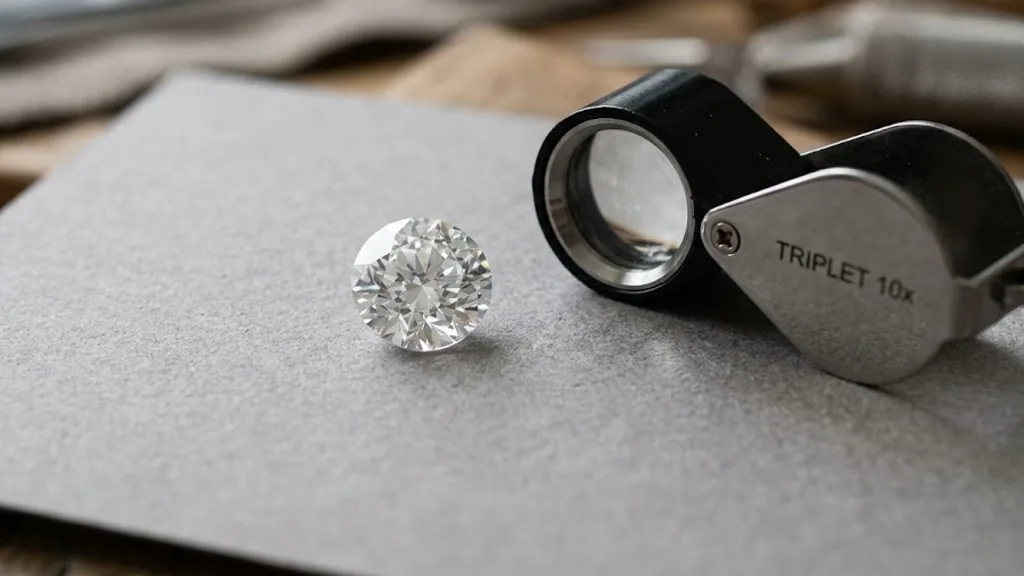
Clarity grading records how many of these there are, how big they are, where they sit and how easily a trained grader spots them under 10x magnification. That last part is the key. The whole scale is defined at ten times magnification, not at arm’s length.
The clarity scale, and where VS sits
| Grade | Full name | What a grader sees at 10x |
|---|---|---|
| FL | Flawless | Nothing inside or on the surface |
| IF | Internally Flawless | Nothing inside; minor surface blemishes only |
| VVS1 / VVS2 | Very, Very Slightly Included | Extremely difficult to find, even for an expert |
| VS1 | Very Slightly Included 1 | Difficult to see at 10x |
| VS2 | Very Slightly Included 2 | Somewhat easier to see at 10x, still minor |
| SI1 / SI2 | Slightly Included | Noticeable at 10x; SI2 may be visible without magnification |
| I1 / I2 / I3 | Included | Obvious, and can affect brightness or even durability |
VS sits directly in the middle of the top half. Two grades above SI, two below VVS.
Is VS clarity good? The short answer
Yes. In practical terms, a VS diamond is a clean diamond.
Both VS1 and VS2 are defined as having inclusions that are difficult or somewhat easy to see under a loupe. Neither definition includes being visible to the naked eye. In the overwhelming majority of cases a VS stone is what the trade calls eye-clean: you can hold it, turn it, and see nothing.
The honest caveat is that “eye-clean” is not a graded term. It is a description, not a grade, and it depends on your eyesight, the lighting and how close you look. It is a rule of thumb in the trade rather than a measured standard.
VS1 against VS2
The gap between them is one step, and it is genuinely small.
| VS1 | VS2 | |
|---|---|---|
| Definition | Inclusions difficult to see at 10x | Inclusions somewhat easy to see at 10x |
| Naked eye | Eye-clean in effectively all cases | Eye-clean in almost all cases; occasional exceptions in large or step-cut stones |
| Typical inclusion position | Often towards the edge or under a crown facet | More likely to include something under the table, the big flat top facet |
| Price position | Slightly higher | Slightly lower — often the best value point on the scale |
The practical advice: VS2 is where a lot of experienced buyers stop, because it delivers a clean-looking stone for less than VS1. The one thing worth checking is where the inclusion sits.
Position matters more than the grade letter
Two VS2 diamonds can look quite different, and the certificate tells you why.
Every laboratory report includes a plot — a diagram of the stone with its inclusions marked. Read it. What you want to know is:
- Is anything under the table? The table is the large flat facet on top. Inclusions there are in the most visible spot.
- Is anything near the girdle? The girdle is the thin band around the widest part. Inclusions here are usually hidden by the setting or the claws.
- Is there a feather reaching the surface? A feather is a small internal fracture. Contained ones are harmless; ones breaking the surface at a vulnerable point are worth asking about.
- Is a cloud listed as a comment? Large clouds can make a stone look very slightly hazy even when the grade looks fine. Certificates sometimes note this.
A VS2 with a small crystal near the girdle is a better buy than a VS1 with a dark crystal dead centre under the table. The letter alone does not tell you that.
Shape changes how forgiving VS is
This is the single most useful thing to know when choosing a clarity grade.
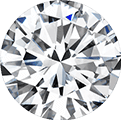
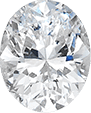
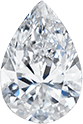
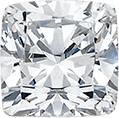
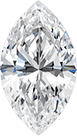
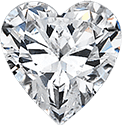
- Brilliant cuts hide inclusions. Round, oval, pear, marquise, cushion, heart and radiant all have busy facet patterns that scatter light and break up the view into the stone. VS2 is comfortably safe here. Our Halo Marquise Cut Engagement Ring in White Gold, at £1,143 correct at the time of writing, is a good example — the halo adds even more visual busyness.
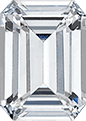
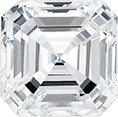
- Step cuts reveal them. Emerald, asscher and baguette cuts use long, open, parallel facets. Looking into one is like looking through a clear window, and small features show far more readily. For these shapes, VS1 is the sensible floor. Our Three Stone Emerald Cut Engagement Ring, at £1,017 correct at the time of writing, is exactly the kind of open cut where clarity earns its money.
- Small accent stones need less. Melee — the tiny diamonds in pavé bands and halos — are far too small for anyone to see into. Paying for high clarity in accent stones makes very little sense. A Stackable Emerald Cut Half Eternity Band, at £770 correct at the time of writing, spreads its sparkle across many small stones rather than one large one.
Browse by shape if you want to compare — emerald, marquise — or see all our engagement rings together.
Does clarity affect sparkle?
Barely, at VS level. The features in a VS stone are far too small and too few to interfere with the light bouncing around inside.
What genuinely drives sparkle is cut: the angles and proportions that decide whether light entering the top comes back out to your eye or leaks through the base. If you are balancing a budget, protect cut first, then choose the clarity grade that suits your shape.
Clarity only starts to cost you brightness at the lower end of the scale, where large clouds or heavy included material can genuinely dull a stone. That is an I-grade problem, not a VS one.
VS clarity in lab-grown diamonds
Lab-grown diamonds are graded on the same FL to I3 scale, by the same laboratories, using the same 10x standard. A VS1 lab-grown stone and a VS1 natural stone carry the same grade definition.
Lab-grown stones do contain inclusions — they are crystals, and crystals grow with features. The types differ slightly: metallic flux inclusions can appear in stones made by the HPHT method, while CVD-grown stones tend towards pinpoints and small dark features. None of this changes the grading.
What it does change is availability. Higher clarity grades are more readily produced in a growth chamber than found in the ground, which is why VS and VVS grades are relatively easy to source in lab-grown at sizes that would be a stretch in natural stones. Treat that as general guidance about how the two markets behave, not a quoted figure.
Every centre stone we set comes with a free IGI certificate recording the clarity grade and the plot diagram.
Should you go higher than VS?
Only for a specific reason. Our guide to VVS1 clarity covers the grade above in detail, but the short version is:
- Go up to VVS if you are buying a large emerald or asscher cut, or if you genuinely want the certificate to say it.
- Stay at VS for essentially every brilliant cut in every everyday size.
- Consider SI if the stone is a brilliant cut, you have seen it or a clear image of it, and the plot shows nothing central. Our guide to SI1 and SI2 clarity explains where the risk sits.
Frequently asked questions
Can you see inclusions in a VS diamond?
Not with the naked eye, in almost all cases. Under a 10x loupe an experienced person will find them — that is what the grade describes. Across a table, on a hand, in normal light, a VS stone looks clean.
Is VS1 noticeably better than VS2?
Not to look at. VS1 inclusions are marginally harder to find under magnification, but both grades read as clean to the eye. The exception is a large step cut, where VS1 is the safer choice.
Is VS2 good enough for an engagement ring?
Yes, and it is one of the most commonly chosen grades for exactly that reason. Check the plot on the certificate to confirm nothing sits centrally under the table, and you are in good shape.
What is the difference between VS and VVS?
VVS inclusions are extremely difficult for even a skilled grader to find at 10x; VS inclusions are difficult but findable. Both are eye-clean. The difference lives on the certificate, not in the ring.
Will a VS diamond’s inclusions get worse over time?
No. Inclusions are part of the crystal and do not grow, spread or change. Diamond is the hardest material there is and does not degrade in normal wear.
Where this leaves you
If you want one sentence to take away: choose VS2 for a brilliant cut, VS1 for a step cut, and spend what you save on cut quality or carat weight.
All of our centre stones are lab-grown and IGI certified, hand-set in solid gold or platinum in North Harrow, London, with free insured UK delivery and 30 days to change your mind. If you would like a particular clarity grade in a design we do not stock, we make bespoke pieces at no extra design cost.
Ready to find your perfect ring?
Explore our lab-grown diamond collection or book a virtual appointment with our team.