What Is a Solitaire Engagement Ring?
One diamond, one setting, one band. What a solitaire is, how claw counts change it, and where to spend the budget.
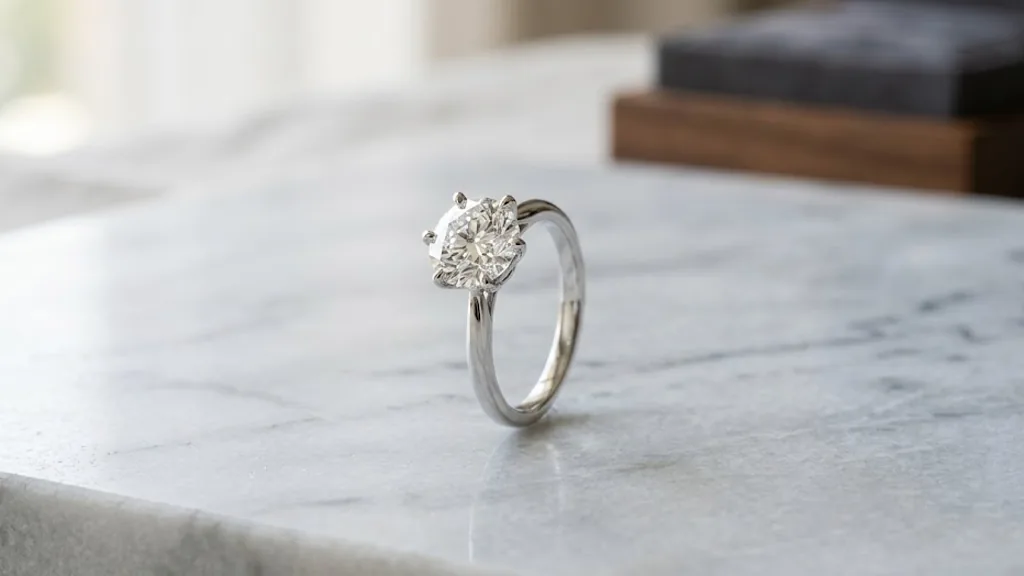
A solitaire engagement ring is a ring with one diamond and nothing else. No side stones, no halo, no diamonds along the band. One stone, one setting, one band.
The word comes from the French for “solitary”. It is the oldest and simplest engagement ring format still in wide use, and it remains the design most people picture when they hear the words “engagement ring”.
The three parts of a solitaire
Every solitaire is made of the same three elements, and understanding them makes the choices much easier.
The stone. The centre diamond. On a solitaire this is the entire visual statement, so its cut quality matters more here than on any other design. There is nothing else on the ring to distract from a dull stone.
The head. The small metal structure that holds the stone. It might be four claws, six claws, or a continuous rim of metal called a bezel. The head controls how high the stone sits and how much light reaches it from the sides.
The band. Also called the shank. Plain on a true solitaire. Its width changes the look of the ring far more than most people expect: a narrow band makes the stone look larger, a wide band makes it look more modest and more modern.
Claw counts and what they actually change
| Setting | Look | Security | Light |
|---|---|---|---|
| Four claw | Squarer outline, more of the stone’s edge visible | Good, but losing one claw is more serious | Excellent, very open |
| Six claw | Rounder outline, classic | Better; one claw failing still leaves five | Excellent |
| Bezel | Modern, clean, the stone framed by metal | The most secure of the three | Slightly reduced from the sides |
Six claws is the safest general recommendation. Four claws suits square and rectangular stones particularly well, because the claws land on the corners where the stone needs protecting anyway. A bezel is the right answer for anyone who works with their hands, because there is nothing to catch. Our Bezel Cushion Cut Engagement Ring in Platinum is £904 at the time of writing and shows how contemporary that setting looks.
Why people still choose solitaires
Four reasons come up again and again, and none of them are about fashion.
Nothing dates. A solitaire has no design signature belonging to a particular decade. A ring bought in 1960 and a ring bought today look substantially the same.
It shows the diamond honestly. There is no frame making the stone look larger, no melee filling the gaps. What you see is what you bought, and the certificate tells you exactly what that is.
It is easy to live with. Fewer stones means fewer things to loosen, fewer places for grime to collect, and simpler cleaning.
It pairs with anything. A plain solitaire sits flush against a straight wedding band, which is not true of most halo and cluster designs.
The trade-off, stated plainly
A solitaire gives you less visual size for your money than a halo does. That is the honest comparison. A halo of small diamonds around a modest centre stone will look bigger on the finger than the same money spent on a solitaire.
What a solitaire gives you instead is the centre stone itself. If two people spend the same amount, the one buying a solitaire will typically end up with a noticeably better centre diamond. Which of those matters more is a genuine personal choice, not a right answer. Our guide to what a halo engagement ring is sets out the other side of it.
Which shapes suit a solitaire
All of them, but they behave differently.
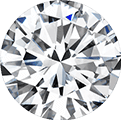
- Round. The most light return of any shape, and the safest choice if you are unsure. Our Solitaire Round Cut Engagement Ring in White Gold is £563 at the time of writing.
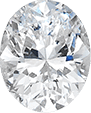
- Oval. Looks larger than a round stone of the same weight because the shape is spread out. Our Solitaire Oval Cut Engagement Ring is £557 at the time of writing.
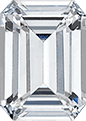
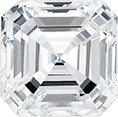
- Emerald. Long, stepped facets that give flashes rather than glitter. Very unforgiving of inclusions, so clarity matters more here.
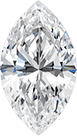
- Marquise. The most finger-lengthening shape, and the most dramatic in a plain setting. Our Solitaire Marquise Cut Engagement Ring is £538 at the time of writing.
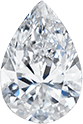
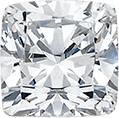
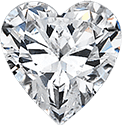
- Cushion, pear, radiant, heart. All work well solitaire, though pointed shapes benefit from a claw specifically over each point.
Getting the most from a solitaire budget
Because there is nothing to hide behind, spend where it shows.
Put your money into cut quality first. A well-cut stone at a lower colour grade will out-sparkle a poorly cut stone at a higher grade every time, and cut is the one grade you cannot compensate for later.
Clarity matters most on large, open-faceted shapes like emerald and asscher, where you look straight into the stone. On brilliant-cut shapes, the facet pattern hides small inclusions well, and a stone graded SI1 often looks identical to a VS2 with the naked eye.
Colour matters more in platinum and white gold than in yellow or rose gold, because warm metal makes a slightly warm stone look whiter by contrast. Choosing yellow gold is a legitimate way to buy a lower colour grade without seeing the difference.
Frequently asked questions
Is a solitaire ring boring?
It is deliberately restrained, which is not the same thing. If you want the ring to have more personality without adding a halo, the band is where to do it: a twisted shank, a knife-edge profile, or a bezel head all change the character while keeping one stone. Our Twisted Round Cut Engagement Ring, £1,007 at the time of writing, is an example.
Are solitaire rings more expensive than other styles?
Not per ring, but often per carat of centre stone, because all the value sits in one diamond rather than being spread across many small ones. We look at this properly in our guide to how much a solitaire diamond ring costs.
Can you add stones to a solitaire later?
Yes, and it is one of the most common upgrades we are asked about. A halo can be added, or diamonds set into the shoulders. Our guide on adding a halo to an existing ring explains what is involved.
What size of diamond suits a solitaire?
Any size, though below about 0.30 carat a solitaire can look sparse on a wider finger. There is no correct weight, only what looks right on the hand it is going on.
Does a solitaire come with a certificate?
Ours do. Every centre stone comes with a free IGI certificate, which records the carat weight, colour, clarity and cut of the exact diamond in your ring. With a solitaire, that document describes the whole ring, which is part of why the format is so easy to value and insure.
Have a look through our engagement ring collection to compare shapes and settings. Every ring is lab-grown diamond, hand-made in solid gold or platinum in North Harrow, London, with free insured UK delivery and 30-day returns.
Ready to find your perfect ring?
Explore our lab-grown diamond collection or book a virtual appointment with our team.