
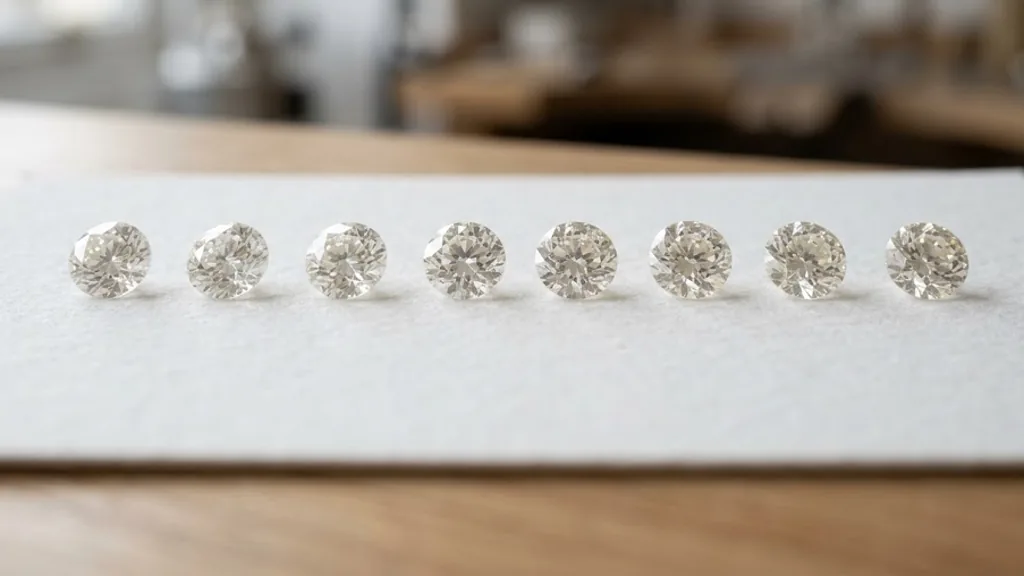
How Coloured Diamonds Are Made
Colour is either grown into a diamond or added afterwards by treatment. Both routes explained, plus what has to be disclosed to you before you buy.
Coloured diamonds are made in two quite different ways, and the difference decides what the stone is worth. Either the colour is built in while the crystal grows, or it is added afterwards by treating a finished stone. Both produce genuine diamond with genuine colour. Only one of them is generally regarded as the higher-value route.
This guide explains both, in plain English, for mined and laboratory-grown stones alike. It also covers what has to be disclosed to you, because that is the part that protects your money.
Route one: colour built in during growth
A diamond takes its colour from what is present while the carbon crystallises. In a laboratory, that is something you can control deliberately.
There are two growing methods. HPHT stands for high pressure, high temperature — it recreates the conditions deep in the earth, squeezing carbon around a small starter crystal. CVD stands for chemical vapour deposition — a carbon-rich gas is broken down in a chamber and carbon settles layer by layer onto a thin diamond seed. We have a full explainer on the difference between CVD and HPHT growth if you want the detail.
Either way, the colour depends on what else is allowed into the chamber:
- Nitrogen produces yellow. Nitrogen atoms take the place of a few carbon atoms and absorb blue light, leaving a yellow body colour.
- Boron produces blue. Boron absorbs at the red end of the spectrum instead, leaving blue.
- Excluding everything produces colourless. Growing a clean, colourless diamond means keeping impurities out, which is harder than letting them in — and it is what almost all jewellery-grade laboratory diamonds are grown to achieve.
Colour grown in this way is as permanent and as real as colour that formed in the earth. The atoms are in the crystal.
Route two: colour added after the stone is finished
The second route takes an existing diamond — usually a dull brownish one of little value — and changes its colour. Three techniques dominate.
Irradiation. The stone is bombarded with electrons or neutrons, knocking atoms out of position and creating gaps in the structure that absorb light. This typically produces green, and often blue or blue-green.
Irradiation followed by annealing. Heating an irradiated stone in a controlled way rearranges those gaps, shifting the colour on to yellow, orange, brown or pink. Most treated pink and orange diamonds on the market come from this two-step process.
HPHT treatment. Putting a finished diamond back under high pressure and high temperature repairs some of the crystal distortion that causes brown. It can turn a brown stone colourless, or push it towards a strong yellow-green depending on the starting material.
There are also surface treatments — thin coloured coatings applied to the pavilion. These are the least durable option and can be damaged by heat or abrasive cleaning. They must always be disclosed.
Grown colour versus treated colour
| Colour built in during growth | Colour added by treatment | |
|---|---|---|
| How the colour got there | Impurity atoms present as the crystal formed | Radiation, heat or pressure applied afterwards |
| Permanent? | Yes | Yes for irradiation and HPHT; coatings can wear |
| Detectable? | Identified as laboratory-grown by a gem laboratory | Yes, by spectroscopy at a gem laboratory |
| Must be disclosed? | Yes — stated on the report and usually laser inscribed | Yes — stated on the report |
| Relative value | Higher of the two | Lower — often substantially |
What a laboratory report tells you
With colourless diamonds a report is useful. With coloured diamonds it is essential, because nothing about how the colour arrived is visible to the eye — not yours, and not most jewellers’ either.
A report from a recognised laboratory such as IGI or GIA will state the colour grade, whether the stone is natural or laboratory-grown, and whether the colour is natural or the result of treatment. Laboratory-grown diamonds are also normally laser inscribed on the girdle with the report number and wording identifying them as lab grown — readable under magnification.
If a seller offers a strongly coloured diamond at a price that seems too good for its colour and size, treatment is almost always the answer. That is perfectly legitimate. Not saying so is not.
What we make, and what we do not
We do not stock fancy coloured diamonds. Every ring in our collection uses colourless or near-colourless lab-grown diamonds, with a free IGI certificate on the centre stone. We would rather tell you that plainly than pretend otherwise.
If you want colour in a ring, the honest and far cheaper route is the metal. Yellow and rose gold cast warmth into a diamond and change the character of the whole piece. The 5 stone radiant cut engagement ring in yellow gold does exactly that, at £917 at the time of writing. So does the bezel hexagon cut engagement ring in rose gold, where the rubbed-over setting puts warm metal right around the edge of the stone.
For the opposite effect — as bright and cool as possible — the bezel cushion cut engagement ring in platinum keeps everything white.
Browse the whole engagement ring collection, or look at our bridal sets if you would like the wedding band to match from the start. And if you genuinely want a coloured centre stone, ask about bespoke — we design at no extra design cost and will be straight with you about sourcing and price.
Why cutters treat coloured stones differently
Once the colour exists, the cutter’s job changes completely. With a colourless diamond, the aim is to return as much white light to the eye as possible, and there are well established proportions that achieve it.
With a coloured diamond the aim is the opposite: to keep light inside the stone long enough for the colour to build. Deeper proportions, larger pavilions and certain facet patterns all concentrate colour. That is why so many fancy colour diamonds are cut as radiants, cushions, ovals and pears, and why the classic round brilliant is comparatively rare among them — a round is engineered to let light out quickly, which weakens the colour.
It also explains why a fancy colour stone can look slightly less brilliant than a colourless one of the same size. That is not poor workmanship. The cutter chose colour over sparkle, deliberately.
What this means for the ring most people are buying
All of the above is fascinating, and almost none of it applies to a standard engagement ring. The overwhelming majority of rings sold in the UK use colourless or near-colourless diamonds, cut for maximum brightness, and that is where the best value sits by a wide margin.
If you want a ring with character, the reliable levers are shape, setting style and metal — not colour. An elongated shape reads as different on the hand. A bezel setting looks modern and holds the stone securely. A three stone design carries meaning that a single stone does not.
The three stone emerald cut engagement ring is a good example of character coming from design rather than colour, at £1,017 at the time of writing. For something quieter, the minimalist round cut engagement ring strips everything back to the stone and a fine band.
Common questions
Is a treated coloured diamond still a real diamond?
Yes. Treatment changes the colour, not the material. It is still diamond, with the same hardness and the same structure. The treatment simply has to be disclosed, and it affects value.
Which colours are easiest to produce in a laboratory?
Yellow, because nitrogen is the easiest impurity to introduce, and blue with boron. Pink is usually achieved by treating a finished stone rather than growing the colour directly.
Do treated colours fade?
Irradiated and HPHT-treated colours are stable in normal wear. Surface coatings are the exception and can be damaged by heat or harsh cleaning. Always tell a jeweller a stone is treated before any repair work involving a torch.
Are laboratory-grown coloured diamonds cheaper than natural ones?
Dramatically, in the rare colours. Natural blues and pinks in strong grades are sold as individual collector pieces. The laboratory-grown equivalent is a small fraction of that price.
Can any diamond be turned any colour?
No. The result depends heavily on the starting stone — its impurities and its structure. A treater works with what a particular diamond will respond to, which is why certain treated colours are far more common than others.
Everything we make is hand-made in solid gold and platinum in North Harrow, London, with free insured UK delivery and 30-day returns.
More guides on this topic
Ready to find your perfect ring?
Explore our lab-grown diamond collection or book a virtual appointment with our team.











