
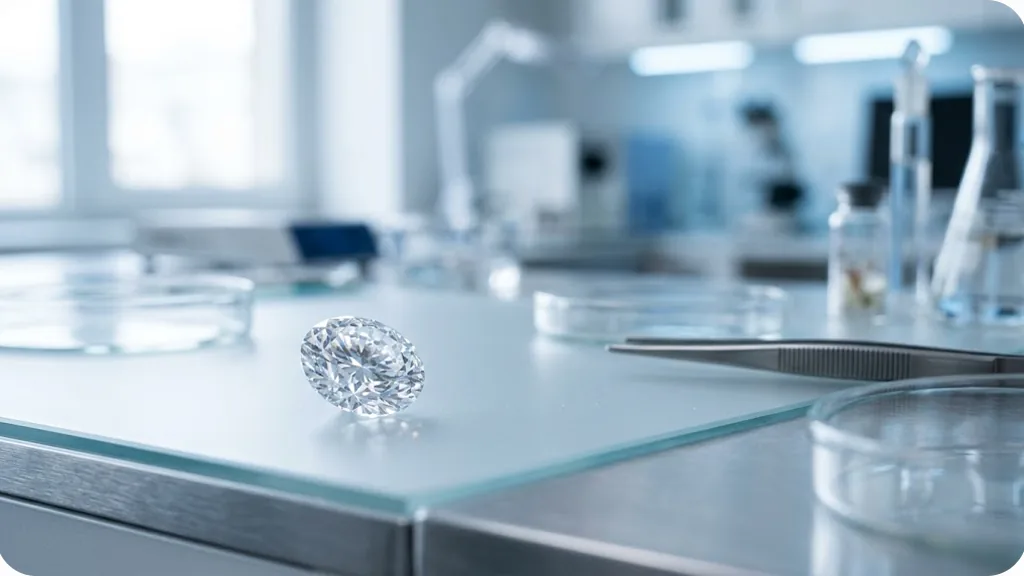
Where Do Lab-Grown Diamonds Come From?
Which countries grow and cut them, what traceability genuinely means, and the energy question answered without invented figures.
Lab-grown diamonds come from reactors, not mines. That is the short answer, but it is not a useful one on its own, because “a reactor” does not tell you which country, which company, or how much of the chain you can actually trace.
Traceability is one of the main reasons people choose grown stones in the first place, so it is worth knowing what can genuinely be traced and what cannot.
The physical journey
A lab-grown diamond passes through four stages before it reaches a ring.
1. Growth
The stone is grown in a sealed chamber, over a period of roughly two to four weeks depending on size and method. It starts from a thin slice of diamond called a seed, and carbon is added to it atom by atom until a rough crystal has formed.
Two methods dominate. HPHT recreates mantle conditions using enormous pressure and heat. CVD uses a carbon-rich gas in a low-pressure chamber, depositing carbon onto the seed layer by layer. Both produce real diamond and both are graded identically.
2. Cutting and polishing
The rough crystal is planned, sawn, shaped and polished into a finished gemstone. This is where a stone’s sparkle is won or lost, and it is skilled human work assisted by laser and computer planning.
Cutting for lab-grown stones happens in the same centres, using the same equipment and often the same cutters, as mined rough. There is no separate industry for it.
3. Grading
The polished stone goes to an independent laboratory such as IGI or GIA, which grades it on the 4Cs and issues a report stating that it is laboratory-grown. Most stones are laser inscribed on the girdle with the report number.
4. Setting
The certified stone is set into a finished piece. Ours are hand-set in solid gold and platinum in North Harrow, London.
Which countries actually grow them
Production is concentrated in a relatively small number of places, and the picture has shifted quickly over the past decade.
| Region | Role in the supply chain |
|---|---|
| India | A major centre for both growing and, overwhelmingly, for cutting and polishing |
| China | Large-scale growth, historically strongest in HPHT production |
| United States | Home to several established growers, particularly using CVD |
| Singapore, Israel, parts of Europe | Smaller specialist growers, often focused on high-end stones |
India’s role in cutting is worth emphasising. The great majority of the world’s diamonds, mined and grown alike, are cut and polished there. If you buy a diamond of any origin, it very probably passed through Surat.
What traceability really means
Here is where we would rather be precise than impressive.
A lab-grown diamond has a short chain: grown in a known facility, cut in a known centre, graded by a known laboratory. That is genuinely shorter and clearer than the path of a mined stone, which typically moves through mine, sorting house, trading centre, cutter and multiple dealers, often across several countries.
What that does not mean is that every lab-grown diamond arrives with a documented origin certificate naming the reactor. Most do not. The certificate confirms the stone is laboratory-grown; it does not usually name the grower. Some producers offer full origin documentation, and some jewellers can tell you the specific facility. Many cannot, and any seller implying otherwise without paperwork is overstating things.
The honest claim is: shorter chain, fewer unknowns, and no possibility of the stone having funded conflict. That is worth having, and it is not the same as full farm-to-table traceability.
The energy question
Growing diamonds uses a great deal of electricity. There is no way around that, and we will not pretend otherwise.
How clean that energy is depends entirely on the grid or the supply behind the facility. A stone grown on a renewables-heavy supply has a very different footprint from one grown on a coal-heavy grid, and the certificate does not tell you which. You will see confident percentage comparisons between growing and mining published by both sides of this argument. We do not repeat them, because the underlying studies are commissioned by interested parties and the figures do not survive scrutiny.
What can be said fairly: mining moves enormous volumes of rock and permanently alters landscapes. Growing consumes energy. Neither is free, and anyone offering a single tidy number is selling something.
Does origin affect the stone itself?
No. A diamond grown in India, China or the United States is the same material with the same properties. Country of origin affects nothing about hardness, sparkle, colour or durability.
What varies between growers is consistency: how reliably they produce colourless, high-clarity, well-formed rough. That shows up in the grades on the certificate, which is exactly what the certificate is for. Judge the stone by its report, not by its passport.
What to ask a seller about origin
If origin genuinely matters to you, these are the questions that get useful answers rather than reassuring noises.
- “Which laboratory graded the centre stone, and what is the report number?” This is the foundation. Everything else is easier once you can verify the report online.
- “Does the report state CVD or HPHT?” It will. This tells you the growth method, though not the facility.
- “Do you have origin documentation naming the grower?” Some sellers do, many do not. A straight “no” is a fine answer. A vague answer that avoids the word “no” is less encouraging.
- “Where was the stone cut?” Usually India. Almost nobody will be able to name the specific workshop, and that is normal across the whole trade.
- “Where is the ring itself made?” This one you can usually get a precise answer to, and it tells you a lot about the piece. Ours are hand-made in North Harrow, London.
Our own position, stated plainly: we can tell you the growth method and give you the full IGI report on every centre stone, and we can tell you exactly who made the ring and where. We cannot always name the specific facility a stone was grown in, and we will say so rather than invent a story. That is the honest limit of what most jewellers in this country can offer today, whatever the marketing suggests.
Frequently asked questions
How long does a lab-grown diamond take to make?
Typically two to four weeks of growth, depending on the target size and the method, followed by cutting, polishing and grading. The whole process from seed to certified stone usually takes a couple of months.
Are lab-grown diamonds made from mined diamonds?
Only in one small sense. The seed plate at the start is a thin slice of diamond, which may itself be lab-grown. The bulk of the stone is built from carbon supplied as gas or from a carbon source in the press.
Can I find out exactly where my stone was grown?
Sometimes. Some producers supply origin documentation, and we will pass on whatever we have. In many cases the certificate confirms only that the stone is laboratory-grown, and we will tell you that plainly rather than guess.
Does the growth method appear on the certificate?
Yes, IGI and GIA reports state whether the stone was grown by CVD or HPHT. It is a point of interest rather than a quality indicator, since both produce excellent stones.
Where are your rings actually made?
By hand in North Harrow, London, in solid gold or platinum. The stones are grown and cut abroad, as essentially all diamonds are, and every centre stone comes with a free IGI certificate.
What to focus on instead
Origin is worth understanding, but it is not the variable that decides whether you love a ring. Cut quality, shape and the standard of the setting do that.
If you want to see the difference craftsmanship makes, put a clean design like our Solitaire Oval Cut Engagement Ring next to a more worked piece such as the Halo Marquise Cut Engagement Ring in White Gold, or a hand-finished band like the Twisted Round Cut Half Eternity Band.
Browse the engagement ring collection or the marquise cut rings, and ask us anything about a stone’s paperwork before you buy. Free insured UK delivery and 30-day returns on everything we make.
More guides on this topic
Ready to find your perfect ring?
Explore our lab-grown diamond collection or book a virtual appointment with our team.











