How Was the First Diamond Cut? A Short History of Diamond Cutting
Only diamond cuts diamond. How cutters got from uncut crystals to the modern round brilliant, and what antique cuts still offer.
Diamond is the hardest natural material there is. So the obvious question about the first diamond ever cut is: what on earth did they cut it with?
The answer is the key to the whole history. Nothing else will cut a diamond. Only diamond will, and once someone worked that out, every advance in diamond cutting followed from it.
Here is how diamonds went from rough octahedral crystals worn as they were found, to the precisely engineered round brilliants in the shops today.
Before anyone cut anything
For most of recorded history, diamonds were not cut at all. They were valued for their extraordinary hardness and their natural shape.
Diamond crystals often grow as octahedrons: two four-sided pyramids joined base to base, producing a natural point. Early diamonds in India, where the world’s supply came from for centuries, were prized precisely because that shape was already striking. They were set point upwards and left alone.
There was also a belief that altering a diamond destroyed its protective powers, which discouraged experimentation. And of course there was the practical problem: nobody had a tool that could touch one.
The first real cuts
The earliest deliberate diamond cutting appears in Europe in the medieval period, and it was minimal. Cutters polished the existing facets of the natural octahedron to make them smoother and more reflective, rather than reshaping the stone.
The first true cut was the point cut: simply a polished-up natural octahedron. From it came the table cut, which was the first genuinely new idea. Cutters ground the top point off the octahedron, creating a flat square face on top called a table. That flat surface let light into the stone and gave a much brighter appearance than the plain point.
This happened around the fourteenth and fifteenth centuries. It sounds modest. It was the foundation of everything.
How they did it with no other hard material
Two techniques, both still recognisable in a modern workshop.
Cleaving. Diamond, despite its hardness, has planes of weakness within its crystal structure. Strike it in exactly the right place, along the right plane, and it splits cleanly. Get it wrong and you shatter a fortune. Cleaving was a specialist skill, done by hand, and until the twentieth century it was performed with a steel blade and a mallet, sometimes after days of study.
Bruting and polishing with diamond dust. Since only diamond cuts diamond, cutters ground diamonds against each other, and collected the resulting dust to charge a rotating wheel. That dust-loaded wheel, called a scaife, is what actually polishes the facets. The scaife was in use by the fifteenth century and the principle has never changed.
The centuries of refinement
| Period | Development | What it achieved |
|---|---|---|
| Ancient India | Uncut octahedral crystals | Natural shape prized as found |
| 1300s to 1400s | Point cut, then table cut | Light finally admitted into the stone |
| 1400s | The polishing wheel and diamond dust | Controlled, repeatable faceting |
| 1500s | Rose cut | Flat base, domed faceted top; soft candlelit glow |
| 1600s | Old mine cut | First cut aiming deliberately at brilliance |
| 1800s | Old European cut | Rounder outline, still cut by eye |
| Early 1900s | The modern round brilliant | Proportions calculated mathematically for maximum light return |
The turning point in that list is the last row. In the early twentieth century, cutting stopped being an art guided by instinct and became a matter of optics. By calculating how light travels through the stone, cutters could work out the angles that send the most light back to the eye, rather than leaking it out of the bottom.
That is why a well-cut modern round brilliant outperforms every antique cut for sheer sparkle. It is not that the old cutters lacked skill. They lacked the maths and the measuring equipment.
What the antique cuts still offer
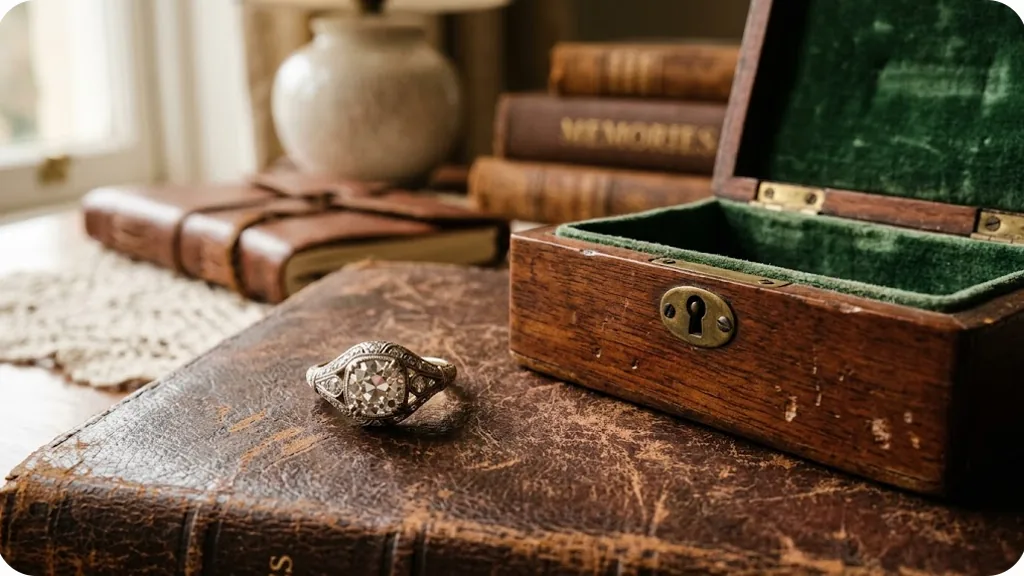
Old cuts have not been beaten so much as overtaken on one particular measure. Judged on character rather than brightness, they hold up beautifully.
Rose cuts, with a flat base and a domed faceted crown, give a soft, watery shimmer instead of hard flashes. They were designed for candlelight and they still look wonderful in low light. We stock rose cut stones, and you can see the effect in our Vintage Pear Rose Cut Engagement Ring and in the Bezel Rose Cut Eternity Band in Sterling Silver.
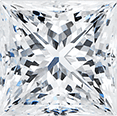
We should be straight about the others. We do not stock old European cut or old mine cut stones, and we do not stock princess cut either. If you want an antique-style cut, we will design and make the piece bespoke at no extra design cost, rather than steer you towards something else and call it close enough.
Modern cutting
Today a rough stone is scanned in three dimensions before anyone touches it. Software models every possible finished stone that could come out of that rough and calculates which option yields the best combination of size and quality. Lasers do the sawing. Human cutters still do the final polishing on a scaife charged with diamond dust, exactly as in the fifteenth century.
The tools changed. The fundamental fact did not: only diamond cuts diamond.
How the shapes we know today emerged
Most of the shapes in a modern jeweller’s window are descendants of solutions to practical cutting problems, not designs dreamt up for their looks.
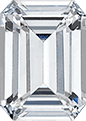
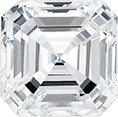
Emerald cut. The step-cut style was developed for emeralds, which are brittle and prone to chipping. Long parallel facets and a cut-off corner reduce the stress on the stone. Applied to diamond, it produced that calm, architectural look with its hall-of-mirrors flashes. You can see the effect in our Solitaire Emerald Cut Engagement Ring.
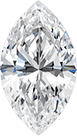
Marquise. An elongated shape with points at both ends, said to have been commissioned in eighteenth-century France. The elongation makes a stone look larger for its weight, which is why it remains popular.
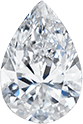
Pear. A hybrid of round and marquise, first cut in the fifteenth century by the Flemish cutter credited with inventing the polishing wheel. It has survived unchanged in principle for over five hundred years.
Baguette. A small rectangular step cut that came into its own in the Art Deco period, when geometric design demanded stones that would sit in clean straight lines.
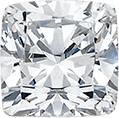
Cushion. The direct descendant of the old mine cut, softened and rounded over time as cutting technology improved.
Each of these still looks best when the cutting is done properly, and each rewards a setting designed around its particular strengths and weaknesses. A marquise or pear needs its points protecting; an emerald cut needs a high colour grade; a cushion suits a slightly warmer stone beautifully.
Frequently asked questions
What was the very first diamond cut called?
The point cut, which was really just a polished natural octahedral crystal. The table cut, which ground the top point flat, was the first shape that genuinely departed from what nature produced.
What is used to cut diamonds?
Other diamonds. Diamond dust on a rotating wheel does the polishing, and laser saws now do much of the sectioning. Nothing softer than diamond will mark it.
Why do antique diamonds look less sparkly?
They were cut by eye, before anyone had worked out the optimal angles, and often for candlelight rather than electric light. They leak more light through the bottom of the stone. Many people prefer that softer look, which is a taste rather than a fault.
Are lab-grown diamonds cut the same way?
Yes, in the same cutting centres, on the same equipment, by the same cutters. The rough is diamond, so the process is identical. Only the origin of the rough differs.
Which cut sparkles most?
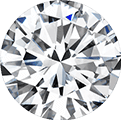
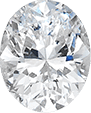
A well-proportioned round brilliant, because its faceting was designed mathematically to return the maximum light. Cut quality matters far more than shape, though: an excellent oval will outshine a mediocre round every time.
Six centuries later
Every modern engagement ring rests on that first realisation in a medieval workshop: that a diamond could be shaped, and that only another diamond could do it.
If you would like to see where that history landed, compare a mathematically proportioned Solitaire Round Cut Engagement Ring against the softer antique feeling of the rose cut pieces above. Browse the full engagement ring collection, or the round cut rings for the shape that six hundred years of refinement produced. Every centre stone comes with a free IGI certificate, and everything is hand-made in solid gold or platinum in North Harrow, London.
Ready to find your perfect ring?
Explore our lab-grown diamond collection or book a virtual appointment with our team.