
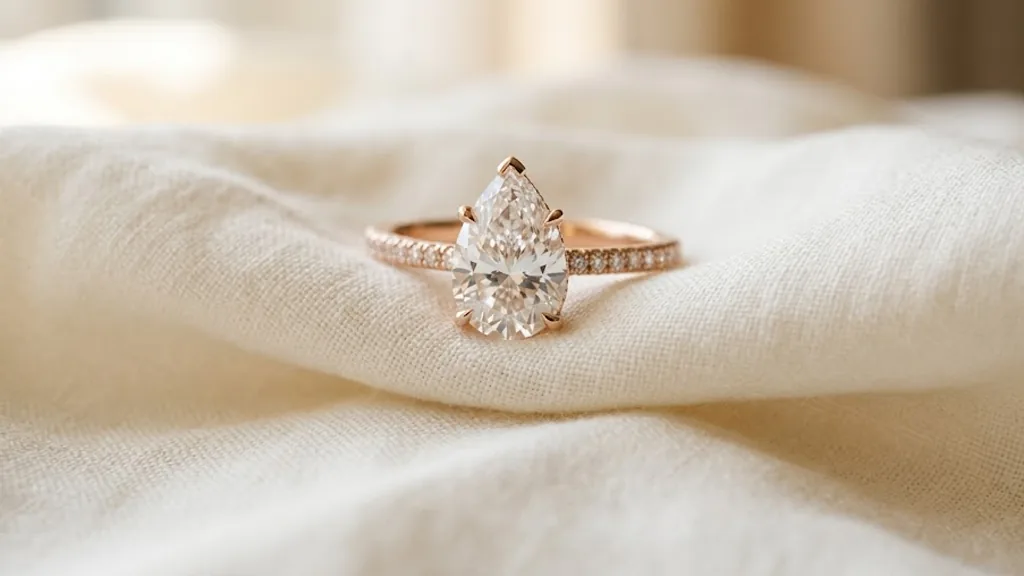
Are Pear Shaped Diamonds Still Popular? What Our Stock Shows
Yes. Pear is the second most stocked shape we make, at 11 rings behind round. No public figure measures shape popularity, so this is what our bench sees.
Yes, pear shaped diamonds are still popular, although no reliable public figure exists to prove it either way. What can be counted is stock: pear is the second most common shape in our own range, at 11 rings behind round at 20. The honest caveat is that popularity is a poor test for a ring you will wear for decades.
Can anyone actually measure how popular a diamond shape is?
Measuring how popular a diamond shape is turns out to be far harder than it sounds, and we will not pretend otherwise. There is no UK register of engagement ring sales and no public dataset that breaks purchases down by shape. The percentages that circulate online usually come from one retailer reporting its own website traffic, which tells you what one shop sold, not what the country bought. So this page uses what can be checked: our own stock and our own workshop.
What does our own stock say about pear demand?
Our own stock is the most honest number we can give you. Of the 68 rings in our range at the time of writing, 11 carry a pear shaped centre stone, which puts pear second only to the round brilliant at 20 rings. A jeweller does not tie up gold in a shape nobody asks for, so a line that size is a demand signal rather than a marketing one. Those 11 pear rings run from £503 to £1,237, correct at the time of writing.
Why has the pear shape lasted this long?
The pear shape has lasted because its outline does two useful jobs at once. Ending in a point makes the stone read as longer than a round of the same weight, and a long stone lengthens the finger it sits on. At the same time a pear is distinctive enough to feel like a choice rather than a default, without being so unusual that it ties the ring to one decade. Our guide to where the pear cut came from covers its history and meaning.
Is a pear shaped diamond a trend or a classic?
A pear shaped diamond is a classic outline that goes through fashionable phases, and the two things are easy to confuse. The cut itself has been made continuously for centuries, so it cannot sensibly be called a passing trend. What does move in cycles is how a pear is set: the halo years, the east-west years, the two stone years. Our complete guide to diamond shapes and cuts sets the pear against every other outline we make.
Will a pear shaped engagement ring look dated later?
A pear shaped engagement ring dates through its setting far sooner than through its stone, and that is the useful thing to know before you buy. The outline of the diamond is a piece of geometry, and geometry does not go out of fashion. What ages is everything around it: a very thin split band, a heavy pierced gallery, a halo cut to last decade’s proportions. Our post on whether an oval will date makes the same argument for elongated shapes generally.
Which pear ring styles do buyers actually ask for?
Pear ring styles fall into three groups, and our own range is built around them rather than around any published trend list. Toi et moi and two stone designs are the ones buyers tend to arrive already knowing they want. Three stone pears and simple claw set solitaires are the quieter choice, for someone who wants the shape without the statement. Bridal sets are the third group, for buyers who want the band question settled at the outset.
The orientation question tends to follow the shape question almost immediately. Almost everyone wears the point towards the fingernail, and our guide to which way to wear the point explains why that became the default.
What puts people off a pear shaped diamond?
Three things put people off a pear shaped diamond, and all three have an answer. The first is the bow tie, a dark band across the middle of elongated stones, which is covered in our post on the bow tie in pear diamonds. The second is the point, which is the thinnest part of the crystal and needs a V shaped claw over it. The third is the wedding band, and which wedding band suits a pear answers that one in full.
Which pear shaped rings can you buy from us today?
Pear shaped rings in our range cover the three patterns described above without needing a bespoke commission at all. The two stone style is answered by a toi et moi pear cut ring in white gold. The quieter version of the same shape is our three stone pear ring in yellow gold. If the band question matters most, the tiara pear cut bridal set in platinum arrives already matched.
The table below lists five of the eleven pear rings we currently make, so you can see what the shape costs across the range rather than at a single price point.
| Ring | Style | Price |
|---|---|---|
| Stackable Pear Cut Engagement Ring | Pavé band | £503 |
| 5 Stone Pear Cut Engagement Ring | Side stones, yellow gold | £528 |
| Toi et Moi Pear Cut Engagement Ring | Two stone, white gold | £685 |
| Pear Cut Engagement Ring in Yellow Gold | Three stone | £938 |
| Tiara Pear Cut Bridal Set in Platinum | Solitaire and band | £999 |
Every centre stone is lab-grown and comes with a free IGI certificate, and every ring is made by hand in our North Harrow workshop. You can see all eleven pear shaped rings we make, or browse our engagement ring collection to compare the pear against the other shapes side by side.
Frequently asked questions
Which shape is asked for more often, pear or oval?
Pear, in our own range, and we would rather say that plainly than dress it up as a national figure. We stock 11 pear rings against 3 oval, which describes what one North Harrow workshop makes and nothing wider than that. No public dataset ranks engagement ring shapes by UK sales, so anyone quoting a percentage is quoting one shop.
Who tends to choose a pear shaped ring?
Buyers who want an elongated stone but find the oval too quiet tend to choose a pear. It is also chosen often by people with shorter fingers, because the point draws the eye along the hand rather than across it. In practice the strongest predictor is simply whether someone likes the outline, since a pear is a shape people react to immediately.
What makes a pear ring look dated, if not the shape?
The mount does. A halo in last decade’s proportions, a very thin band that has gone out of favour, or a yellow gold head on a white gold shank will all age a ring while the stone stays current. All three are fixable at the bench, because the diamond can be reset into a new mount without ever being recut.
Does a pear shaped diamond cost less than a round?
Yes, usually. A pear keeps more of the original crystal than a round brilliant does, so less material is lost in the cutting and the price per carat comes out lower. A pear also spreads wider on the finger for the same carat weight. Our post on what a pear ring costs sets out the exceptions to that.
Do you make pear shaped wedding bands as well?
Yes. Two of our 11 pear rings are wedding bands rather than engagement rings: a chevron band in rose gold and a seven stone band in sterling silver. Both are shaped to sit against a pointed centre stone without leaving a gap at the point. We also make curved and contoured bands to order at no extra design cost.
Which length-to-width ratio looks most current on a pear?
Ratios of roughly 1.50 to 1.70 to 1 are the range the trade treats as the usual choice, with shorter, rounder pears reading as more vintage. That is a rule of thumb rather than a measured figure: no grading body publishes an ideal ratio for a pear. It is genuinely a matter of taste, so ask to see two ratios side by side.
More guides on this topic
Ready to find your perfect ring?
Explore our lab-grown diamond collection or book a virtual appointment with our team.











