Is a Cluster Engagement Ring the Same as a Halo?
No. A halo frames one centre diamond with 1–1.5 mm stones, while a cluster groups several similar stones into one shape. Here is how they differ.
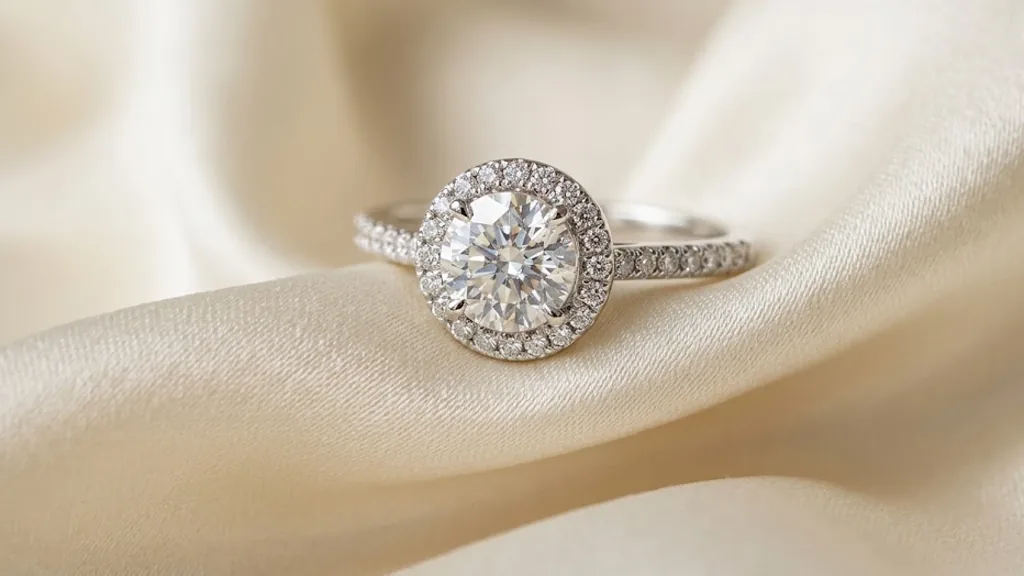
No, a cluster engagement ring is not the same as a halo. A halo ring has one main diamond circled by a single row of much smaller stones, usually about 1 to 1.5 mm each. A cluster ring groups several stones of similar size into one shape, with no single star. The difference changes the price, the paperwork and how the ring looks from across a room.
What is a cluster engagement ring?
A cluster engagement ring is a ring where several diamonds sit tightly together so they read as one larger shape, often like the petals of a flower. The classic layout is seven stones: one in the middle and six around it, all close in size. No single stone dominates. Cluster rings were popular in Georgian and Victorian jewellery, which is why the style still feels vintage today.
Many rings mix both ideas. Our Cluster Round Cut Engagement Ring keeps a 1 to 3 ct round centre and adds clusters of 2.6 mm stones on the shoulders.
How is a halo different from a cluster?
A halo is different from a cluster because a halo always has a clear star: one larger centre diamond, framed by a ring of much smaller stones that follows its outline. In a typical halo the frame stones are 1 to 1.5 mm wide, set around a 6.5 mm centre for a 1 ct round. A cluster spreads the attention evenly. A halo frames one diamond; a cluster builds the shape from many.
Which looks bigger on the finger, a cluster or a halo?
A cluster or a halo can both look bigger on the finger than a solitaire of the same total weight. A halo typically adds 2 to 3 mm to the width of the centre stone, so a 6.5 mm round reads as roughly 9 mm across. A cluster’s whole outline is stone. For spread per pound, a cluster usually wins; for one bright point of light, a halo does.
The table below shows that a halo is built around one diamond, while a cluster shares the work between many.
| Feature | Halo ring | Cluster ring |
|---|---|---|
| Centre stone | One clear centre, often 1 ct or more | No single star |
| Small stones | One row, about 1–1.5 mm each | Several of similar size |
| Certificate | Usually for the centre stone | Rarely for each stone |
| Best for | Sparkle from one diamond | Vintage look and spread for the money |
Does a cluster ring come with a diamond certificate?
A cluster ring rarely comes with a certificate for every stone, because grading each small stone would cost more than it adds. Certificates such as IGI reports are normally issued for the main stone, while accent stones are listed by total carat weight. Our Cluster Pear ring, for example, has a 0.7 to 3.0 ct pear centre with 0.11 ct of small stones around it.
CarbonstoneUK, of North Harrow, London, includes a free IGI certificate on every centre stone, so choose a centre-led design if paperwork matters.
How much does a cluster ring cost compared with a halo?
A cluster ring usually costs less than a halo of the same face-up size, because small diamonds are cheaper than large ones. Price per carat climbs steeply with size, for lab-grown and natural diamonds alike, so 1 ct made of seven small stones costs far less than one 1 ct stone. At the time of writing, our Cluster Round ring starts at £707 and our Cluster Pear at £729.
The Cluster Pear Cut Engagement Ring in Sterling Silver adds a fine beaded milgrain edge. Compare both with our halo designs in the full lab-grown engagement ring collection.
Frequently asked questions
Is a cluster ring the same as a pie cut ring?
No. A pie cut ring fits wedge-shaped diamond segments together inside one collet, like slices. A cluster uses whole small diamonds, often seven, each held by its own claws. Both give a big outline for the money, but a cluster is easier to repair if a stone is lost.
Are cluster engagement rings old-fashioned?
No. Cluster rings have roots in Georgian and Victorian jewellery, roughly 1714 to 1901, so they read as vintage rather than dated. A modern cluster in 18ct gold or platinum with crisp, even stones looks current, while a heavier, domed cluster leans towards an antique style.
Do cluster rings lose stones more often than halos?
No, not when they are well made. Both styles hold many small stones on fine claws (prongs), so both need the same care. Have the claws checked about once every 12 months, and sooner after a hard knock. Taking the ring off for the gym and gardening helps either style.
Can a halo be added around a cluster of diamonds?
Yes. A halo of small stones, often around 1 mm each, can frame a cluster to make it bolder, sometimes sold as a cluster halo. It widens the top of the ring, so try the width first. We can design one bespoke, with no extra charge for the design work.
Which suits a slim finger better, a cluster or a halo?
A small cluster usually suits a slim finger better, because it gives sparkle without a wide frame. A halo around a 1 ct round can reach about 9 mm across, which looks generous on a narrow hand. A cluster of six or seven little stones can stay nearer 6 to 7 mm.
Is a cluster ring cheaper than a solitaire of the same size?
Yes, usually. Several small diamonds cost less than one diamond of the same total weight, so a cluster as wide as a 1 ct solitaire normally costs less. The trade-off is paperwork: small stones are rarely certified one by one, while a 1 ct solitaire centre can carry its own IGI report.
More guides on this topic
Read our full guide to halo engagement rings, our answer on whether halo engagement rings are out of style, and what a pie cut diamond really is.
Ready to find your perfect ring?
Explore our lab-grown diamond collection or book a virtual appointment with our team.