How Are Small Diamonds Cut? From Rough to Finished Stone
How melee diamonds are cut, from rough crystal to sieved, matched stone: sawing, bruting, brillianteering and hand setting explained.
Look closely at a pavé band or a halo ring and you will find dozens of diamonds, each one smaller than a grain of sugar, each one faceted and polished exactly like a big diamond. People often assume these are chips, or offcuts, or something machine-stamped. They are none of those things. They are cut stones, and getting one right is a genuinely difficult piece of work.
Here is how a small diamond goes from a shapeless piece of rough to a finished stone sitting in a ring.
What counts as a “small” diamond
The trade word is melee, pronounced “meh-lay”, borrowed from the French for a scuffle or a jumble. It covers the small accent stones used in pavé settings, halos, eternity bands and shoulder details — generally anything under roughly 0.18 carat.
Carat is a unit of weight, not size. One carat is 0.2 grams, and it is divided into 100 points. So a 0.01ct melee stone is one point — one hundredth of a carat. In everyday terms, that is a stone around 1.3mm across, which is about the thickness of a stack of a few sheets of paper.
Because they are so small, melee is usually bought and sold by millimetre size rather than by weight, sorted through graded sieves into calibrated sizes. That is what allows a jeweller to order stones that will sit evenly along a band.
Stage one: sorting the rough
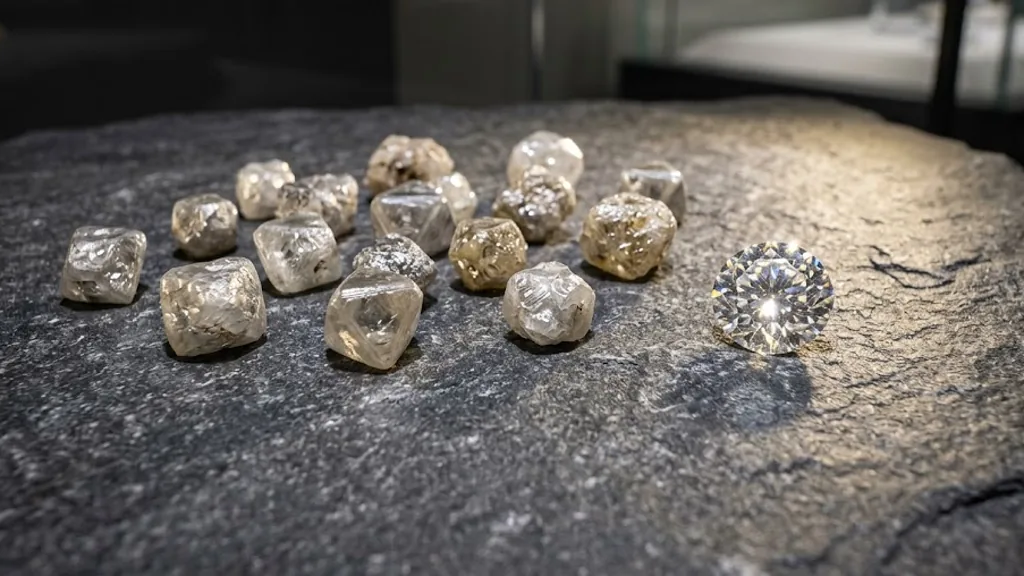
Everything starts with rough — the uncut crystal. With lab-grown diamonds the rough comes out of the growth reactor rather than out of the ground, but from this point on the process is identical to natural, because the material is identical: pure crystallised carbon.
Rough destined for melee is sorted by size, shape and clarity. Larger, cleaner crystals go to be cut as centre stones. Smaller pieces, and offcuts left over from cutting bigger stones, are gathered for melee production. Nothing usable is wasted.
Stage two: planning and sawing
For a large stone, planning is a slow, careful job done with 3D scanning to work out the biggest, cleanest finished stone hidden inside the crystal. For melee, the economics do not allow that level of individual attention, so planning is done in batches by size class.
The rough is then divided. Historically this was done by cleaving — striking the crystal along its natural grain so it split cleanly — or by sawing with a phosphor-bronze blade charged with diamond powder. Diamond is the only thing hard enough to cut diamond, so every tool in the process is loaded with diamond grit.
Today most sawing is done with lasers, which are faster, more precise and do not care about the crystal’s grain direction. For melee, laser cutting is what makes the whole category economically possible.
Stage three: bruting — making it round
A round diamond has to be made round before it can be faceted. This stage is called bruting or girdling, and it produces the girdle — the thin band around the widest part of the stone, the bit a setting’s claws grip.
The traditional method is beautifully simple: two diamonds are mounted on spinning shafts and pressed against each other, each grinding the other round. Modern production more often uses a laser or a diamond-tipped tool on a lathe. For melee, this is automated and done at high speed.
Stage four: faceting and polishing
Now the flat faces go on. The stone is held in a dop — a small clamp or holder — and pressed against a spinning cast-iron wheel called a scaife, which is dressed with a paste of diamond powder and oil. Each facet is ground and polished by contact with that wheel.
Faceting happens in two phases. Blocking puts on the main facets that establish the stone’s basic geometry: the table (the flat top), the crown facets above the girdle and the pavilion facets below it. Brillianteering then adds the smaller facets that create the fine sparkle.
The angles matter enormously. Light enters through the top, bounces off the pavilion facets and returns to your eye. Get the angles wrong and the light passes straight out of the bottom, and the stone looks dead. This is as true at 1.2mm as it is at 8mm.
What is different about cutting small stones
Three things, mainly.
Automation and multi-stone tooling. A skilled cutter cannot profitably hand-turn a one-point stone. Melee is produced on semi-automatic machines with jigs that hold and index the stone, often processing many at a time, with human oversight rather than human hands on each facet.
Facet count. A full round brilliant has 57 or 58 facets. On the smallest stones there is simply not enough surface to place that many facets and have any of them do useful optical work, so the very smallest sizes are often cut as single cuts with around 17 or 18 facets. Single cuts give broader, softer flashes. Fine jewellery mostly uses full cuts wherever size allows.
Consistency over individuality. A centre stone is judged on its own. Melee is judged as a group. Stones must match each other in size, colour and cut, because a single stone that sits proud, or reads slightly yellow next to its neighbours, ruins the line. Matching parcels of melee is a skilled job in itself.
The stages at a glance
| Stage | What happens | Trade term |
|---|---|---|
| 1 | Rough sorted by size, shape and clarity | Sorting |
| 2 | Crystal divided, now almost always by laser | Sawing / cleaving |
| 3 | Outline ground round, creating the girdle | Bruting |
| 4 | Main facets placed to set the geometry | Blocking |
| 5 | Fine facets added for sparkle | Brillianteering |
| 6 | Final polish on the diamond-charged wheel | Polishing |
| 7 | Sieved into calibrated millimetre sizes and matched | Sieving / matching |
Small stones that are not round
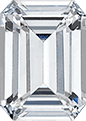
Not all accent stones are round. Baguettes are small rectangular step cuts — long parallel facets rather than tiny triangular ones — and they are cut individually rather than tumbled through a rounding process, because they need straight edges and sharp corners. Sitting side by side they read as a continuous ribbon of light, which is why a Pave Baguette Cut Wedding Band looks so architectural next to a round-set one.
Tapered baguettes, marquise accents and small pears are all cut to order for specific designs, and all take more individual attention than round melee.
Then comes the setting
Cutting is only half the story. Setting melee is delicate handwork done under a microscope. In pavé, from the French for “paved”, stones are set close together and held by tiny beads of metal raised from the ring itself with a graver, so the surface reads as continuous diamond with barely any metal showing. In an eternity band such as a Stackable Round Cut Full Eternity Band, that work runs the whole way round the finger.
Detailed antique-style designs like a Vintage Round Cut Engagement Ring in Yellow Gold combine both crafts — melee cut to match, then set by hand into milgrain and scrollwork. All of ours is done in our North Harrow workshop.
Frequently asked questions
Are small diamonds real diamonds?
Yes, completely. A melee stone is the same crystallised carbon as a centre stone, with the same hardness and the same optical properties. It is simply smaller.
Do melee stones come with certificates?
Individually, no — it is not practical or meaningful to certify a one-point stone, and the cost of the report would exceed the stone. Melee is supplied and specified as matched parcels within a stated colour and clarity range. The centre stone is what gets a report, and every centre stone we set comes with a free IGI certificate.
Why do small diamonds sometimes look brighter than large ones?
Because there are more of them, and their facets are all catching light from slightly different angles as your hand moves. It is a scattering effect rather than a sign of better cutting.
Can melee diamonds fall out?
They can, if a bead or claw is knocked or worn down over years, which is true of any jewellery. Bead-set pavé is robust in normal wear. It is worth having a pavé ring checked every couple of years, and avoiding heavy manual work with it on.
Are lab-grown melee stones cut differently?
No. Same wheels, same angles, same sieves, same matching process. The only difference is where the rough came from.
See the craft in person
If you want to look at how melee behaves across different designs, our wedding ring collection is the best place to start, or browse everything set with round cut stones.
Everything is hand-made in solid gold or platinum, UK delivery is free and insured, and you have 30 days to return. If you have a design in mind that needs a particular melee layout, we do bespoke at no extra design cost.
More guides on this topic
Ready to find your perfect ring?
Explore our lab-grown diamond collection or book a virtual appointment with our team.