What Is the Difference Between VVS and VS Diamond Clarity?
VVS and VS clarity look identical to the naked eye. Here is the real difference, what the grades mean, and when VVS is worth paying for.
VVS and VS are two of the most quoted abbreviations in diamond shopping, and two of the least understood. They sit next to each other on the clarity scale, they cost noticeably different amounts, and to your naked eye they look exactly the same.
So what is the actual difference, and when is it worth paying for? Here is the plain-English version.
What clarity is measuring
Every diamond contains tiny internal features formed while the crystal grew. Gemmologists call the internal ones inclusions and any surface irregularities blemishes.
An inclusion is not damage and not a defect in the ordinary sense. It might be a minute crystal of another mineral, a pinpoint of carbon, a wisp of cloud, or a feather — a hair-thin fracture that catches light like a tiny crack. They are simply what happens when carbon crystallises.
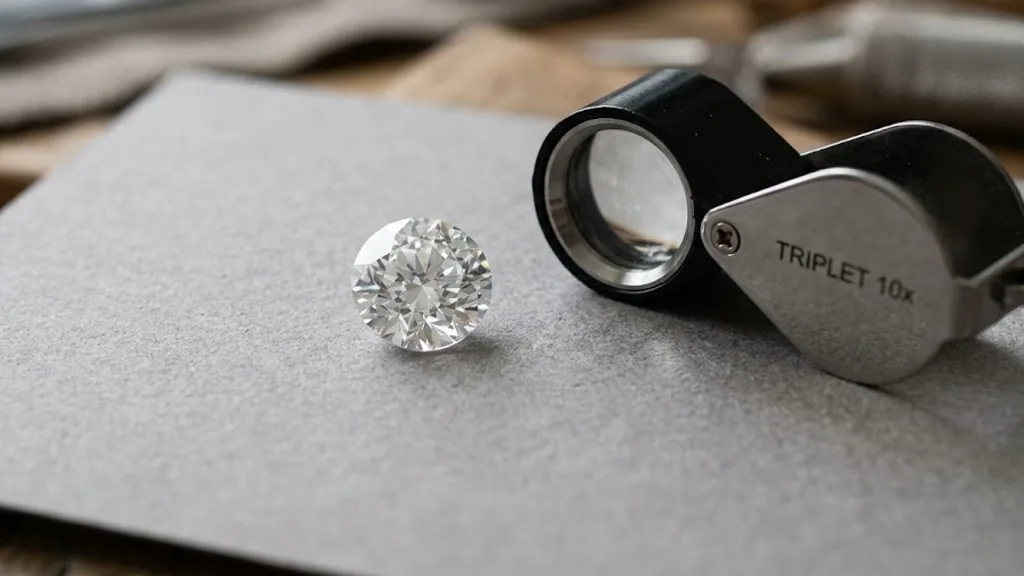
Clarity grading records how many of these there are, how large, where they sit, what colour they are, and — crucially — how difficult they are to find under 10x magnification. That last part is the key to the whole VVS-versus-VS question. Clarity is graded through a loupe, not with the naked eye.
What the letters stand for
| Grade | Full name | Plain meaning |
|---|---|---|
| FL | Flawless | No inclusions or blemishes at all under 10x. |
| IF | Internally Flawless | Nothing inside; possibly a tiny surface mark. |
| VVS1 | Very Very Slightly Included 1 | Extremely difficult to find at 10x, even for a trained grader. |
| VVS2 | Very Very Slightly Included 2 | Very difficult to find at 10x. |
| VS1 | Very Slightly Included 1 | Difficult to find at 10x. |
| VS2 | Very Slightly Included 2 | Somewhat easy to find at 10x, once you know where to look. |
| SI1 / SI2 | Slightly Included | Easy to find at 10x. Often still invisible to the eye, but not guaranteed. |
| I1 / I2 / I3 | Included | Visible without magnification. |
Read those definitions again and notice what they describe. Not “how visible to you”, but “how hard for a professional to locate with a loupe”. Every grade from Flawless down to VS2 is describing something you will never see with your own eyes.
The difference between VVS and VS, honestly
The difference is one of degree, and it lives entirely under magnification.
In a VVS stone, a grader with a loupe and good light has to hunt. The features are pinpoints, faint clouds or minuscule feathers, often tucked near the girdle where the geometry hides them.
In a VS stone, the same grader finds the features without much hunting — but they are still small, still typically pale rather than dark, and still nowhere near large enough to register at arm’s length.
Put a VVS2 and a VS1 diamond side by side on a table and ask anyone in the room to tell them apart. Nobody will. The difference is real, documented, and priced — but it is a difference on paper, not a difference in the ring.
The word that actually matters: eye-clean
Eye-clean means you cannot see any inclusion with the naked eye, viewed face-up from a normal distance of roughly 25 to 30cm in ordinary light.
Eye-clean is not printed on a certificate. It is a practical outcome, and it is what governs how a ring looks in real life. VVS and VS are both comfortably, reliably eye-clean. So are many SI1 stones — though SI needs checking case by case, which is exactly why the extra step up to VS is a sensible floor for most buyers.
If your goal is a diamond that looks perfectly clean on a hand, VS achieves it. Everything above VS is buying certainty and a nicer piece of paper, not a better-looking diamond.
When VVS genuinely earns its money
There are three situations where paying up for VVS makes real sense.
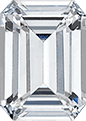
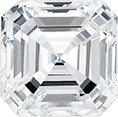
Step cuts. Emerald and Asscher cuts have long, flat, parallel facets and a large open table. Instead of scattering light, they act like a series of windows straight into the stone. Anything inside has nowhere to hide. For a Solitaire Emerald Cut Engagement Ring, clarity does more visible work than it does in any brilliant cut, and going to VS1 or VVS is money well spent. The same applies to a Hidden Halo Emerald Cut Engagement Ring, where the centre stone is the whole point of the design.
Larger stones. The bigger the diamond, the larger the physical size of an inclusion at the same grade, and the more surface area there is for your eye to wander over. Above roughly 2 carats, moving up a clarity grade or two is worth considering.
Peace of mind. Some people simply want the higher grade on the report, and there is nothing wrong with that as long as the decision is made with open eyes. It is a preference, not an optical upgrade.
When VS is the smarter buy
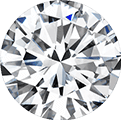
For a round brilliant, VS is very hard to beat on value. A round has 57 or 58 facets throwing light in every direction, and that constant flashing is remarkably good at swallowing small inclusions. A VS1 round and a VVS1 round look identical in a ring — a Solitaire Round Cut Engagement Ring in White Gold at VS clarity will not give anything away.
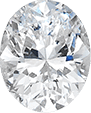
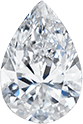
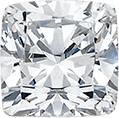
The same logic holds for oval, cushion, radiant, pear and marquise, which all use brilliant-style faceting. It also holds for any design where the centre stone is surrounded by pavé or a halo, because the surrounding sparkle adds even more visual noise.
Our general advice for a first-time buyer: put your money into cut quality first, then colour, then clarity — and let clarity settle at VS.
What this means for lab-grown diamonds
Clarity grading works identically for lab-grown and natural diamonds, because they are the same material graded by the same laboratories against the same scale. Lab-grown stones have inclusions too, though the typical character differs — you are more likely to see fine metallic traces in an HPHT-grown stone or faint growth features in a CVD-grown one, rather than the mineral crystals common in natural diamond.
What changes is affordability. High clarity is a scarcity story in natural diamonds, and scarcity is what makes VVS expensive. With lab-grown, high clarity is far more attainable, and the steps between grades cost much less in absolute terms.
In practice this reframes the question. Instead of agonising over whether to stretch from VS2 to VVS2, most lab-grown buyers can simply take the higher grade and still have budget left for a better cut, a whiter colour grade or more carat weight. That is a genuinely better position to be shopping from.
Every centre stone we set comes with a free IGI certificate, so the clarity grade is independently assessed rather than claimed by the seller. Whoever you buy from, insist on that.
Frequently asked questions
Can you see the difference between VVS and VS?
Not with the naked eye, in any realistic setting. Under a 10x loupe, a trained grader can — that is precisely what the grades are describing.
Is VVS worth the extra money?
For a step cut such as emerald or Asscher, or for a large stone, it can be. For a round brilliant at typical sizes, the money usually buys more visible improvement if spent on cut quality or colour instead.
What does the diagram on my certificate mean?
Reports often include a plotted diagram marking where the clarity characteristics sit. It is a map, not a warning — it shows features that are invisible without magnification, and it also acts as a fingerprint for identifying your specific stone.
Does clarity affect sparkle?
In the VVS to VS range, no. Sparkle is produced by cut quality — the angles and proportions that control how light travels through the stone. Clarity only begins to dull a diamond’s appearance at the low end of the scale, where inclusions are large or clouds are widespread.
What clarity should I buy?
For a round or other brilliant-style cut, VS is the value sweet spot and an eye-clean SI1 can work if you have checked it. For emerald and Asscher cuts, start at VS1 and look at VVS. Above 2 carats, go a grade higher than you otherwise would.
Is Flawless worth it?
Only if the grade itself matters to you. Flawless looks exactly like VS in a finished ring.
Have a look
The easiest way to understand clarity is to compare shapes and see how differently they behave. Browse our engagement ring collection, or narrow to round cut designs if you want the most forgiving option.
Everything is hand-made in solid gold or platinum at our North Harrow workshop, with a free IGI certificate on the centre stone, free insured UK delivery and 30-day returns. If you would like a specific clarity and colour combination set into a design of your own, our bespoke service carries no extra design cost.
More guides on this topic
Ready to find your perfect ring?
Explore our lab-grown diamond collection or book a virtual appointment with our team.