How Many Colours Do Diamonds Come In?
Diamonds come in twelve main colour families and hundreds of graded variations. A plain-English guide to the full spectrum and the D to Z scale.
Diamonds come in every colour of the rainbow plus a few that are not on it — brown, grey, black and white. The number people usually settle on is twelve main colour families, but that is a convenience rather than a rule. Colour in a diamond is a continuous range, and where one family stops and the next begins is a judgement call made by a grading laboratory.
So the useful answer is not a single number. It is understanding which colours exist, how strong they get, and which of them you will ever realistically see in a jeweller’s window. Here is all of that in plain English.
The twelve colour families
Grading laboratories describe a coloured diamond using a main colour with an optional modifier in front of it — “Fancy Intense purplish pink”, for instance. Strip the modifiers away and you are left with these families.
| Colour family | How often it turns up | Typical cause |
|---|---|---|
| Brown | The most common of all | Distorted crystal structure |
| Yellow | Common among fancy colours | Nitrogen |
| Grey | Fairly common, often with a blue or violet cast | Hydrogen or boron |
| Black | Available, often treated | Dense dark inclusions |
| Pink | Rare | Distorted crystal structure |
| Purple | Rare, usually small | Hydrogen and structural distortion |
| Orange | Very rare when pure | Nitrogen in a specific arrangement |
| Blue | Very rare | Boron |
| Green | Extremely rare when even | Natural radiation |
| Violet | Extremely rare | Hydrogen |
| Red | The rarest | Severe structural distortion |
| White | Unusual, milky rather than colourless | Countless microscopic inclusions |
Note that last one, because it trips people up constantly. A “white diamond” in the technical sense is a milky, translucent stone — the opposite of what shoppers mean when they say white. In a shop, “white diamond” almost always means colourless or near-colourless, which is a different thing entirely.
Why counting is harder than it looks
Once you allow modifiers, the number of recognised colour descriptions runs well past two hundred. A stone can be graded orangey pink, brownish greenish yellow, greyish blue and so on. Every one of those is a distinct entry on a certificate.
Then there is strength. Each colour is graded for how deep and saturated it is, on a scale running Faint, Very Light, Light, Fancy Light, Fancy, Fancy Intense, Fancy Vivid, Fancy Deep and Fancy Dark. Multiply twelve families by hundreds of modifier combinations by nine strength grades and the honest answer to “how many colours” is: more than anyone has usefully counted.
The other scale — the one that applies to the diamond in most rings
Everything above is the fancy colour system. It only applies once a diamond has enough colour to leave the ordinary scale behind. Almost every diamond you will look at in a shop sits on the other scale: D to Z.
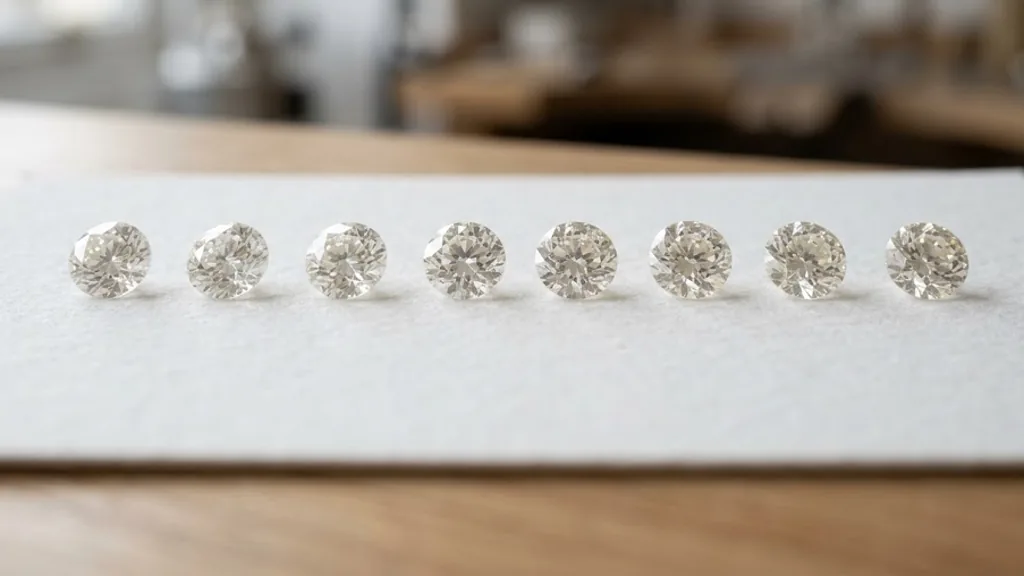
D is completely colourless. Z is a noticeably light yellow or brown. On this scale, less colour costs more, which is the exact reverse of the fancy system. Somewhere past Z, a yellow diamond stops being a poor grade and becomes a Fancy Light yellow — a desirable stone in its own right.
| Grade range | What you see | Who it suits |
|---|---|---|
| D–F | Colourless, even against a white background | Anyone setting in platinum or white gold who wants no warmth at all |
| G–J | Near-colourless; warmth only shows in comparison | Most buyers — the sensible value zone |
| K–M | A faint warm tint, visible face-up to a careful eye | Yellow and rose gold settings, where the tint disappears |
| N–Z | Clearly tinted | Rarely used in fine jewellery |
| Fancy | Colour beyond Z, graded as a colour in its own right | Collectors, and anyone who deliberately wants a coloured stone |
Which colours can you actually buy?
Colourless and near-colourless, easily. Yellow, brown and black, with some hunting. Everything else in a good size and a strong grade is a specialist purchase, priced per stone at auction.
Our collection is built entirely on colourless and near-colourless lab-grown diamonds, because that is what the overwhelming majority of engagement rings use and it is where you get the most beauty for your money. Every centre stone comes with a free IGI certificate that states its colour grade in writing.
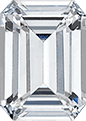
If you want the stone to be the whole story, the solitaire emerald cut engagement ring is a good test of a clean colour grade — emerald cuts have large open facets that show colour more readily than brilliant cuts, so nothing hides. At £672 at the time of writing, it is also one of our best value pieces.
For a brighter, sparklier look, the halo round cut engagement ring surrounds the centre with small stones, which lifts the apparent size and brightness. And if you like warmth without paying for a fancy colour, the pear cut engagement ring in yellow gold gets it from the metal.
Browse the full engagement ring collection, or narrow by shape — our emerald cut rings are a small, carefully chosen group.
Fancy colours and lab-grown diamonds
Laboratory growth changes the maths on coloured diamonds considerably. Yellow can be produced by allowing nitrogen into the growth chamber, blue by introducing boron, and pink by treating the finished stone. The result is genuine diamond with genuine colour, at a fraction of what a natural equivalent costs.
We do not hold fancy coloured stones in stock. If that is what you want, ask us about bespoke — we design at no extra design cost, will source honestly, and will tell you plainly what is and is not sensible.
How a laboratory decides which colour a diamond is
Colour grading is more controlled than most people expect. It is not somebody holding a ring up to a window. The stone is unset, cleaned, and viewed face-down in a white tray under a standardised light that removes any warm or cool cast from the room.
For the D-to-Z scale, the grader compares the stone against a set of master stones of known grade, working through the alphabet until it matches. Face-down is deliberate: it removes the sparkle, which otherwise distracts the eye from the underlying body colour.
For fancy colours, the stone is viewed face-up instead, because that is how the colour will be seen once it is set. The grader assesses hue (which colour it is), tone (how light or dark) and saturation (how strong), and the combination produces the final grade.
Two practical consequences follow. First, grading conditions are far harsher than real life — a stone graded face-down under a controlled lamp will look better on a hand than its grade suggests. Second, colour is judged on a loose stone, so the setting you choose afterwards can change the impression completely.
Choosing a colour grade for the metal you want
| Metal | Grades that work well | Why |
|---|---|---|
| Platinum | D–H | Bright white metal shows any warmth in the stone |
| White gold | D–H | Same reason, though rhodium plating softens it slightly |
| Yellow gold | G–K | Warm metal masks a faint tint completely |
| Rose gold | G–K | Warm pink cast does the same job |
This is one of the easiest ways to get more ring for the same money. Pairing a slightly lower colour grade with a warm metal is not a compromise — it is how the setting is meant to work.
Common questions
How many colour grades are there on a normal diamond certificate?
Twenty-three, from D to Z. Grades A, B and C do not exist — the scale deliberately started at D to avoid confusion with older grading systems.
Is a colourless diamond a colour?
In grading terms, no. Colourless means the absence of body colour, which is why it sits at the top of the D-to-Z scale rather than in the fancy colour system.
Do all coloured diamonds cost more?
No. Brown and some grey diamonds are widely available and can cost less than a colourless stone of the same size. Only the rare colours in strong grades carry big premiums.
Can you see the difference between neighbouring colour grades?
Not usually with the naked eye. Laboratories grade loose stones face-down against a white background under controlled lighting. Once a diamond is set in a ring and viewed face-up, one or two grades apart is very difficult to call.
Does the metal change the colour of the diamond?
It changes how the colour reads. Yellow and rose gold reflect warmth into the stone, which masks a faint tint. White metals do the opposite and make any warmth easier to spot. This is why a slightly lower colour grade in yellow gold can look flawless.
If you would like help choosing a grade that suits your setting, get in touch — or start with the engagement rings we make by hand in North Harrow, with free insured UK delivery and 30-day returns.
More guides on this topic
Ready to find your perfect ring?
Explore our lab-grown diamond collection or book a virtual appointment with our team.