Is an L or M Colour Diamond Too Yellow?
Often, yes. L and M sit below the near-colourless band and show warmth face-up, especially above 1 carat. Yellow gold hides it better than platinum.
Yes, usually. An L or M colour diamond sits below the near-colourless run of G, H, I and J, and shows a warm, faintly yellow cast face-up. The warmth is mild under 0.5 ct and hard to miss above 1 carat, especially in platinum. Yellow gold absorbs it. Below M, buyers stop hiding colour and start choosing it.
What does an L or M colour diamond look like face-up?
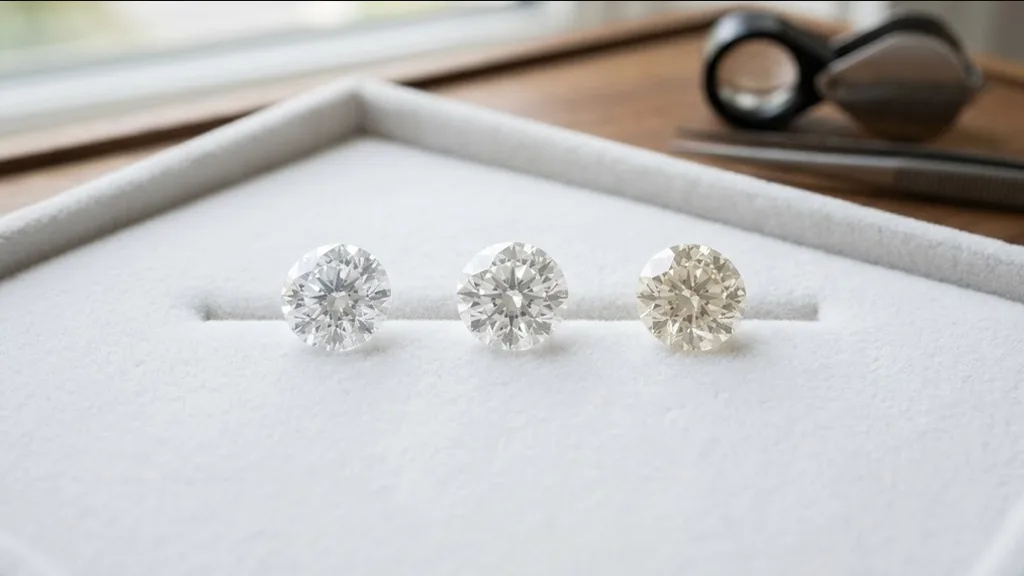
An L or M colour diamond looks faintly warm face-up, closer to cream than to snow, and the tint gathers through the middle of the table rather than at the rim. Set one on a white card beside a G or an H stone and the difference shows in a second. Worn alone on a hand, the same stone usually reads as soft rather than yellow. That gap between side-by-side and on-its-own is the entire argument.
Nothing at the bench moves a stone up the scale afterwards. Polishing, re-tipping and re-setting all leave the body colour exactly where it started, and so does a change of outline, which is why our guide to whether a diamond can be recut is worth reading before anyone spends money hoping to lift an L to a J. Colour is fixed at growth. Only the setting around it is negotiable.
Why does our colour ladder stop at L and M?
Our colour ladder stops at L and M because the question genuinely changes shape there. From D down through K, the useful advice is how to keep a faint tint invisible: pick a smaller stone, a warmer metal, a busier design. At L and M that advice runs out, and the honest position is that the warmth will show in some lights however the ring is built. From N downward, buyers are choosing colour on purpose.
That is also the point where price stops being the reason to drop a grade. The saving between K and M is smaller than most people expect, because the market thins out at the warm end rather than getting cheaper in a straight line, and our explanation of what keeps lab-grown prices where they are sets out why the bottom of a scale is rarely where the bargain sits.
How much warmer does an M look beside an H colour stone?
An M looks clearly warmer than an H when the two sit side by side under a lamp, and the honest way to describe the gap is five rungs of scale rather than a small nudge. H reads white. I and J read white with a hint. K reads warm in a white metal. M reads warm in almost anything. Alone on a hand, an M still reads as a diamond, never as a yellow gemstone.
Most people never see that comparison, because nobody puts five stones on a tray at home. If you want the rung above instead, our page on what is an I colour diamond covers the grade that still passes as white to an untrained eye in every metal.
The table below matches each rung to what a customer actually sees at the counter, and to the setting where that rung stops being a problem.
| Grade | What you see face-up | Where it stops being a problem |
|---|---|---|
| G to H | White in every metal | Any metal, any size |
| I to J | White with a hint above 1 ct | All metals under 1 ct |
| K | Warm in white metal | 18ct yellow or rose gold |
| L | Warm in daylight above 0.75 ct | Yellow gold, under 1 ct |
| M | Warm in most light | Yellow gold, vintage or pave designs |
At what carat weight does an L or M stone read yellow?
Carat weight is what turns an L or M from soft to obvious, because body colour is seen through the depth of the crystal rather than off its surface. Under about 0.5 ct there is not enough stone for the tint to gather, and most people read white. Between 0.75 ct and 1 carat it becomes visible in daylight against a white metal. Above 1.5 ct an L or M reads warm to anyone looking properly.
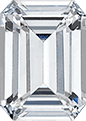
Shape moves the same line. A deep, chunky outline holds more crystal for its face-up size, so a cushion or an oval shows an L more readily than a shallow round of the same weight, while step cuts show it worst of all because their long, flat facets act like windows into the stone.
Does yellow gold hide an L or M colour grade?
Yellow gold hides an L or M colour grade better than any other metal, and that is the single most useful thing to know about the warm end of the scale. A warm stone in an 18ct yellow gold claw setting borrows the colour of the metal around it and reads as intentional. The same stone in platinum has nothing to hide behind, so the tint shows against the white. Rose gold works nearly as well.
You can see the effect on the bench in seconds. A vintage round cut ring in yellow gold at £1,051 or a solitaire round cut ring in rose gold at £1,007 both flatter a warm stone, while a solitaire round cut ring in platinum at £657 gives the eye a white reference and shows every trace of tint. All three prices are correct at the time of writing.
Why does the GIA change matter most at L and M?
The GIA change matters most at L and M because that is exactly where the letter carries the whole decision. GIA stopped grading lab-grown diamonds on the D to Z and IF to I3 scales on 1 October 2025, and now gives a lab-grown stone an overall assessment of Premium or Standard instead. Somebody weighing a K against an L needs a letter. Premium and Standard cannot separate them, and that is why our certificates are IGI.
IGI still uses the familiar 4Cs scales, so an IGI report on a lab-grown stone still prints a colour letter and a clarity code you can compare against another stone. If the clarity side of that report is unfamiliar, our page on what P1, P2 and P3 clarity mean covers the older European codes that still turn up on second-hand paperwork.
Should you buy an L or M stone, or step up to J?
Buying an L or M makes sense when the mount is yellow or rose gold, the stone is under a carat, and the money saved goes somewhere you value more than colour. Stepping up to J makes sense when the ring is platinum or white gold, the centre stone is over 1 carat, or you already know you are the kind of person who compares. Neither is the safe answer.
What we will not tell you is that a warm stone is just as good. It is not the same stone, and it does not look the same. It is a different, cheaper, warmer thing, and plenty of people prefer it once they have seen one on a hand rather than on a grading tray. If a warm cushion is what you are picturing, our page on how much does a cushion cut diamond cost gives the numbers, and you can see the range in our engagement ring collection.
Frequently asked questions
Is an L colour diamond good?
Yes, for the right ring. An L colour diamond is a genuine, well-formed stone with a warm cast that yellow or rose gold absorbs neatly. It is a poor choice in a plain platinum solitaire above 1 carat, where the tint has a white metal to fight against all day. Judge it in the metal you actually want, never on a white grading tray.
Is M colour too low for an engagement ring?
No, not automatically, but M asks more of the setting than any other grade we are asked about. In 18ct yellow gold, under 1 carat, in a busy vintage or pave design, an M looks warm and deliberate. In a plain platinum solitaire at 2 carats it looks like a compromise. The design decides the answer, not the letter.
Which setting metal suits a warm stone?
Yellow gold suits a warm stone best, rose gold runs a close second, and platinum or white gold come last. Warm metals lend their own colour to the stone, so an L or M reads as part of the design rather than a fault. White metals give the eye a reference point, and any tint shows against that reference straight away.
Does yellow gold hide a warm colour grade?
Yes, to a useful degree. Yellow gold does not change the stone, but it removes the white reference the eye uses to judge tint, so an L or M set in 18ct yellow gold reads a rung or two whiter than it measures. The effect is strongest in a rubover setting, where metal wraps the girdle and touches the stone all the way round.
At what carat weight does warmth become obvious?
Around 1 carat for most people, and reliably by 1.5 carats. Body colour is seen through the depth of the crystal, so a heavier stone gives the tint more room to gather before it reaches your eye. Under 0.5 ct an L can pass for near-colourless in ordinary indoor light. The same grade at 2 carats will not pass at all.
Do lab-grown diamonds even come in L or M colour?
No, not usually. Lab-grown growth is tuned to produce colourless material, and the IGI-certificated lab-grown stones that cross our bench come in well above L. A warm stone in front of you is far more likely to be a natural diamond. If you want a deliberately warm lab-grown stone, ask us, because that is a special order.
Ready to find your perfect ring?
Explore our lab-grown diamond collection or book a virtual appointment with our team.