
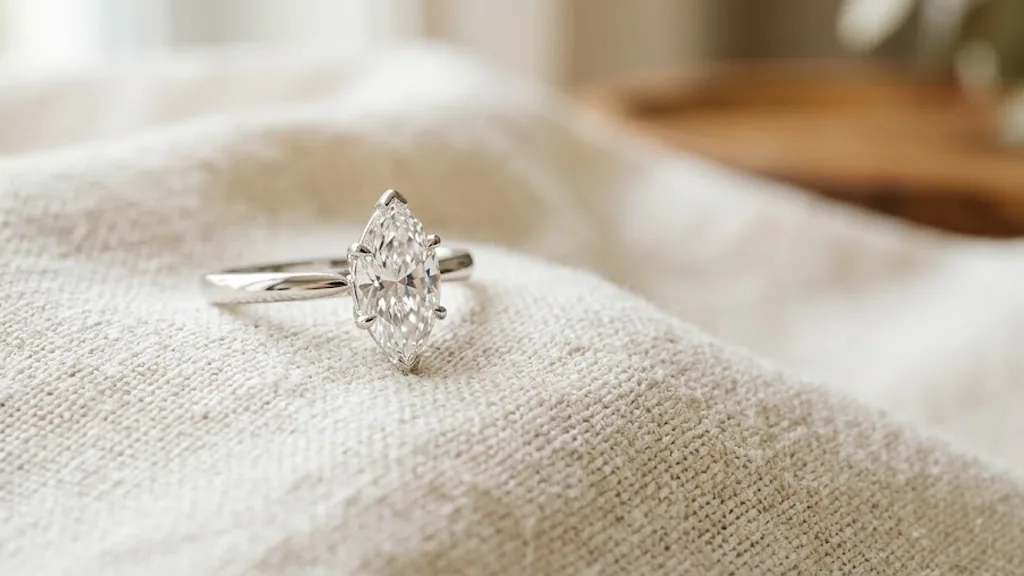
What Choosing a Marquise Diamond Says About Your Taste
Diamond shape reveals nothing about personality, but a marquise does say something about taste. The advantages, the real drawbacks, and which setting suits.
Let us deal with the obvious thing first. There is no evidence that the shape of a diamond reveals anything about personality. Any article that tells you marquise wearers are 68% more adventurous has made the figure up. Diamond shape is a matter of taste, not psychology.
What choosing a marquise does say is something narrower and more interesting: it tells people about your taste in jewellery. In a market where round and oval dominate, picking a marquise is a deliberate decision, and it signals a set of preferences that are worth spelling out — particularly if you are trying to decide whether it is the right shape for you.
What the choice actually signals
Four things, in our experience of who asks for this shape.
You are not choosing by default. Round brilliants are the standard choice. Ovals are the current popular alternative. Marquise is neither, so nobody arrives at it accidentally — you have to have looked at the options and preferred this one.
You like drama over softness. A marquise is long, pointed at both ends and unapologetically theatrical. Somebody who wants a quiet, understated ring does not choose it.
You value the look of the stone on the hand. The marquise covers more finger than any other shape at the same carat weight. Choosing it usually means you care how the ring reads on the hand rather than what the certificate says.
You are comfortable with something vintage-leaning. The shape has strong associations with earlier decades, and choosing it means you are happy for a ring to nod backwards rather than look brand new.
Is the marquise making a comeback?
It has been getting more attention in recent years, alongside a general revival of elongated and antique-feeling shapes. We are not going to attach a percentage to that, because no reliable figure exists for the UK market.
What we can say from our own range is that marquise is one of our better-represented shapes, with six designs currently, behind round and pear but ahead of most others. That is a reasonable indicator of demand rather than a statistic about the market.
If your worry is the opposite one — that the shape looks old-fashioned — we have written separately about whether marquise diamonds are outdated and how to update one, which deals with that question properly.
The genuine advantages
| Advantage | Why it happens |
|---|---|
| Looks larger than its weight | The elongated shape puts more surface area facing upwards |
| Elongates the finger | The length runs along the finger and draws the eye down it |
| Costs less than a round of the same weight | The cut retains more of the original crystal, so less is wasted |
| Distinctive | You will rarely meet someone wearing the same ring |
That combination is why the shape keeps returning. It is the most efficient way to turn a modest carat weight into a ring that looks substantial.
The honest disadvantages
Three, and you should know all of them before choosing.
The bow tie. Elongated shapes show a dark band across the centre, and the marquise shows it more than most. Some is normal and even attractive; a hard black stripe is not. The only way to judge is to look at the specific stone in movement.
Vulnerable points. The two tips are the thinnest part of the diamond and can chip if struck. A setting with a claw over each point protects them, and it is not optional for a ring worn daily.
Symmetry is unforgiving. If the two halves of a marquise do not match, or the points are not level, the eye notices immediately even if it cannot say why. Check the stone against its own reflection.
Which marquise setting suits which taste
The shape adapts further than people expect, and the setting changes the message considerably.
For the purest version of the shape, a solitaire marquise cut ring at £538 (correct at the time of writing) shows the stone with nothing competing. It is also the most honest way to assess a marquise, because there is nowhere for a poor stone to hide.
For maximum presence, a halo marquise cut ring in white gold at £1,143 surrounds the stone with small diamonds, which makes the whole ring read larger and adds light around the centre where the shadow sits.
For something classical, a three stone marquise cut ring at £1,143 uses a layout that has been in use for well over a century, which tempers the drama of the shape with a familiar structure.
For a vintage character, a V shaped marquise cut ring at £1,143 follows the point of the stone with the line of the band, so the whole ring becomes one shape rather than a stone sitting on a circle.
How to judge a marquise before you buy
Fancy shapes are not given an overall cut grade by the major laboratories in the way round brilliants are. A certificate will tell you the carat weight, the colour, the clarity, the polish and the symmetry, but it will not tell you whether the stone is beautiful. For a marquise, that gap matters more than for almost any other shape.
So look, and look at these five things in order:
- The two points. Are they level with each other, and does light reach all the way into them, or do the tips go dead?
- The centre. Tilt the stone. Does the shadow break up and refill with light, or sit there as a solid black band?
- Symmetry. Imagine folding the stone in half lengthways and then across. Do the halves match?
- The outline. Marquise shapes vary from narrow and sharp to broad and rounded. Decide which you want rather than accepting whichever you are shown.
- The setting. Check there is a claw covering each point. Without it, the tips are exposed.
A rule of thumb in the trade, not a measured figure: length-to-width ratios around the middle of the range look most balanced to most people, with longer stones reading as more dramatic. There is no correct answer, only a preference to make deliberately.
Who the shape suits
Marquise flatters shorter fingers most obviously, because the length of the stone visually extends them. On long fingers it still works, but a slightly broader outline usually looks better in proportion than the narrowest version.
It is a poor choice for someone who catches rings constantly on clothing, or who works with their hands all day, because the shape is long and the points are exposed. If that describes the wearer and they still love the shape, a bezel setting that wraps metal around the whole outline solves most of it.
How to wear a marquise
Traditionally the stone is set lengthways along the finger, which is what produces the elongating effect. Setting it across the finger — sometimes called east-west — is an unusual and quite modern alternative that makes the hand look wider rather than longer, and it is worth seeing before deciding.
On wedding bands, the points are the complication. A straight band often sits fine against a marquise if the setting is low, but a shaped or chevron band that follows the point looks more considered. Our guide to what wedding band goes with a marquise engagement ring goes through the options.
Frequently asked questions
Does the shape of a diamond really say anything about personality?
No. It reflects taste in jewellery, nothing more. Treat personality-by-shape articles as entertainment.
Are marquise diamonds popular again?
They have been getting more attention alongside other elongated and antique-style shapes. We have no reliable market figures to quote, and neither does anyone else who claims otherwise.
Is a marquise cheaper than a round diamond?
Generally yes, for the same carat weight and quality, because less of the rough crystal is lost in cutting.
Do the points chip easily?
They are the most vulnerable part of the stone. A setting that covers each point with a claw largely removes the risk.
What is a Dutch marquise?
A variation on the shape with a slightly different faceting arrangement and a softer, more antique character. Our solitaire Dutch marquise cut ring at £932 shows what the difference looks like.
All six of our marquise designs are in the marquise cut collection, and you can see how they compare with everything else in the full engagement ring range. Free IGI certificate on centre stones, free insured UK delivery, and bespoke design at no extra design cost if you want a particular set of proportions.
Ready to find your perfect ring?
Explore our lab-grown diamond collection or book a virtual appointment with our team.











