
What Is the Most Expensive Diamond Clarity?
Flawless is the most expensive diamond clarity grade. The full FL to I3 scale explained, and whether it is worth paying for.
The most expensive diamond clarity is Flawless, abbreviated to FL on a certificate. It sits at the very top of the clarity scale and it is the rarest grade a diamond can be given.
That is the whole answer to the question. The more interesting question — the one worth a few minutes of your time — is whether Flawless is worth paying for. In most cases it is not, and understanding why will change how you shop.
What clarity means
Diamonds grow with tiny natural features inside them. Those internal features are called inclusions: a minute crystal of another mineral trapped during growth, a feather-shaped internal fracture, a hazy patch known as a cloud, or a thin dark line called a needle. Marks on the outer surface, such as a small scratch or a nick on the edge, are called blemishes.
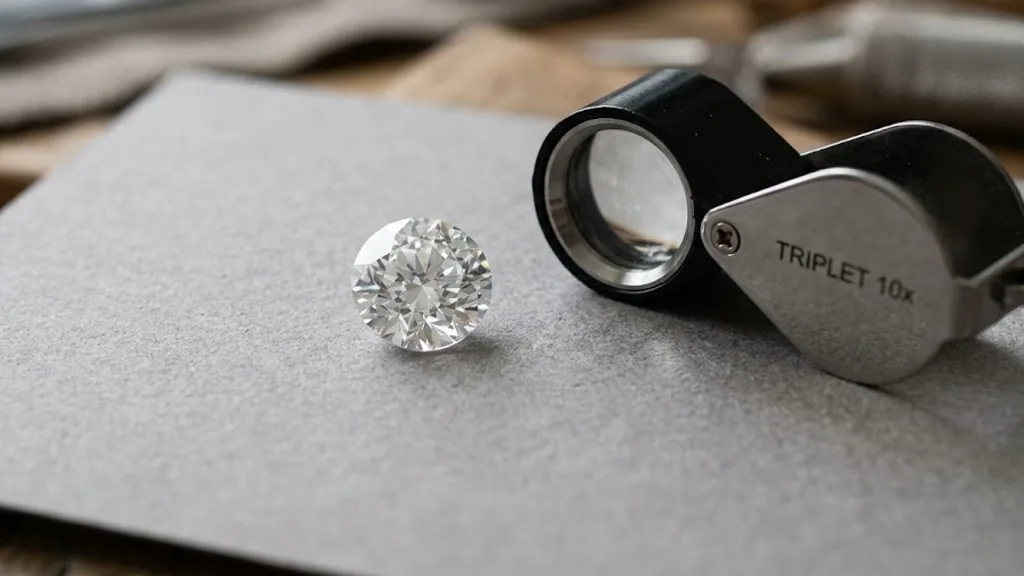
Clarity is a measure of how few of these a diamond has, how big they are, where they sit and how noticeable they are. It is assessed by a trained gemmologist at 10x magnification, using a standard jeweller’s loupe. Hold that detail in mind — the entire scale is defined by what a professional can find with a lens.
The full clarity scale, top to bottom
| Grade | Full name | What a grader sees at 10x | Relative rarity and price |
|---|---|---|---|
| FL | Flawless | Nothing at all, inside or on the surface | Rarest — most expensive |
| IF | Internally Flawless | Nothing inside; perhaps a tiny surface mark | Very rare — very expensive |
| VVS1 | Very, Very Slightly Included 1 | Extremely difficult to find anything | Rare |
| VVS2 | Very, Very Slightly Included 2 | Very difficult to find | Rare |
| VS1 | Very Slightly Included 1 | Difficult to find | Uncommon |
| VS2 | Very Slightly Included 2 | Found without much effort | Common — best value |
| SI1 | Slightly Included 1 | Easy to see with a loupe | Common — good value |
| SI2 | Slightly Included 2 | Very easy to see with a loupe | Common — cheapest safe option |
| I1, I2, I3 | Included | Visible without any magnification | Least expensive |
Price climbs steeply as you go up that table, and it climbs fastest right at the top. The jump from VS2 to VVS2 costs real money. The jump from IF to FL costs a great deal more again, for a difference that does not exist to the human eye.
Why Flawless commands such a premium
Scarcity, essentially. A Flawless diamond has to grow with no internal features whatsoever and then be cut and polished without leaving a single trace on the surface. Most rough that could yield a Flawless stone loses the grade during cutting, because polishing marks and tiny nicks are almost unavoidable.
There is also a market effect. Flawless stones are bought by collectors and by people who want the certificate to say the rarest thing, and that demand sits on top of an already tiny supply. You are paying for rarity as a concept, which is a legitimate thing to buy — but you should know that is what you are buying.
The uncomfortable truth about the top of the scale
Here is the part the trade is not always keen to spell out. Everything from Flawless down to VS2 looks identical to the naked eye. Not similar. Identical.
The trade term for a diamond you cannot see anything in is eye clean, meaning nothing is visible at normal viewing distance in normal light. Eye clean typically starts around VS2 to SI1, depending on shape and size. Above that point, every extra grade you buy is invisible.
Set a Flawless diamond and a VS2 diamond of the same size, colour and cut side by side on a hand and nobody in the world can tell you which is which without a loupe. Including the person wearing them.
Where the money is better spent
The difference between a VS2 and a Flawless stone is money you could put into:
- Cut quality. The one thing you genuinely see every day. A superbly cut VS2 outshines a mediocre Flawless from across a room.
- Colour. Graded from D (completely colourless) down to Z (visibly tinted). Moving up a colour grade is more noticeable than moving up three clarity grades.
- Carat weight. Actual visible size, which people do notice.
- The setting. A better-made ring in solid gold or platinum lasts a lifetime and shows every day.
When higher clarity genuinely earns its keep
We are not arguing that clarity never matters. It matters in specific situations, and knowing them is more useful than a blanket rule.
Step cuts. Emerald, Asscher and baguette diamonds are cut with long, straight, parallel facets and a wide open table — the flat top facet. Instead of scattering light like a brilliant cut, they give you a clear view straight into the stone, and any inclusion is reflected repeatedly by the parallel facets. For these shapes, VS2 is the sensible floor and VS1 is worth considering on larger stones.
Large diamonds. Clarity grades are relative, so an inclusion at a given grade is physically bigger in a 3 carat stone than in a 0.5 carat one. Above roughly 1.5 carats, move up a grade.
Very simple settings. A bare solitaire gives an inclusion nowhere to hide. A halo of small stones, or a pavé band, adds surrounding sparkle that draws the eye outward.
Clarity in the lab-grown world
Lab-grown diamonds are graded on exactly the same FL-to-I3 scale, by the same independent laboratories, using the same 10x standard. Nothing about this page changes because a diamond was grown rather than mined.
What does change is what a top clarity grade costs you. Because lab-grown prices have fallen substantially in recent years, the premium for a high clarity grade is a much smaller amount of money in absolute terms than it would be on a mined stone. So if the certificate genuinely matters to you, a VVS or IF lab-grown diamond is far more reachable than the equivalent mined stone. Even so, the visual argument is unchanged: you still will not see it.
What we recommend
For almost every customer, VS2 is the right answer, and SI1 works well in a brilliant-cut shape once we have checked the stone face-up. Every centre stone we set comes with a free IGI certificate, so you can read the grade and the inclusion plot yourself.
Our Solitaire Round Cut Engagement Ring in White Gold is the setting that shows this best — a round brilliant scatters light so thoroughly that a well-placed SI1 vanishes, so clarity money goes further here than anywhere else.
Where we would ask you to spend a little more on clarity is a step cut. The Solitaire Emerald Cut Engagement Ring is a good example of the shape and its demands, and for a wedding band the Stackable Asscher Cut Wedding Band in Yellow Gold lines up several small step-cut stones — each one with the same open view inside.
Have a look through our emerald cut collection or the full wedding ring range.
Frequently asked questions
Is Internally Flawless the same as Flawless?
Not quite. Internally Flawless means no inclusions inside the stone but possibly a very small surface blemish, such as a faint polish line. Flawless means nothing at all, inside or out. IF is a little more common and a little less expensive; visually they are the same diamond.
Is Flawless the same as perfect?
No. Flawless describes clarity only. A Flawless diamond can still be poorly cut, and a poorly cut diamond looks dull no matter how clean it is. Clarity is one of four grades, and it is not the one that decides how a diamond looks.
Do Flawless diamonds sparkle more?
No. Sparkle comes from cut — the angles and proportions that bounce light back out of the top of the stone. Clarity only starts to affect brightness at the very bottom of the scale, in I2 and I3, where large inclusions physically block light.
What is the cheapest clarity that still looks good?
SI1 in a brilliant cut such as round, oval, pear or cushion, provided you or your jeweller check the stone first. SI2 can work in smaller brilliant cuts but the results vary far more, so never buy one from the grade alone.
Can you make a Flawless diamond ring if I want one?
Yes. We work bespoke at no extra design cost, and can source a specific clarity grade to order. Every piece is hand-made in solid gold or platinum in our North Harrow, London workshop.
Flawless is the most expensive clarity, and it is a real and rare thing. But the grade that makes most people happiest is several steps below it, and the difference between them lives entirely inside a loupe. Free insured UK delivery and 30-day returns on everything, so you can make that judgement in your own hands rather than ours.
More guides on this topic
Ready to find your perfect ring?
Explore our lab-grown diamond collection or book a virtual appointment with our team.











