Do Marquise Diamonds Sparkle?
Yes, though differently to a round. The long shape throws flashes rather than even fire, and a bow-tie shadow across the centre dulls a badly cut 1 carat.
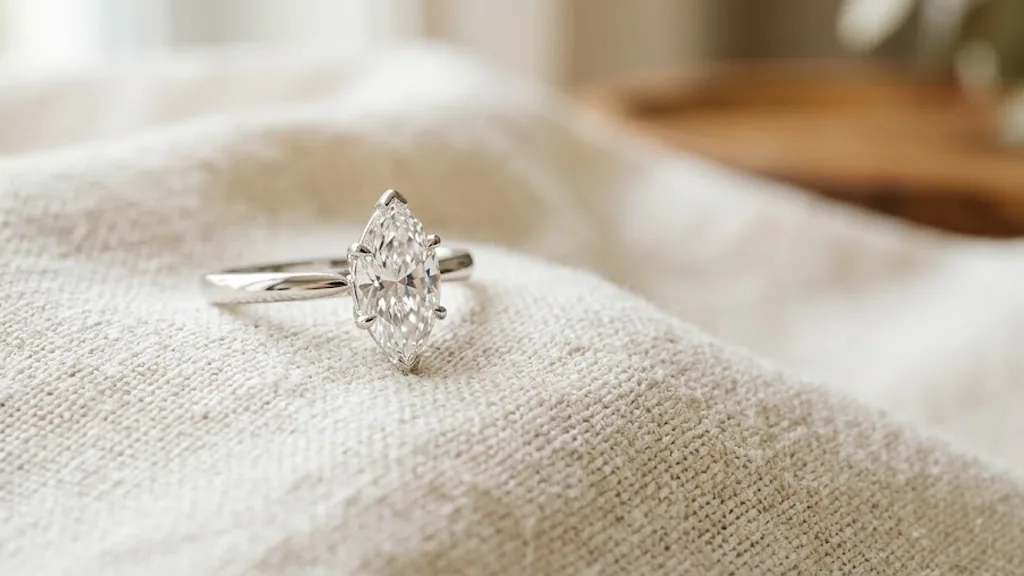
Yes, marquise diamonds sparkle, though not in the way a round brilliant does. A marquise has 58 facets arranged along a long, pointed outline, so it throws bold flashes rather than an even shimmer. The one thing to check is the bow-tie: a dark band across the middle of a badly cut 1 carat stone.
How does marquise sparkle differ from a round brilliant?
Marquise sparkle differs from a round brilliant in pattern rather than in amount. A round is cut to send light back in small, even bursts from every angle, so it twinkles steadily. A marquise is long and narrow, so its 58 facets throw fewer and larger flashes that switch on and off as your hand moves. Across a dinner table it reads as bold winks rather than a constant shimmer.
Cut quality does far more for that flash than carat weight ever will. A round brilliant is cut to a published set of proportions, which is one reason round stones carry a premium, and our guide to why round cut diamonds cost more sets out where that money goes. A marquise has no such rulebook, so two stones of the same weight can look very different.
What is the bow-tie, and how much does it dull the stone?
A bow-tie is a dark shadow shaped like a man’s bow tie, lying across the middle of a marquise where the stone sends no light back to your eye. Every marquise has one to some degree, because the long shape forces light to bounce at awkward angles. On a good stone it is faint and shifts as you tilt the ring. On a poor one it is a solid grey band that never moves.
At the bench we look at a loose marquise face-up under a desk lamp, then rock it about ten degrees each way. A bow-tie that breaks into separate dark patches as the stone moves is normal, and nobody will notice it at arm’s length. One that sits still is a depth problem, and no setting, cleaning or claw arrangement will fix it.
Which length-to-width ratio sparkles best?
Length-to-width ratio is simply how many times longer a marquise is than it is wide, and most cutters and buyers settle between 1.75 and 2.15. Below about 1.70 the stone looks stubby and the bow-tie widens. Above about 2.20 it looks elegant, but the ends thin out, the points chip more easily and light leaks straight through the tips. Around 1.90 to 2.00 is the safest place to start.
Ratio also decides how big the stone reads on a finger, because a longer outline covers more skin for the same weight. That is the same effect that makes any elongated shape look generous next to a round of equal weight. Length buys apparent size rather than extra light, so pick the ratio you like the look of and judge the sparkle separately.
The table below sets out the ratios we see most often, what each one looks like on a hand, and how much bow-tie to expect from it.
| Ratio | How it looks on the hand | Bow-tie to expect |
|---|---|---|
| 1.60 to 1.70 | Short and wide, closer to an oval | Wide and often obvious |
| 1.75 to 1.85 | Full and rounded through the middle | Moderate, usually breaks up |
| 1.90 to 2.05 | The classic marquise outline | Usually mild |
| 2.10 to 2.25 | Long, slender and dramatic | Narrow, but the tips can leak light |
Does the setting change how much a marquise sparkles?
Setting changes a marquise more than it changes most shapes, because the mount decides how much light reaches the stone from underneath. A high mount with an open frame below the diamond lets light in from beneath and keeps the flash lively. A rubover setting, where a collar of metal wraps right round the edge of the stone, shades those edges and flattens the same diamond noticeably.
Claw counts matter here as well. A marquise needs a V-shaped claw folded over each point, because the tip is the thinnest part of the crystal and the part that chips against door frames. Our comparison of claw, rubover and channel settings compared covers what each mount does to the light.
Mounts also fail when they fight the outline of the stone, which is exactly the problem described in setting a round diamond in a square mount. A marquise dropped into a mount cut for an oval sits low at the points, and those points are the first thing a knock finds.
How do marquise and baguette diamonds handle light differently?
Marquise and baguette diamonds handle light in two completely different ways. A marquise is a brilliant cut, with 58 small triangular and kite-shaped facets that chop light into flashes. A baguette is a step cut, with long parallel facets like the steps of a staircase, so it gives broad mirror-like glints and almost no twinkle. Side by side on one hand, the marquise is the stone that catches your eye first.
That difference in cutting also shows up in price, because a step cut wastes less of the rough crystal and takes less work at the wheel. The figures in how baguette prices compare with round stones explain the gap. A marquise sits between the two: cheaper per carat than a round, dearer than a baguette, and livelier than either would suggest on paper.
What should you check before you buy a marquise?
Checking a marquise before you buy comes down to four things you can see without any equipment: the bow-tie, the two points, the outline and the symmetry. Hold the stone at arm’s length in ordinary room light rather than under a bright spotlight, because a shop lamp makes almost anything look alive. Then look straight down at it, and only then tilt it slowly from side to side.
Symmetry is the one most people skip. Lay a straight edge along the long axis and the two halves should mirror each other, with both points meeting the centre line. A marquise with one shoulder fuller than the other never looks right once it is on a finger, and no jeweller can correct it without recutting the stone and losing weight.
All of our marquise stones are lab-grown and carry a free IGI certificate on the centre stone. To see the shape set three ways, compare our solitaire marquise cut engagement ring at £538 with the halo marquise ring in white gold at £1,143, both correct at the time of writing. The halo fills the space either side of the points with small diamonds.
For a busier look, our three stone marquise engagement ring sets two smaller stones alongside the centre. You can see every marquise shaped ring we stock in one place, or browse the wider engagement ring collection while you weigh up shapes. If nothing fits, we design bespoke at no extra design cost, and the full diamond shape guide covers the alternatives.
Frequently asked questions
Do marquise diamonds sparkle less than rounds?
Yes, slightly, when you measure the total light coming back. A round brilliant is cut to proportions designed to return as much light as possible, and a marquise is cut to a long outline that always loses some light through the ends. In everyday wear the difference reads as a different rhythm of flash rather than a duller stone.
Can a bow-tie be cut out?
No, not without recutting the stone and losing weight. The bow-tie comes from the depth and angle of the facets under the middle of the marquise, so a cutter has to remove material to change it. That usually costs more in lost carats than the improvement is worth. Choosing a stone with a mild bow-tie is the cheaper answer.
Does a marquise look bigger than its carat weight?
Yes, usually. A marquise spreads its weight along a long outline instead of packing it into a deep round shape, so it covers noticeably more of the finger than a round of the same weight. A 1 carat marquise typically measures around 10 mm long, against about 6.5 mm across for a 1 carat round.
Which way should the points face for the best light?
Point up and down the finger is the traditional setting and the one that flatters most hands, because the long axis follows the finger and makes it look slimmer. Turned across the finger, sometimes called east-west, the stone reads wider and catches light differently as you move. Neither direction changes how much light the diamond returns.
Do marquise diamonds get a cut grade?
No, not usually. The major laboratories publish a full cut grade for round brilliants only, so a marquise report normally shows polish and symmetry instead. That is why your own eyes matter more here than the paperwork does. Look at the bow-tie, the outline and the way the two halves mirror each other.
Is a lab-grown marquise as bright as a natural one?
Yes. A lab-grown diamond is the same material with the same optical behaviour, so a lab-grown marquise and a mined marquise cut to the same proportions return light identically. Every marquise we sell is lab-grown, sometimes called man-made, and the brightness you get depends entirely on how well the stone was cut.
More guides on this topic
Ready to find your perfect ring?
Explore our lab-grown diamond collection or book a virtual appointment with our team.