Does GIA Grade Lab-Grown Diamonds? IGI vs GIA on Your Certificate
Yes. GIA has examined lab-grown diamonds since 2007, but from October 2025 it classes them Premium or Standard, not D to Z. IGI still grades in letters.
Yes. GIA does assess lab-grown diamonds, and has issued reports for them since 2007. Since 1 October 2025, though, GIA no longer gives a colourless lab-grown diamond the D-to-Z colour grade and clarity grade it gives a mined stone. It classes the stone as Premium or Standard instead. IGI still grades lab-grown diamonds on the full letter scales, which is why the two documents now look so different.
The table below sets the two laboratories side by side for a colourless lab-grown diamond, using what each one publishes about its own service as at August 2026.
| What you are comparing | GIA | IGI |
|---|---|---|
| Does it examine lab-grown diamonds | Yes, reports since 2007 | Yes, and it says it began in 2005 |
| What the document is called | Laboratory-Grown Diamond Quality Assessment | Laboratory Grown Diamond Report |
| Colour and clarity shown | Premium or Standard, no letter grades | D to Z colour, IF to I3 clarity |
| Cut, polish and symmetry | Counted inside the Premium or Standard test | Cut grade for round brilliants, polish and symmetry noted |
| Girdle inscription | The words Laboratory-Grown plus the assessment number | The report number, laser inscribed |
What does GIA issue for a lab-grown diamond today?
GIA issues a Laboratory-Grown Diamond Quality Assessment for a colourless lab-grown diamond, and that document replaced the previous grading service on 1 October 2025. It classes the stone as Premium or Standard rather than printing a colour letter and a clarity grade. The service covers loose stones of 0.15 carats and above, the girdle is laser inscribed with the words Laboratory-Grown and the assessment number, and a printed document is returned with the stone.
GIA published the thresholds when it announced the service, and they are worth reading before anyone tells you what Premium means:
- Premium — clarity of Very, Very Slightly Included or better, colour D, Excellent polish and symmetry, and an Excellent cut grade on round brilliants.
- Standard — clarity of Very Slightly Included, colour E to J, Very Good polish, Very Good symmetry (Good on fancy shapes), and a Very Good cut grade on round brilliants.
- Neither — a stone that misses the Standard minimums receives no GIA assessment at all.
The published fee is US$15 per carat with a US$15 minimum, correct at the time of writing. Fancy coloured lab-grown diamonds are treated separately and still receive a full GIA report, issued digitally.
Why did GIA stop using D to Z colour grades on lab-grown diamonds?
GIA stopped printing D-to-Z colour grades on lab-grown diamonds because, in its own account of the change, that vocabulary was created for natural diamonds and is not appropriate for a manufactured product. Announcing the new service on 26 August 2025, GIA president and chief executive Pritesh Patel said most lab-grown diamonds fall into a very narrow range of colour and clarity, so descriptive terms suit them better. The change took effect six weeks later.
Whether that reasoning is convincing is a separate question, and it is one the trade is still arguing about. If you want the scale itself explained rather than the politics, our guide to the colour letter printed on your report walks through D to Z, and a companion piece explains why the colour scale starts at D.
What does an IGI laboratory grown diamond report show?
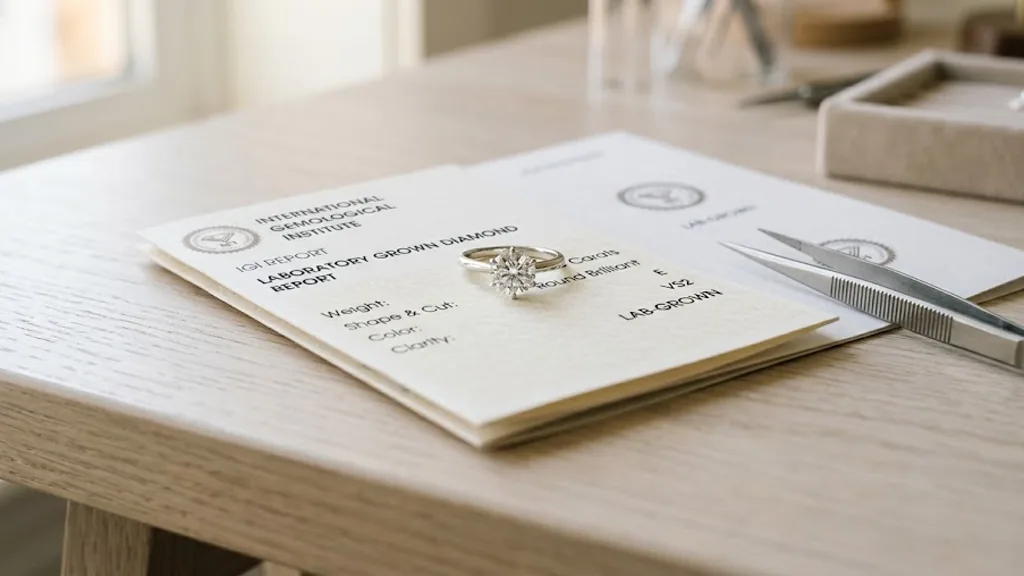
An IGI Laboratory Grown Diamond Report shows the same four measures a buyer expects to see on a mined stone: carat weight, colour on the D to Z scale, clarity from Internally Flawless down to Included, and cut. IGI publishes a cut grade for round brilliants and a four-step assessment for fancy shapes, and it notes polish and symmetry on every report. The growth method, HPHT or CVD, and any treatment are noted in the comments on request.
IGI also describes how it reaches those grades: several graders give an opinion independently, with no collaboration, and the grade is settled when enough opinions agree. Clarity is judged at 10x magnification, the same magnification used for mined stones. Our guides to reading the clarity grades on your report and to how clarity is judged under a loupe cover what those letters mean in the hand.
Is IGI or GIA stricter on lab-grown diamonds?
Neither laboratory can honestly be called stricter on lab-grown diamonds, on published evidence a buyer could check — and we should declare an interest before saying it, because every centre stone we sell carries a free IGI certificate. No independent, repeatable study comparing the two laboratories on lab-grown stones is published anywhere we can point you to. Since October 2025 the comparison is harder still, because GIA no longer prints a colour letter on a colourless grown stone to set against IGI’s.
What is left is a practical test rather than an argument. Look at two stones next to each other in daylight, with the reports beside them, and see whether the paper matches what your eye reports. A jeweller who will not put two stones side by side is telling you something. Anyone quoting you a precise number of grades’ difference between two laboratories is quoting an opinion, not a measurement.
How do you tell which laboratory graded your diamond?
Your diamond’s laboratory is named on the girdle in almost every case, and a jeweller’s 10x loupe will show it. IGI inscribes the report number using its Laserscribe process; GIA inscribes the words Laboratory-Grown together with its report or assessment number. Both laboratories run a free online lookup, so the number on the stone can be matched against the record the laboratory holds. If the number does not match, stop there and ask.
What the document itself covers, and what it deliberately leaves out, is set out in our guide to what certified actually means for a grown stone.
Does the grading laboratory change what a lab-grown diamond is worth?
The grading laboratory does not change what a lab-grown diamond is worth in any way we can put a number on, and no reliable published UK resale figures exist that separate lab-grown stones by laboratory. A report describes a stone; it does not value it. Two stones with the same written description can sell at different prices because of cut quality, setting, metal and the shop they sit in. Treat a precise premium quoted for one laboratory’s paper with caution.
For the money side of this, our guides cover what a grown stone is worth later and what a ring appraisal costs, which is a different document again from a grading report.
Which report should you ask for when buying in the UK?
Ask for a report that grades colour and clarity in letters, ask which laboratory issued it, and ask for the report number in writing before you pay. For a colourless lab-grown centre stone bought in the UK that means an IGI report in practice, because the current GIA service returns a Premium or Standard class instead. Ask for the girdle inscription too, since that is the thread tying the paper to the stone in your ring.
Every centre stone we set at our North Harrow workshop comes with a free IGI certificate, whether the ring is a round cut solitaire engagement ring at £657, a solitaire emerald cut engagement ring at £672, or a pear cut ring in yellow gold at £938. Prices correct at the time of writing. On a three-stone design the centre stone is the one documented, and the side stones are matched by hand at the bench. The full range sits on our engagement rings in gold and platinum page.
Frequently asked questions
Are lab-grown diamonds GIA certified?
No, not in those words. GIA calls its documents reports and assessments rather than certificates, and for a colourless lab-grown stone it now issues a quality assessment classing it Premium or Standard. IGI does use the word certification on its own site. Sellers say certified as shorthand for both, so ask which laboratory and which document they mean.
Are GIA diamonds lab-grown?
No. GIA is a gemmological laboratory, not a diamond producer, so a GIA diamond is not something you can buy. GIA examines both mined and lab-grown stones and states on the document which it has examined. A grown stone is identified as laboratory-grown on the paper and on the girdle inscription.
Do lab-grown diamonds come with a certificate?
Yes, in almost every case for a centre stone of about a quarter of a carat or more. Most lab-grown diamonds sold in the UK arrive with an IGI report, and smaller accent stones in a ring are usually not documented individually. If a seller cannot give you a report number you can look up, treat that as your answer.
What happens to a GIA lab-grown report issued before October 2025?
Reports issued before the October 2025 change still stand, and the numbers can still be looked up with GIA. They carry the older colour and clarity wording, so a stone bought in 2024 may show a letter grade that GIA would not print on a new document today. Keep the paperwork with the ring.
Where can you buy GIA graded lab-grown diamonds in the UK?
Few UK jewellers offer them now, because the current GIA service returns a Premium or Standard class rather than the letter grades buyers want for comparison. Ask any jeweller which laboratory graded the stone before you travel to see it. Our own centre stones are graded by IGI and the certificate is included in the price.
Does GIA still assess fancy coloured lab-grown diamonds?
Yes. GIA still issues a full report for fancy coloured lab-grown diamonds, with a quality assessment, a plotted clarity diagram and an assessment of growth type and post-growth treatment. That report is digital only and covers loose stones of 0.15 carats and above, and it sits outside the Premium and Standard system.
More guides on this topic
Certification is one strand of a bigger subject, and the rest of it is covered in our diamond education guides, from the colour and clarity scales through to what a grown stone is worth years later. If you would rather ask a person than read a report, our bench in North Harrow will answer honestly, including when the honest answer is that nobody has published the figure you are asking for.
Ready to find your perfect ring?
Explore our lab-grown diamond collection or book a virtual appointment with our team.